
Canada’s next immigration levels plan is due within weeks, and it will set firm targets for 2027. The current plan already has a 2027 number: 380,000 new permanent residents. That figure is notional. The new plan either confirms it or changes it.
On September 29, the Prime Minister told The New York Times the question now is “when do we resume some controlled increase in the population.” That is a signal, not a number. No target has been announced.
Here is what is already on paper, what can realistically move, and what it means if your file depends on how many spots each program gets.
How the levels plan actually works
Section 94 of the Immigration and Refugee Protection Act requires the minister to table an annual report to Parliament by November 1. It must include how many people Canada expects to admit as permanent residents next year. If Parliament isn’t sitting on November 1, the deadline becomes 30 sitting days later.
That matters this year. November 1, 2026 is a Sunday. Last year November 1 fell on a Saturday, and IRCC’s supplementary notice for the 2026–2028 plan went up on November 5. Don’t treat November 1 as a hard release date.
The plan rolls. Each year sets a firm target and range for the next year, plus notional targets for the two years after. IRCC’s own notice says the 2027 and 2028 numbers “will be confirmed or adjusted by November 1 of each year.” So this fall’s plan locks in 2027 and pencils in 2028 and 2029.
The 2027 number has already moved once
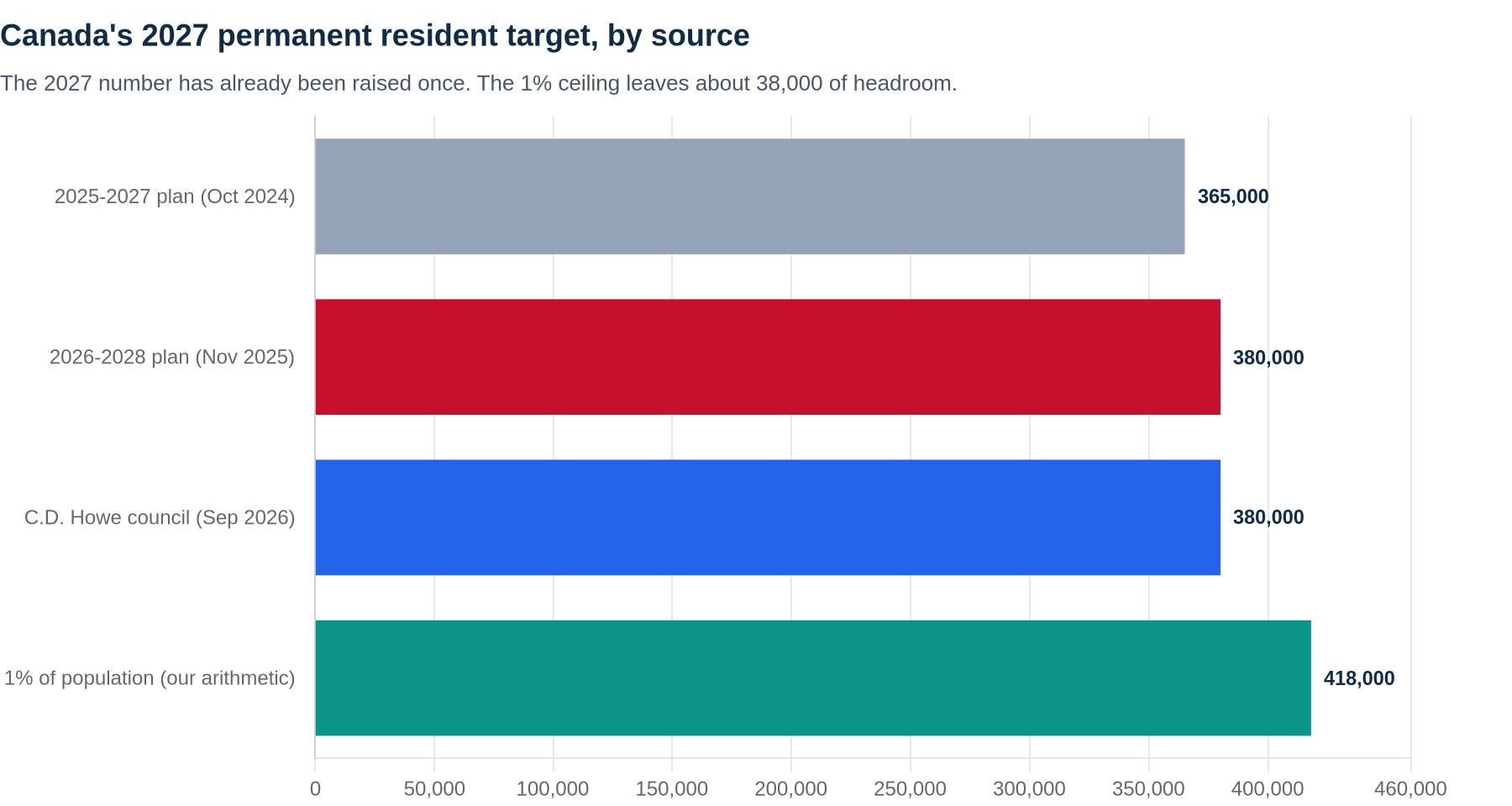
The 2025–2027 plan, published in October 2024, set 2027 at 365,000. The 2026–2028 plan raised it to 380,000 and held 2028 at the same level. So “380,000” is not a cut. It is a plateau.
For context, the 2024–2026 plan had aimed for 500,000 in 2025 and 2026. The cuts already happened. The fight now is over whether the plateau holds, drifts up, or drops again.
Where the 380,000 spots go
The overall number gets the headlines. The program lines decide your odds. Here is the current 2027 split from IRCC’s supplementary notice.
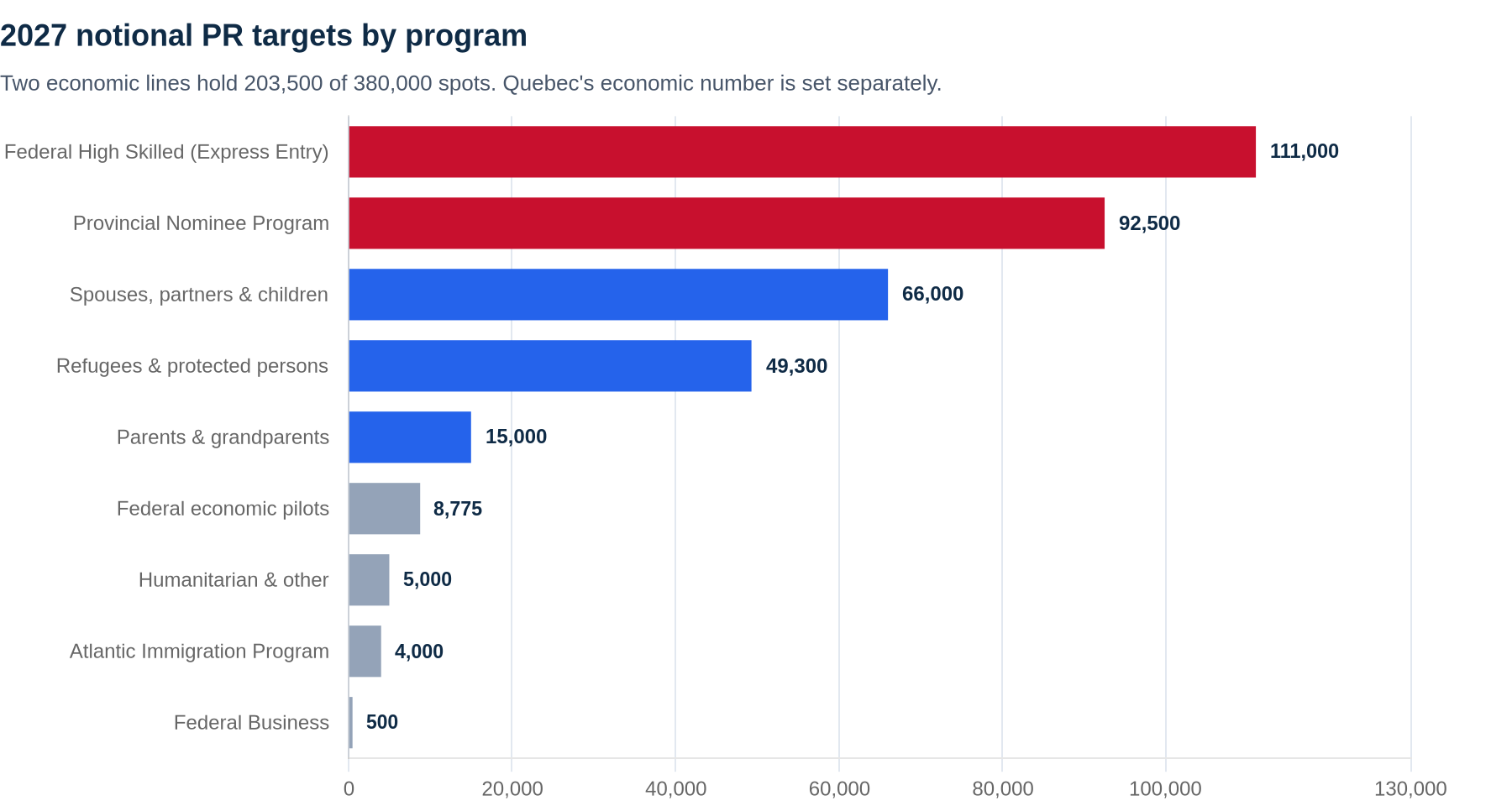
Economic immigration is 244,700 in 2027, or 64% of the total. That is up from 239,800 in 2026. Federal High Skilled, which is mostly Express Entry, goes from 109,000 to 111,000. The PNP goes from 91,500 to 92,500.
Family is the line that shrinks. Spouses, partners and children drop from 69,000 in 2026 to 66,000 in 2027. Parents and grandparents stay at 15,000, even though new parent and grandparent sponsorships are paused. Humanitarian and other admissions fall from 6,900 to 5,000.
Quebec’s economic number shows as “TBD” in the federal tables. Quebec selects its own economic immigrants and sets its own plan.
The numbers that sit outside the headline
Two one-time measures in the current plan are easy to miss. About 115,000 protected persons already in Canada are to become permanent residents over 2026 and 2027. IRCC states plainly that these are “in addition to” the targets above. Separately, up to 33,000 skilled temporary workers are to transition to PR over two years. IRCC’s notice does not say whether those 33,000 count inside the economic line.
This is why the C.D. Howe Institute’s immigration council, in a September 3 report, asked that all PR admissions be counted in the published target “regardless of program or pathway.” It recommended 380,000 for 2027, 350,000 for 2028 and 340,000 for 2029. That is lower than the government’s current 2028 pencil-in.
Don’t mix up the two sets of numbers
The plan has temporary resident targets too, and they get quoted as PR targets more often than you would think. The current plan sets 385,000 temporary arrivals in 2026 and 370,000 in 2027. Of the 2027 figure, 220,000 are workers and 150,000 are students. If you see “385,000 permanent residents in 2026,” that is the wrong table.
The two ceilings that constrain the plan
The government has committed to keep PR admissions under 1% of the population, and to cut the temporary population below 5% by the end of 2027.
Statistics Canada’s preliminary estimate puts the population at 41,798,407 on July 1, 2026. One percent of that is about 418,000. A 380,000 target leaves roughly 38,000 of room under the ceiling. That is the space a “controlled increase” could use without breaking the government’s own rule.
The temporary side is tighter. StatCan counted 2,779,774 non-permanent residents on July 1, about 6.65% of the population. Getting under 5% at today’s population means roughly 690,000 fewer temporary residents in 18 months. That target is what keeps pressure on study permits, work permits and the study permit cap. It is also why in-Canada candidates keep getting priority for PR: each one converts a temporary resident into a permanent one and moves both numbers in the right direction.
What to do about it
If you’re in the Express Entry pool: watch the Federal High Skilled line, not the headline. A higher total with a flat FHS number does nothing for you. Also watch how IRCC describes category-based selection, because that decides who gets the draws. Recent CEC cut-offs near 518 reflect how tight that line already is.
If you’re waiting on a provincial nomination: the PNP line becomes each province’s allocation. A change of a few thousand nationally can shift a province’s draws for the year. Watch for the PNP figure and any provincial announcements that follow it.
If you’re sponsoring a spouse or partner: the 2027 line is already set lower than 2026. Get a complete application in. Files that are ready are the ones that use the available space. Our look at applications waiting for levels space explains why a slower queue isn’t always a processing problem.
If you’re on a work or study permit: the temporary target and the under-5% goal matter more to you than the PR number. Plan your status around your current permit’s expiry date, not around a hoped-for pathway that hasn’t been announced.
If someone is selling you a “new program” based on the levels plan: walk away. The plan sets numbers. It doesn’t open programs. New pathways come through separate public policies or ministerial instructions, published on canada.ca.
What to watch when the plan lands
Five things will tell you most of what you need. The 2027 total and its range. Whether the economic share stays at 64%. The FHS and PNP lines. Whether the protected-person and worker transitions are extended or folded into the main targets. And the Francophone target outside Quebec, now set at 9.5% for 2027 on the way to 12% by 2029. That last one shapes French-language Express Entry draws.
The direction of travel looks like stability, with some room upward. But until the plan is tabled, nobody knows the 2027 numbers. Anyone quoting you final figures before then is guessing.
Related reading
- IRCC Has Two Queues. 41% of Family Immigration Files Are in the One That Isn’t Moving.
- Canada Invited 733 Provincial Nominees on September 28. The Cut-Off Doesn’t Mean What You Think.
- Nova Scotia Now Charges $1,000 to Apply for a Nomination. Here’s What Every Province Charges.
Targets are from IRCC’s supplementary information notices for the 2025–2027 and 2026–2028 levels plans. Population figures are Statistics Canada’s preliminary estimates for July 1, 2026. The 1% ceiling (about 418,000), the 38,000 headroom, the 6.65% temporary share and the roughly 690,000 reduction are our own arithmetic, not published IRCC figures. Data as of October 3, 2026. This is general information, not legal advice. Consult a licensed immigration lawyer or a regulated Canadian immigration consultant (RCIC) about your situation, and verify current rules on canada.ca.
Discover more from CanadianUpdates
Subscribe to get the latest posts sent to your email.