
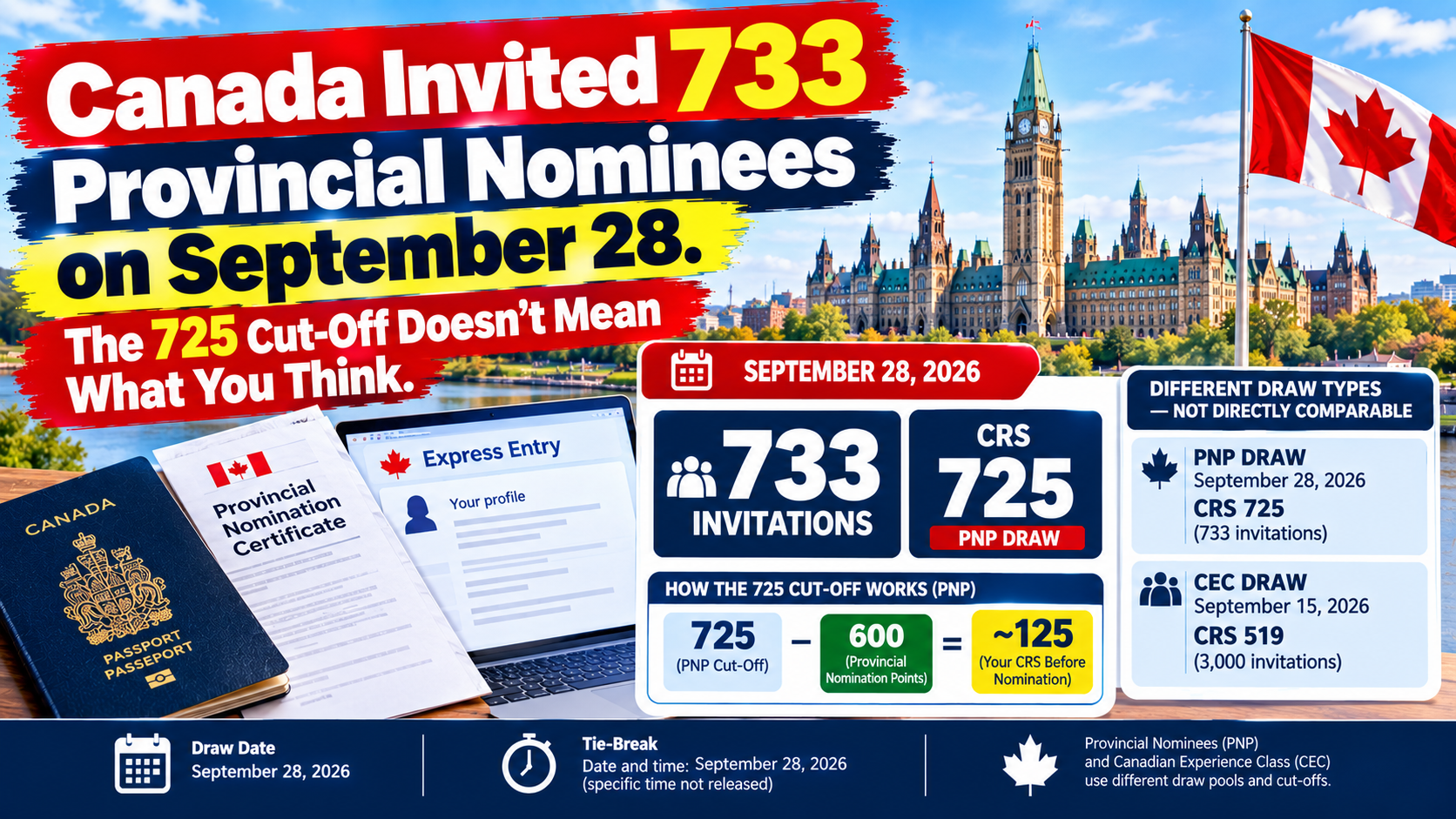
IRCC invited 733 provincial nominees to apply for permanent residence on September 28, 2026. The lowest-ranked candidate invited had a CRS score of 725. It is the largest Provincial Nominee Program (PNP) round since June 22, when 955 were invited.
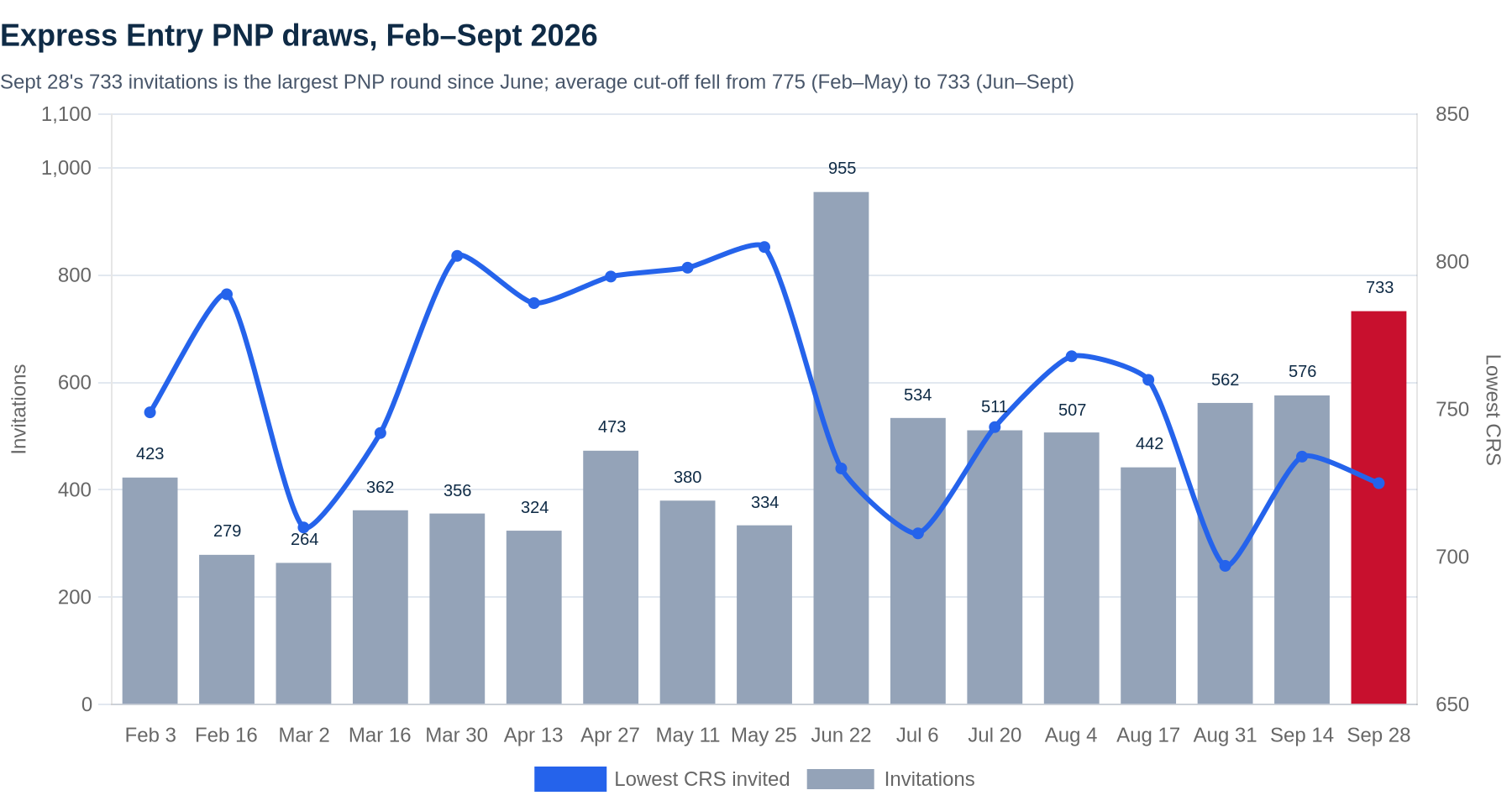
That matters if you hold a provincial nomination, or are chasing one. PNP draws have been getting bigger and cheaper to enter all summer. Across the eight PNP rounds from June to September, the average cut-off was 733. Across the nine from February to May, it was 775.
Here is what the number actually means, and what it doesn’t.
A 725 cut-off does not mean you need 725 points
You will see posts online telling people they need “725 CRS” to get invited. That is wrong. An enhanced provincial nomination adds 600 points to your Comprehensive Ranking System score. So a 725 cut-off means the lowest-ranked nominee invited had a core score of about 125 before the nomination.
In practice, PNP draws invite nearly everyone who holds an active nomination and has accepted it in their Express Entry profile. The cut-off is less a hurdle than a snapshot of who happened to be in the pool that day. The hard part is getting the nomination, not clearing the draw.
IRCC’s own pool data backs this up. As of September 27, the day before the draw, there were 728 candidates in the pool with scores between 601 and 1,200. Almost all of them would be nominees. The next day, 733 were invited. The small gap likely reflects nominees who added their nomination between the snapshot and the draw.
Why the draws got bigger
PNP draw size is driven by provinces, not by IRCC. Each province has a yearly nomination allocation. When provinces issue more enhanced nominations, more nominees show up in the pool, and the next PNP round is larger.
From February to May, the nine PNP rounds averaged 355 invitations. From June to September, the eight rounds averaged about 603. That is consistent with provinces nominating more heavily in the second half of the year, which is a common pattern as they work through their allocations. IRCC has not published a province-by-province breakdown for these draws, so we can’t say which provinces drove the increase.
Why the cut-off fell
The falling cut-off is mostly a side effect of the larger draws. When a round sweeps up more nominees, it reaches further down into lower core scores. A nominee with a core score of 110 gets invited just the same as one with 250. The drop from spring’s 800-range cut-offs to the low 700s does not mean the program got easier to qualify for. It means more people with modest core scores are getting nominations.
PNP is a small slice of Express Entry invitations
Despite the headline, PNP rounds are a minor share of total invitations. In September, IRCC held seven Express Entry rounds and issued 9,288 invitations. The two PNP rounds accounted for 1,309 of them, about 14%.
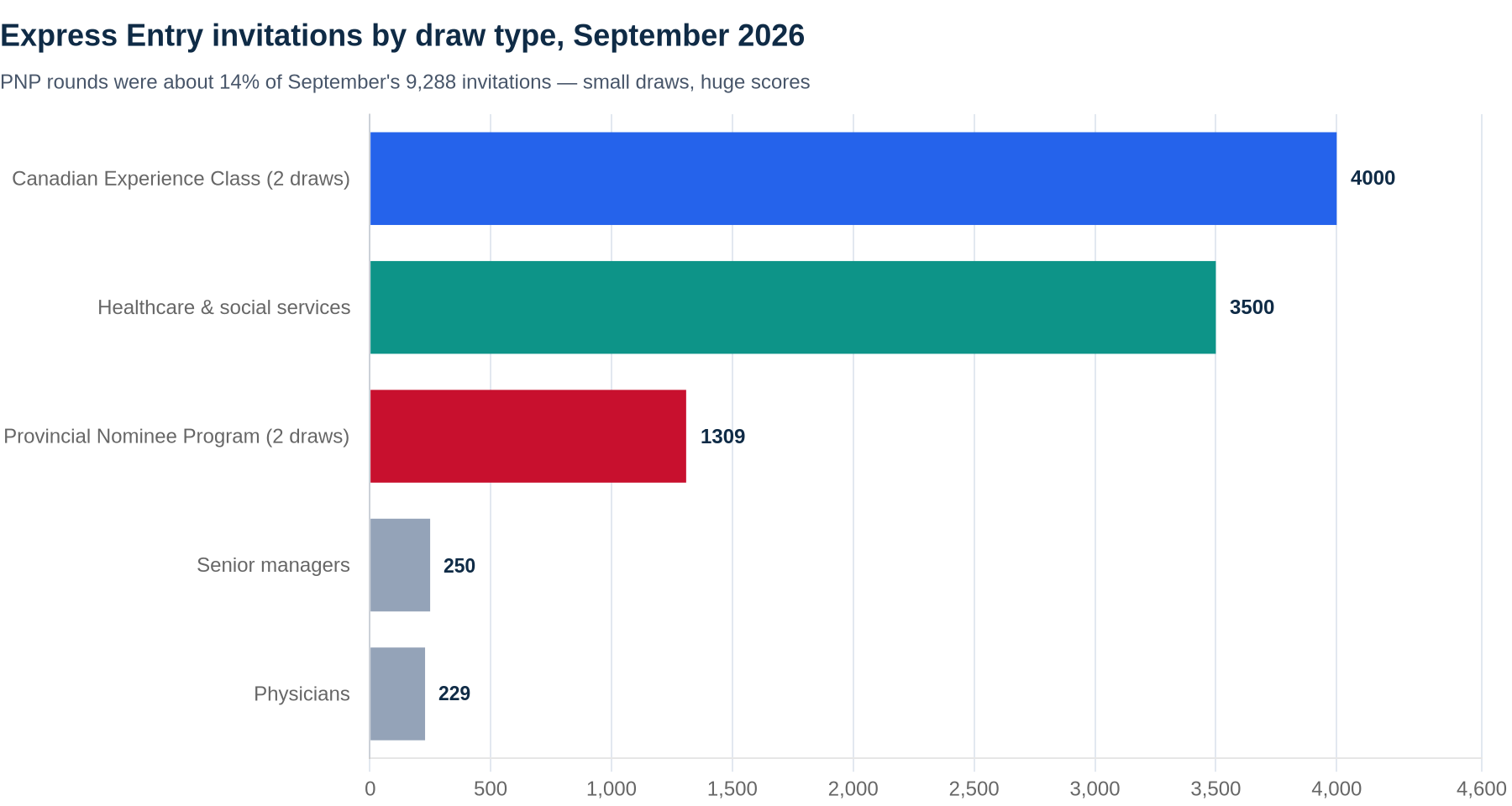
The Canadian Experience Class got 4,000 invitations across two rounds, with cut-offs of 521 on September 1 and 519 on September 15. We covered that in detail in our breakdown of the September CEC cut-off. The September 4 healthcare and social services round invited 3,500 at a cut-off of 475.
The bigger picture: the federal 2026–2028 Immigration Levels Plan targets 91,500 PNP admissions in 2026, against 109,000 for Federal High Skilled (Express Entry). Keep in mind that the PNP target also covers nominees who apply outside Express Entry through paper-based “base” streams. So you can’t compare it directly with Express Entry draw totals.
What this means for you
If you already have an enhanced nomination: make sure you’ve accepted it in your Express Entry profile and that your profile hasn’t expired. If it’s in the pool before the next PNP round, you should expect an invitation. Don’t wait to line up your documents. You get 60 days to submit a complete application after you’re invited.
If you have a notification of interest from a province but no nomination yet: the federal draw is not your bottleneck. The province is. Put your energy into a complete, accurate provincial application. If you’re aiming at Ontario, our guide to the rebuilt OINP and its Workforce Priority stream covers what replaced the old streams.
If your core CRS is low, say under 450: a provincial nomination is still one of the most reliable ways to get an invitation. General CEC rounds have needed between 507 and 523 since February. Look at provincial streams that match your occupation, job offer or location. If you speak French, French-language rounds have cut off far below CEC all year.
If someone is selling you a way to “reach 725”: walk away. No legitimate strategy gets you to 725 without a nomination. Only a provincial nomination adds the 600 points.
What to watch next
IRCC has held PNP rounds about every two weeks since June, usually on a Monday and followed by a CEC round. That’s a pattern, not a schedule, and IRCC doesn’t pre-announce draws. Nobody knows what the next cut-off will be. It depends on how many nominees are in the pool on the day.
The more useful signal is the 601–1,200 band in IRCC’s pool distribution, published with each draw. If it’s growing between rounds, provinces are nominating faster, and the next PNP round will probably be large. Also watch for the 2027–2029 Immigration Levels Plan, usually released in the fall. Any change to the PNP target will shape provincial allocations for next year. And keep an eye on IRCC’s proposed Express Entry overhaul, which puts CRS points on the table.
Related reading
- The CEC cut-off climbed 16 points since March
- CRS cut off at 389 for senior managers. The day before, CEC cut off at 519.
- The OINP was rebuilt in 2026: what replaced Ontario’s nine streams
Draw data from IRCC’s Express Entry rounds of invitations, current to the September 28, 2026 round; pool distribution as of September 27, 2026. Levels plan figures from IRCC’s Supplementary Information for the 2026–2028 Immigration Levels Plan. Averages, percentages and totals (including 9,288 September invitations and the 355 vs 603 and 775 vs 733 comparisons) are our own arithmetic from IRCC’s published draw data, covering PNP rounds from February 3, 2026 onward. This article is general information, not legal advice. For advice on your situation, consult a licensed immigration lawyer or a Regulated Canadian Immigration Consultant (RCIC), and always verify current rules on canada.ca.
Discover more from CanadianUpdates
Subscribe to get the latest posts sent to your email.