
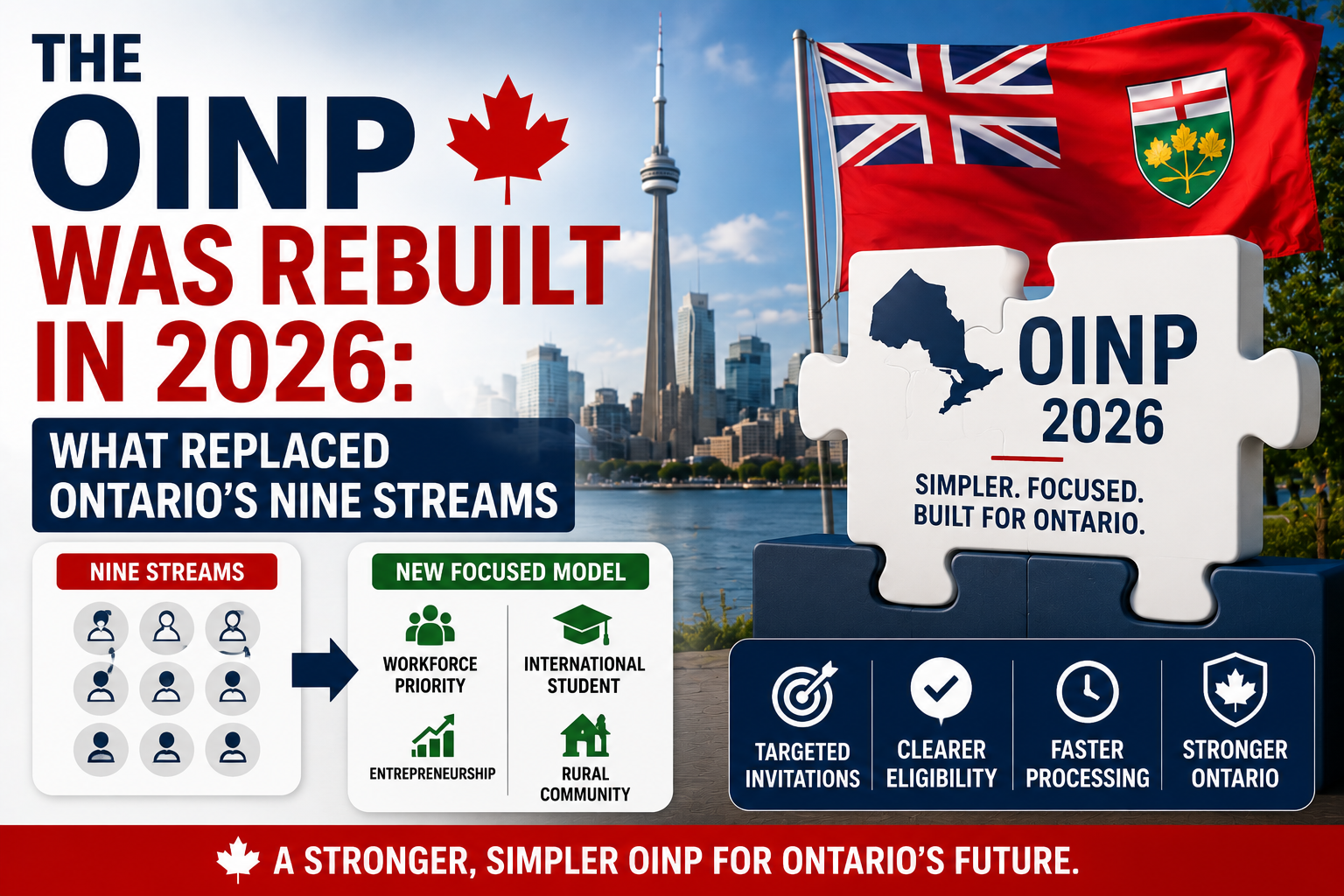
If you were counting on the Ontario Immigrant Nominee Program to get you permanent residence, the program you were planning for no longer exists. Over about ten weeks this summer, Ontario closed every one of its nomination streams and replaced them with a single pathway called the Ontario Workforce Priority stream.
This is the biggest change to the OINP since the program started. It also unfolded in a confusing sequence — a repeal in May with nothing to replace it, a new stream in late June, and an intake system that did not actually open until August. A lot of the advice circulating online is out of date because it was written during one of the gaps.
Here is where things actually stand, and what you should be doing about it.
How Ontario got here
The redesign started with a stakeholder consultation in December 2025, which closed on January 1, 2026. Ontario floated a plan to replace its existing streams with several new pathways, including ideas for a healthcare stream, an entrepreneur stream and an exceptional talent stream.
That is worth remembering, because those proposals are still being repeated as though they are the plan. They were not what Ontario built first.
On March 16, 2026, the province amended its immigration regulation to set May 30 as the date all nine OINP nomination categories would be revoked. That date came and went with the streams gone and no replacement announced — roughly four weeks in which Ontario had no active provincial pathway to permanent residence at all.
The replacement arrived on June 26, 2026, through changes to Ontario Regulation 422/17 under the Ontario Immigration Act, 2015, which came into force on June 25. Those amendments removed the eight remaining active streams and introduced the Ontario Workforce Priority stream. Ontario updated its program webpages with the eligibility criteria on July 20, and finally opened the Expression of Interest portal on August 4, 2026.
The province has been explicit that this is phase one of a two-phase redesign. More changes are coming.
The streams that are gone
These eight OINP streams are closed permanently, and no further invitations will be issued under any of them:
- Employer Job Offer: Foreign Worker
- Employer Job Offer: In-Demand Skills
- Employer Job Offer: International Student
- Master’s Graduate
- PhD Graduate
- Express Entry Human Capital Priorities
- Express Entry French-Speaking Skilled Worker
- Express Entry Skilled Trades
The two graduate streams matter most to people who are caught off guard. If you finished a master’s or PhD in Ontario and were planning to use that credential as your route to nomination, that route is not on the table anymore. The new stream is built around employment, not education.
What happens to applications already in the system
Ontario drew a hard line between applications and expressions of interest.
If you submitted a complete application before the change, it will be assessed against the eligibility requirements that were in effect at the time you submitted. Your file is not being reopened under new rules.
If you had an EOI in the pool that never produced an invitation to apply, it is gone. Ontario has been withdrawing those registrations automatically and notifying affected candidates, employers and representatives directly. There is no appeal and no transfer — you have to start over under the new stream if you still qualify.
If you are an employer who registered in the employer portal previously, you do not need to register again. But you do need to submit a new job offer and a new application for approval of the employment position to start a fresh EOI for your candidate.
The Ontario Workforce Priority stream
The new stream has three pathways.
TEER 0–3 pathway
For skilled workers with a full-time, permanent job offer in Ontario in any NOC TEER 0, 1, 2 or 3 occupation. Minimum requirements:
- Work experience — one of: six consecutive months in the last 12 in the offered position with the offering employer; three consecutive months in the last 12 for recent Ontario graduates; or two cumulative years in the last five in the NOC occupation. Licensed applicants are exempt.
- Language — Canadian Language Benchmark 6, or CLB 5 for certain occupations.
- Education — a post-secondary degree or diploma.
TEER 4–5 pathway
For workers with a full-time, permanent job offer in any TEER 4 or 5 occupation:
- Work experience — nine cumulative months in the last two years in the offered position with the offering employer.
- Language — CLB 4.
- Education — a Canadian secondary school diploma or equivalent.
Self-employed physicians
Physicians can qualify without a job offer if they are a member in good standing with the College of Physicians and Surgeons of Ontario, hold a valid certificate of registration in the independent, academic or provisional class, and are eligible to bill OHIP.
Some occupations carry alternate criteria, so check the regulation rather than assuming the general rule applies to yours.
What actually changed in substance
Three things are worth pulling out, because they change who has a realistic shot.
Coverage got broader. The old employer streams carved the labour market into three separate programs with different rules. The new stream covers all TEER categories, 0 through 5, in one place.
The bar got higher. Ontario has said openly that it raised language and education benchmarks to improve the calibre of nominees and strengthen program integrity. A CLB 6 floor plus a post-secondary credential for TEER 0–3 rules out candidates who could previously have made it through.
Rural employers got easier terms. Lower gross annual revenue thresholds apply to employers in rural communities, defined for program purposes as a census division with a population under 150,000. If you are working in northern or rural Ontario, your employer is more likely to clear the bar than before.
How the process runs now
The order of operations matters, and candidates cannot start it themselves.
- Your employer goes first. They register the job offer in the OINP Employer Portal and get approval for the employment position, which generates a job offer ID.
- You register an EOI in the e-Filing Portal using that ID. Registration is free and does not commit you to anything. Reports indicate the job offer ID expires if unused within 30 days, so do not sit on it.
- You wait in the pool. Ontario scores registrations and periodically invites the highest-ranking candidates, weighted by provincial labour market priorities. Registering does not guarantee an invitation.
- If invited, your employer must submit their application within 14 calendar days, and you must submit your application and payment within 17 calendar days of the invitation. The fee is only payable at this stage.
If you are in a TEER 0–3 occupation and qualify under a federal Express Entry program, you can take your nomination through Express Entry and collect the 600 additional CRS points, which effectively guarantees an invitation for permanent residence in a subsequent federal draw. You need to keep a valid Express Entry profile active and keep meeting the federal program’s requirements throughout.
No draws yet
As of early September 2026, Ontario has not announced when it will start issuing invitations under the new stream, and the province has signalled that invitation rounds may happen without advance notice. Ontario has been allocated 14,119 nomination spaces for 2026 under the federal levels plan, and very few of them have been used since the transition began.
That combination — a large unused allocation and a pool that has only been filling since August — means the first round could be significant. It also means nobody can tell you today what score will be competitive, and anyone who claims to know is guessing.
What to do this month
If you have an employer: ask them now whether they will support an OINP nomination and whether they meet the revenue threshold for your location. Employers are fielding a lot of these requests and many have not decided on a policy.
If your EOI was withdrawn: re-check yourself against the new criteria before assuming you are still eligible. The language and education requirements are the most common places people now fall short.
If you are gathering documents: keep evidence for every factor you claim in your EOI. Ontario can request supporting documents after issuing an invitation, and claims you cannot back up can sink the application.
If you were relying on a graduate stream: you need a different plan. Look at Express Entry directly, at other provinces’ nominee programs, or at building the employer relationship the new stream requires.
Phase two is still coming, and it may add the healthcare, entrepreneur or talent pathways Ontario floated last year. Until it lands, the Workforce Priority stream is the only way through.
This article is general information, not legal advice. For guidance on your own case, consult a licensed immigration lawyer or an RCIC. Program rules can change without notice — verify current requirements on ontario.ca before you act.
Discover more from CanadianUpdates
Subscribe to get the latest posts sent to your email.