
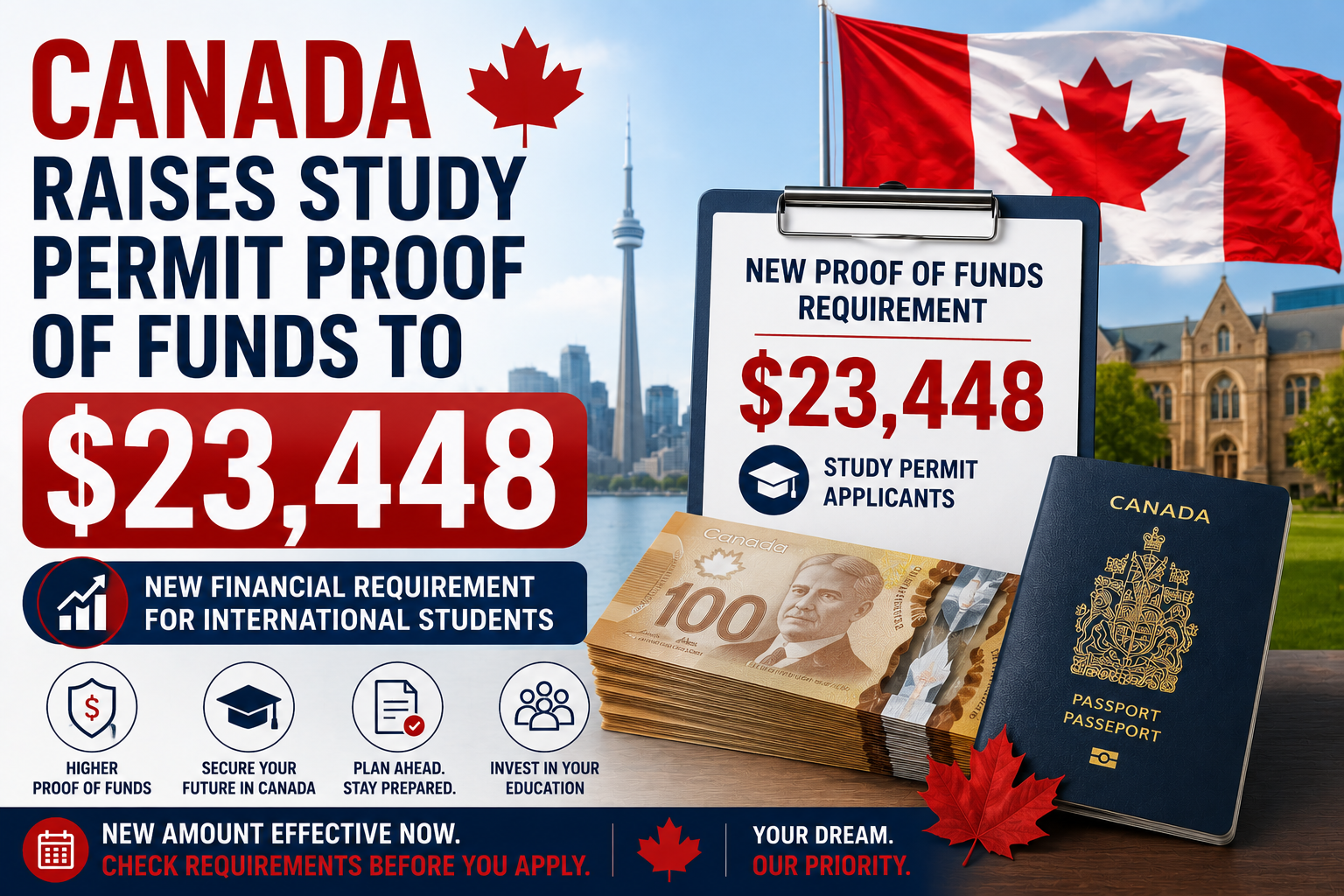
Starting September 1, 2026, a single international student applying for a Canadian study permit must show $23,448 in living-expense funds — up $553 from the $22,895 that has applied since January 2025.
Immigration, Refugees and Citizenship Canada (IRCC) updated its official proof of financial support page on August 28, 2026 with the complete new table. The figures below are taken directly from that page, not estimated.
The short version
- The new amounts apply to study permit applications submitted on or after September 1, 2026.
- Applications submitted on or before August 31, 2026 are assessed against the old, lower amounts.
- The amount covers living expenses only. Tuition and travel are separate and additional.
- Quebec is not covered by this table — it runs its own financial assessment through the CAQ.
- The increase works out to roughly 2.4% across every family size.
Full proof of funds table by family size
These amounts apply to all provinces and territories except Quebec, and cover one year of living costs for you and any family members coming with you.
| Family members (including you) | From Sept 1, 2026 | Until Aug 31, 2026 | Increase |
|---|---|---|---|
| 1 | $23,448 | $22,895 | +$553 |
| 2 | $29,192 | $28,502 | +$690 |
| 3 | $35,888 | $35,040 | +$848 |
| 4 | $43,572 | $42,543 | +$1,029 |
| 5 | $49,419 | $48,252 | +$1,167 |
| 6 | $55,736 | $54,420 | +$1,316 |
| 7 | $62,054 | $60,589 | +$1,465 |
| Each additional member beyond 7 | $6,318 | $6,170 | +$148 |
Your family size includes you, your spouse or common-law partner, and your dependent children. IRCC counts them whether or not they are travelling with you.
The mistake that costs people their application
The single most common misunderstanding is treating $23,448 as the total you need in the bank. It isn’t. IRCC requires proof that you can cover three separate categories without working in Canada:
- First-year tuition for your program
- Living expenses — the table amount above
- Transportation to and from Canada for you and anyone coming with you
For a single student at a college program with tuition around $16,000 and a return flight around $2,000, the realistic total is closer to $41,000 than $23,448. Students who prepare only the living-expense figure regularly get refused, and insufficient funds remains one of the leading reasons study permit applications are turned down.
If your program runs longer than one year, you also have to explain how you will pay for the remaining years — a multi-year scholarship letter, evidence of a parent’s ongoing employment, and so on. You only need to prove the first year’s funds are available now, but IRCC wants to see the plan for the rest.
Who this affects
New applicants
Anyone submitting a completed study permit application on or after September 1, 2026 is assessed at the new amounts. The date that matters is the submission date, not the date your letter of acceptance was issued or the date your semester starts.
Students applying for an extension
Extensions and renewals filed on or after September 1 are also evaluated against the new table. If you are already in Canada on a valid permit and planning to extend this fall, budget for the higher figure.
Students already holding a valid permit
Nothing changes retroactively. If you already have a study permit and are not applying for anything new, you do not need to show additional funds.
Students headed to Quebec
Quebec sets its own financial requirements through the Quebec Acceptance Certificate (CAQ), assessed by the Ministère de l’Immigration, de la Francisation et de l’Intégration. The federal table above does not apply to you — check Quebec’s own published costs.
Why the number goes up every September
The requirement is pegged to 75% of Statistics Canada’s Low-Income Cut-Off (LICO), a benchmark for the income a household needs to avoid financial hardship. IRCC adopted this formula in 2024, replacing a flat $10,000 figure that had gone essentially untouched for two decades.
Because LICO is recalculated annually, the study permit figure resets every September 1. The trajectory has been steep: $10,000 before 2024, $20,635 in 2024, $22,895 in 2025, and now $23,448. The good news for planning is that the number holds steady until September 1, 2027 — so anyone applying between now and next August can rely on $23,448.
What IRCC accepts as proof
Your funds have to be real, accessible, and yours — not borrowed for the week or merely promised. IRCC lists several document types, and most strong applications combine two or three:
- A Guaranteed Investment Certificate (GIC) from a participating Canadian financial institution for the required amount or more
- Proof of a student or education loan from a bank or recognised lender
- Bank statements for the past six months, with documentation showing where the money came from
- Proof you have already paid first-year tuition and housing fees, such as a receipt from your school
- Proof of a scholarship or a Government of Canada–funded program
- Recent pay stubs, or a signed letter of support from a sponsor including their occupation, relationship to you, number of dependants, and the amount they will provide
- Proof of a Canadian bank account in your name if you have already transferred money
- Documents for pension income or rental property income
A large deposit that appears a few weeks before you apply, with no explanation, is a red flag to officers. If the money came from selling property or from a relative, include the paper trail. If your country has foreign exchange controls, you also need to prove you will actually be permitted to move the funds out.
The bigger picture for international students
This increase lands in a year when Canada has already tightened the study permit system considerably. The 2026 allocation was cut to 408,000 permits — 155,000 for new students and 253,000 for extensions — roughly 7% below the 2025 target and 16% below 2024. Financial documentation is also getting closer scrutiny than it did a few years ago.
Practically, that means the margin for a sloppy application has narrowed. Show more than the minimum where you can, keep your six-month statement history clean, and confirm the exact figure on IRCC’s own page on the day you submit.
Frequently asked questions
Does the $23,448 include tuition?
No. It covers living expenses only. First-year tuition and return transportation must be shown separately and on top of this amount.
What if I submitted my application in August 2026?
You are assessed against the amount in effect on the date you submitted your completed application — $22,895 for a single applicant. The change is not applied retroactively to files already in the queue.
Do I need to keep the money in my account after I get approved?
The requirement is that the funds are genuinely available to you for your studies. A GIC is structured to release to you in instalments after you arrive, which is part of why it is such a widely accepted form of proof.
Will the amount change again mid-year?
No. IRCC updates this figure once a year, effective each September 1. The next adjustment is expected on September 1, 2027.
Can my parents’ money count as my proof of funds?
Yes, if it is properly documented. You need a signed letter of financial support along with evidence of their employment or income, their relationship to you, and how many dependants they have.
Related reading
- Full List of CRA Benefits International Students Can Get in Canada (2026 Guide)
- IRCC Processing Times: July 2026
- New Canada Immigration Levels 2027–2029: What International Students, Workers, and PR Applicants Need to Know
You can confirm the current figures directly on IRCC’s proof of financial support page before you submit.
Disclaimer: This article is for general information only and is not immigration or legal advice. Requirements can change without notice. Verify current amounts on IRCC’s official website and consult a licensed immigration professional about your own situation.
Discover more from CanadianUpdates
Subscribe to get the latest posts sent to your email.