

Ontario’s provincial pathway is in transition, study permit rules just tightened, and in the middle of it Express Entry has quietly become a much harder place to be an average candidate.
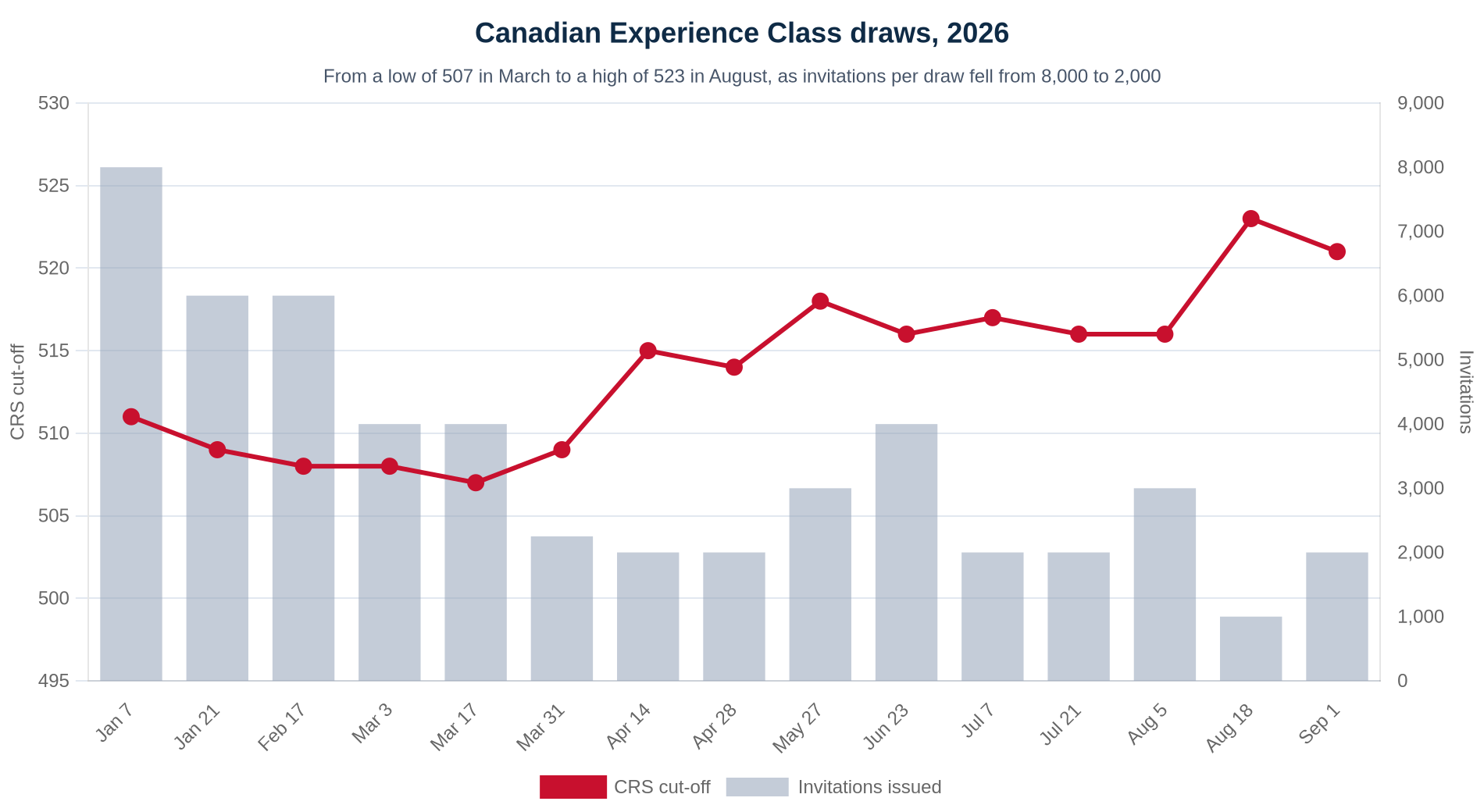
The Canadian Experience Class cut-off has climbed from a low of 507 in March to 523 on August 18, before settling at 521 in the September 1 draw. That is a 16-point swing in five months, in the one category most people in Canada on a work permit are counting on.
The reason is not mysterious, and it is not that candidates got better. Here is what the numbers actually show.
The draws got smaller, not the pool
In January, IRCC issued 8,000 invitations in a single CEC draw. By August 18, a CEC draw was worth 1,000 invitations. September 1 came in at 2,000.
When you cut the number of invitations by three quarters and the queue does not shrink by the same amount, the cut-off has to rise. That is the whole mechanism. A CRS score is not a pass mark — it is simply the score of the lowest-ranked person who still fit inside the draw.
So a 516 that would have been comfortable in June is now a near miss, and nothing about the candidate changed.
Where everyone actually sits
This is the part most people have never looked at, and it explains more than any prediction article will.
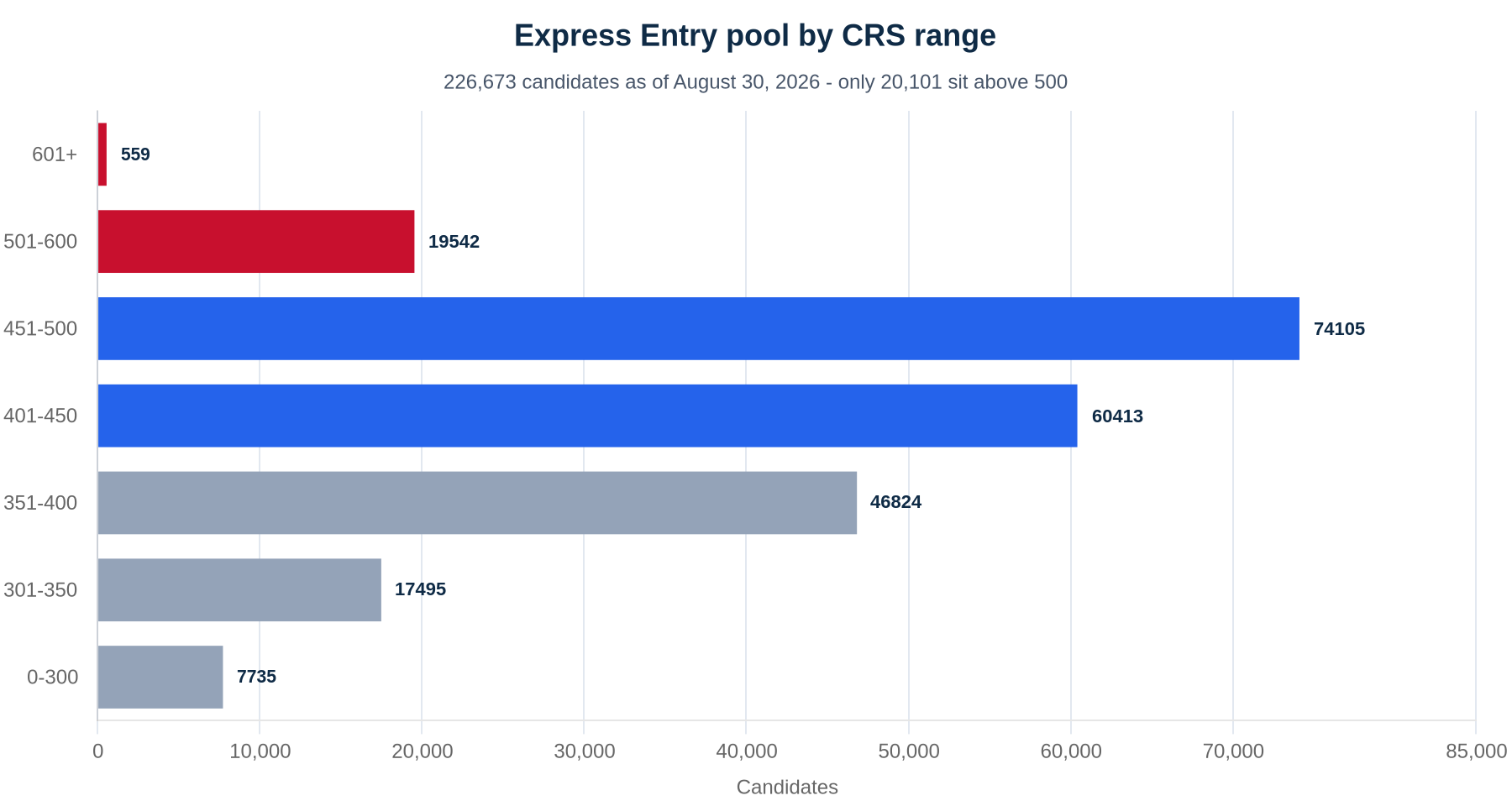
As of August 30, 2026, the pool held 226,673 active profiles. Of those, 20,101 score above 500 — 19,542 in the 501 to 600 band and 559 above 601.
The single largest group is 451 to 500, with 74,105 candidates. That is the band directly beneath every recent CEC cut-off. Roughly 74,000 people are sitting one tier below the line, and general CEC draws are not reaching them.
The pool has also been shrinking. It peaked at 242,379 on December 7, 2025 and has fallen about 6.5% since. But the contraction is happening in the middle and lower bands, not the top — which is why a smaller pool has not produced an easier cut-off.
The category draws are where the invitations went
IRCC has issued 122,427 invitations across 51 draws in 2026. General CEC draws account for 51,250 of them. French-language proficiency draws account for 50,500 — almost exactly the same share, from a category that most candidates cannot enter.
And the scores in those draws are not close. The August 19 French draw cut off at 382. The September 1 CEC draw cut off at 521.
A 139-point gap between two people invited within two weeks of each other. Not because one is more qualified, but because one of them can pass a French test.
The other category draws follow the same logic. Healthcare and Social Services went at 475 in June. Trade occupations at 477 in April. Transport at 470 in August. Physicians went at 223 in June and 169 in February — scores that would be irrelevant in any general draw.
Provincial nomination is not the easy answer either
PNP draws in 2026 have cut off between 697 and 805. Those numbers look alarming until you remember a provincial nomination is worth 600 CRS points on its own — a candidate at 760 in a PNP draw is really a candidate at 160 who holds a nomination.
The real constraint is volume. PNP draws have issued roughly 7,960 invitations all year, in rounds of a few hundred at a time. And in Ontario specifically, the nomination itself is the bottleneck — the province closed all nine of its streams and replaced them with the Workforce Priority stream, which had not run a single draw as of early September.
What this means if you are in the pool
If you are between 451 and 500: a general CEC draw is not realistically coming for you at current volumes. Your route is a category-based draw or a provincial nomination, not waiting for the cut-off to fall. Check the 2026 category list against your NOC code before you assume you do not qualify — transport, trades, healthcare, education and agriculture all had draws this year at scores far below 500.
If you are between 501 and 520: you are close enough that ordinary point gains matter. A language retest is the cheapest and fastest lever most people have — the difference between CLB 9 and CLB 10 across all four abilities can be worth 50 points or more with a spouse, and IELTS or CELPIP results come back in days, not months.
If French is even remotely on the table: the 139-point gap is the single largest arbitrage in the system right now. TEF or TCF at NCLC 7 unlocks a category where cut-offs have run between 382 and 420 all year. It is a genuine year or two of work for most people, which is exactly why the gap persists.
If your profile is close to expiring: resubmit rather than let it lapse. Profiles are valid for 12 months, and there is no penalty for creating a new one — but there is no benefit to an old one either. Time in the pool earns you nothing.
What to watch next
The 2026 levels plan sets the ceiling on how many invitations IRCC can issue, and the department has been running category draws at 5,000 while holding general draws at 1,000 to 3,000. If that split holds through the fall, expect CEC cut-offs to stay in the high 510s and low 520s rather than drift back down.
The thing to watch is not the next cut-off number. It is the size of the next general draw. That is the variable that moves the score, and it is announced at the same time.
Related reading
- The OINP Was Rebuilt in 2026: What Replaced Ontario’s Nine Streams
- IRCC Processing Times: July 2026
- Canada Raises Study Permit Proof of Funds to $23,448
Draw figures and pool data are as reported for 2026 rounds of invitations up to September 1, 2026, with pool composition as of August 30, 2026. This article is general information, not legal advice. For guidance on your own case, consult a licensed immigration lawyer or an RCIC. Verify current requirements on canada.ca before you act.
Discover more from CanadianUpdates
Subscribe to get the latest posts sent to your email.