
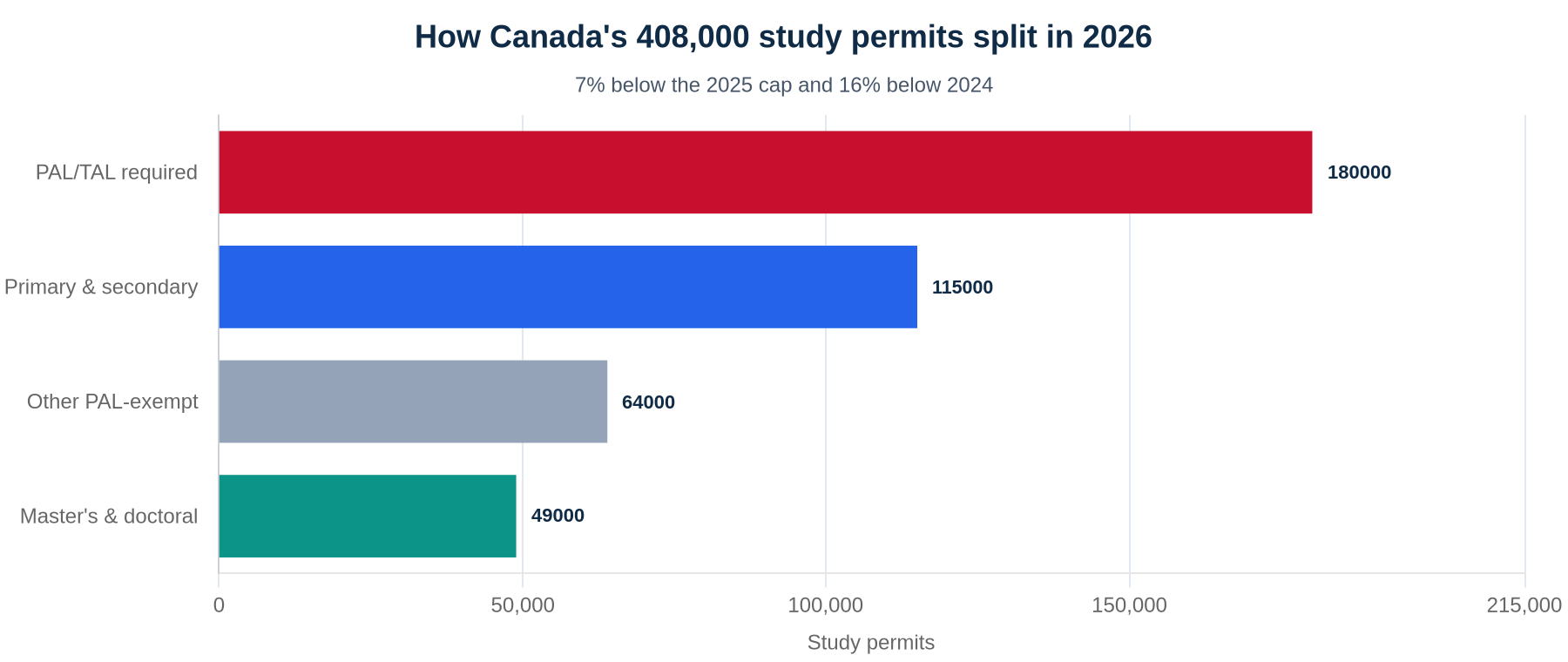
Canada will issue 408,000 study permits in 2026. That is 7% fewer than 2025 and 16% fewer than 2024, and it continues a contraction that has already cut the number of study permit holders in the country from over a million in January 2024 to roughly 725,000 by September 2025.
The headline number is not the useful part. The useful part is how those permits are divided, because the split decides whether your particular application is competing against 100,000 other people or 1,300.
Here is the breakdown, and what it means depending on which group you are in.
Four groups, and only one of them is capped the way you think
The 408,000 splits into four cohorts:
- 180,000 — applicants who need a Provincial or Territorial Attestation Letter. This is the group most people mean when they talk about “the cap.”
- 115,000 — primary and secondary school students, who are PAL-exempt.
- 64,000 — other PAL or TAL-exempt applicants, including certain federal priority and vulnerable groups, and existing permit holders renewing at the same institution and level.
- 49,000 — master’s and doctoral students at public designated learning institutions.
That last one is the significant change for 2026. Master’s and doctoral students at public DLIs no longer need a provincial attestation letter. If you are applying to a public university for graduate study, you have been lifted out of the provincial queue entirely and into a 49,000-permit lane of your own.
Renewing students at the same institution and level are also exempt. If you are extending a permit to finish the program you are already in, the provincial allocation is not your constraint.
Where the provincial spaces went
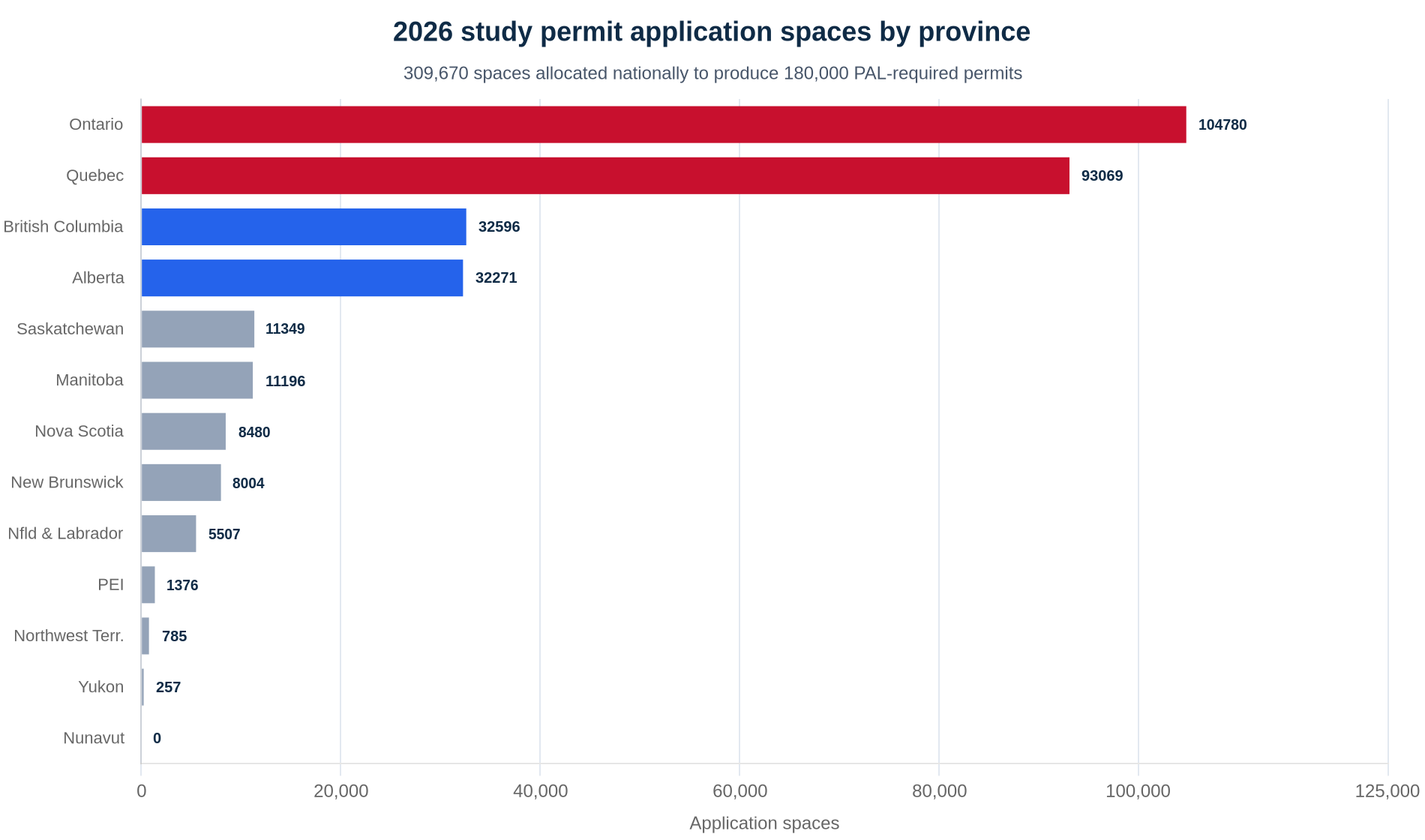
Ontario received 104,780 application spaces and Quebec 93,069. Between them that is 197,849 of the 309,670 spaces allocated nationally — roughly 64% of the country’s total, held by two provinces.
British Columbia (32,596) and Alberta (32,271) are effectively tied for third, each with under a third of Ontario’s allocation. After that the numbers fall away quickly: Saskatchewan 11,349, Manitoba 11,196, Nova Scotia 8,480, New Brunswick 8,004, Newfoundland and Labrador 5,507, Prince Edward Island 1,376, Northwest Territories 785, Yukon 257.
Nunavut received zero.
The number nobody is talking about
Add the provincial allocations together and you get 309,670 application spaces. The PAL-required permit target is 180,000.
Those two numbers are not supposed to match, and the gap is deliberate. Provinces issue attestation letters up to their allocated spaces; IRCC then assesses the resulting applications and approves some of them. Working backwards from the two figures, the system is built around roughly 58 approved permits for every 100 attestation letters issued.
Holding a PAL is not the finish line. It gets your application looked at. On these numbers, a bit under half of the people who obtain one will still not end up with a permit — because of financial documents, program legitimacy, ties to home country, or straightforward refusal.
Anyone telling you a PAL means you are approved is either confused or selling something.
PGWP field of study rules are frozen
One piece of genuinely stable news: the eligible fields of study for the Post-Graduation Work Permit are not changing in 2026. No fields are being added and none are being removed.
The eligible categories remain agriculture and agri-food, education, healthcare and social services, STEM, skilled trades, and transport. Eligibility runs on six-digit CIP codes, not program titles — a program called “Business Analytics” may or may not sit under an eligible code, and the course name tells you nothing. Check the CIP code with the institution before you enrol.
The timing rule is the part worth knowing: your program has to be on the eligible list when you submitted either your study permit application or your PGWP application. If a code is removed after you applied, you can still qualify on the earlier submission.
Bachelor’s, master’s and doctoral degree holders are exempt from the field of study requirement altogether, as are flight school graduates and anyone who applied before November 1, 2024.
What to do about it
If you are applying for graduate study at a public university: you are in the exempt lane. Do not wait on a provincial attestation letter you do not need, and do not pay a consultant to obtain one for you.
If you need a PAL: the province you apply to matters enormously. Ontario and Quebec have the volume, but they also have the demand. The smaller provinces have far fewer spaces in absolute terms and correspondingly fewer applicants — worth weighing if your program choice is flexible.
If you are budgeting: the financial requirement went up. Proof of funds for a single applicant rose to $23,448 as of September 1, 2026, separate from tuition and travel. That change alone disqualifies applicants who would have cleared the bar last year.
If you are already here and renewing: same institution and same level means PAL-exempt. Confirm that both conditions apply before assuming it — changing institutions or moving up a level can put you back in the capped stream.
If your long-term plan is permanent residence: look at the CRS numbers before you commit. General Express Entry draws have been cutting off above 515 all year, and a Canadian credential alone does not get most graduates there.
The direction of travel
Three straight years of reductions, a PAL system now in its third iteration, and a graduate-student carve-out all point the same way: Canada is trying to shrink the volume while raising the average calibre of who comes.
For applicants, that means the old strategy of picking an affordable college program and sorting out the rest later has stopped working. The programs that survive this policy direction are graduate degrees at public institutions and credentials that map to an eligible PGWP field. Everything else is getting squeezed.
Related reading
- Canada Raises Study Permit Proof of Funds to $23,448
- The CEC Cut-Off Climbed 16 Points Since March
- The OINP Was Rebuilt in 2026: What Replaced Ontario’s Nine Streams
Allocation figures are as published for the 2026 cap year. The 58% figure is arithmetic derived from the published permit target and total application spaces, not an approval rate published by IRCC. This article is general information, not legal advice. For guidance on your own case, consult a licensed immigration lawyer or an RCIC, and verify current requirements on canada.ca before you act.
Discover more from CanadianUpdates
Subscribe to get the latest posts sent to your email.