
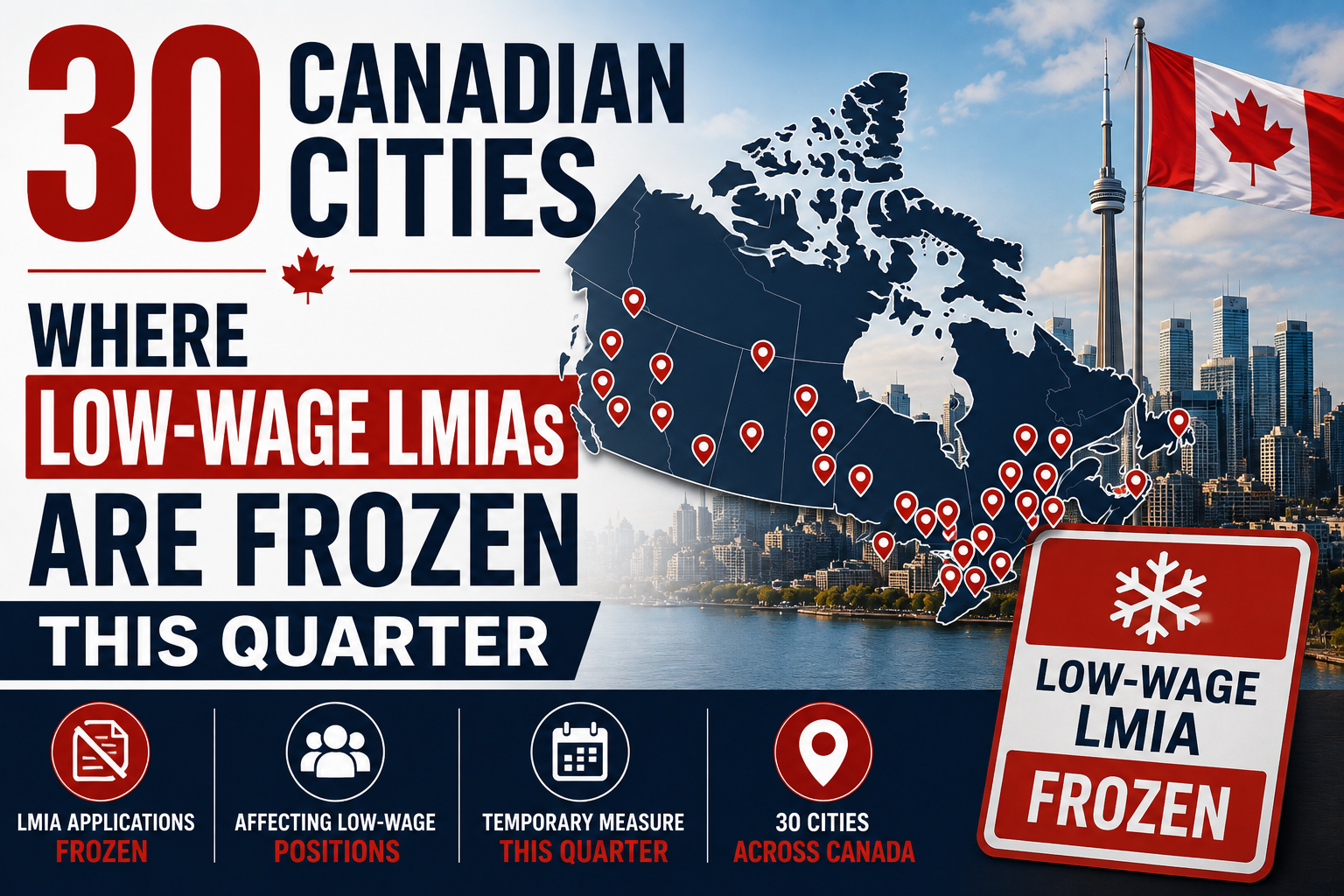
Employment and Social Development Canada has quietly redrawn the map for the low-wage Temporary Foreign Worker Program. As of July 10, 2026, 30 of Canada’s 41 Census Metropolitan Areas are on the refusal list — meaning ESDC will refuse to process most low-wage LMIA applications for jobs located inside them, based on a 6% CMA unemployment threshold.
The rule is not new. What is new is the current list. Toronto, Montréal, Vancouver, Ottawa-Gatineau, Calgary, Edmonton, Kitchener-Cambridge-Waterloo, London and 22 other CMAs are all above the 6% line for the July 10 to October 8, 2026 quarter. Together they cover the majority of Canada’s population and almost all its urban labour markets.
If you were planning to sponsor a foreign worker at a low-wage position in most Canadian cities this quarter, the default answer from ESDC is now no. Here is what the rule actually does and how narrow the exceptions really are.
How the 6% rule actually works
Under a policy first introduced on September 26, 2024 and refreshed every quarter since, ESDC refuses to process a low-wage LMIA application when the job’s work location sits inside a Census Metropolitan Area with an unemployment rate of 6% or higher, as reported by Statistics Canada’s Labour Force Survey.
“Low-wage” here means a position paying below the median hourly wage for the relevant province or territory. High-wage streams and the Global Talent Stream operate under different rules and are not caught by this list. But the low-wage stream is the one that most restaurants, warehouses, retailers, cleaning contractors and hospitality employers actually use.
The list is refreshed quarterly using the most recent three-month Labour Force Survey moving average. The current list applies to applications submitted between July 10, 2026 and October 8, 2026. A new list will replace it in October.
What “refused to process” means, in practice
A refusal to process is not the same thing as a refused LMIA. ESDC does not open the file. The employer receives back the processing fee, and no assessment is made on the merits. There is no appeal because there is nothing to appeal. If the job is in a listed CMA and does not qualify for one of the exemptions below, the file simply cannot move.
Which cities are on the list
Twelve CMAs sit at or above 7% unemployment. Oshawa leads at 8.5%. Moncton and Kitchener-Cambridge-Waterloo are tied at 8.1%. Abbotsford-Mission, Chilliwack, Windsor, Barrie and London are all at or above 7.8%. Toronto and St. John’s are both at 7.3%.
Below those, another 18 CMAs — including Montréal (6.8%), Ottawa-Gatineau (6.7%), Vancouver (6.7%), Hamilton (6.9%), Calgary (7.0%), Edmonton (7.2%), Peterborough (7.0%) and Kelowna (7.5%) — clear the 6% threshold and are also on the refusal list.
Where the low-wage stream is still open
Eleven CMAs are below 6% and remain open for low-wage LMIA processing this quarter: Saguenay (3.4%), Québec (4.0%), Sherbrooke (4.3%), Victoria (4.6%), Thunder Bay (4.9%), Trois-Rivières (5.3%), Kingston (5.3%), Fredericton (5.3%), Lethbridge (5.4%), Winnipeg (5.6%) and St. Catharines-Niagara (5.8%). Halifax and Saint John are technically off the list at 5.9%, but sit close enough that a small labour-market shift could pull them back in October.
If your employer is one CMA over from an open city, moving the job location a few kilometres does not solve the problem. The rule is applied to the actual worksite address on the LMIA, not the employer’s head office.
The exemptions are narrower than the internet suggests
A common misconception in employer forums right now is that the 6% rule effectively shuts down the entire low-wage stream. It does not. ESDC keeps processing low-wage LMIAs in listed CMAs for a specific set of exempted sectors and situations. If your job fits, the CMA unemployment rate is irrelevant.
- Primary agriculture occupations
- Construction — NAICS 23 (residential and non-residential building, heavy and civil engineering, specialty trades)
- Food manufacturing — NAICS 311
- Hospitals — NAICS 622
- Nursing and residential care facilities — NAICS 623
- In-home caregiver positions under NOC 31301, 32101, 44100 and 44101
- Short-duration positions of 120 calendar days or fewer
- Positions supporting a permanent residency application (the LMIA is used to support PR only, not a work permit)
Read that list twice. Restaurants, retail, hotels, general warehousing, cleaning, gig-economy fulfilment and most trucking are not on it. If the job is one of those and it is in a listed CMA, the file will be sent back — regardless of the employer’s recruitment record or wage offer.
Why the rule tightened, not loosened, this summer
ESDC’s July 2026 refresh made the list bigger, not smaller. As Canadian unemployment has crept upward through the spring and summer, more CMAs crossed the 6% line. The July 10 update brought in cities that had been open in the previous quarter and only removed a handful — including Halifax, Winnipeg and Regina — as reported in our June 2026 policy roundup.
The direction of travel matters. If you are counting on a specific CMA being open in October, do not. The next Labour Force Survey update could push it above the line. Halifax is a case study: it sits at 5.9% today. Two-tenths of a point in the wrong direction and it is back on the list.
What this means for you
If you are an employer with a low-wage job in a listed CMA: unless your NAICS code or NOC is on the exemption list above, the file will not be processed this quarter. Do not pay the fee expecting a decision. If your position is a construction, agriculture, hospital, long-term-care or in-home care role, confirm the correct NAICS/NOC code with your immigration lawyer before filing — the exemption depends on it, not on your general description of the job.
If you are a worker whose LMIA-supported job offer is in a listed CMA: if the job is not in an exempt sector, the LMIA is stuck. Ask the employer whether the role qualifies under any of the eight exemptions. If it doesn’t, the realistic paths forward are a different work-permit stream (International Mobility Program, Global Talent Stream for high-wage tech roles, intra-company transfer if applicable), or waiting to see if the CMA drops off the list on October 9.
If you are trying to use an LMIA to support a permanent residency application: the CMA rule does not block you. LMIAs used only to add points to an Express Entry profile or to support PR are exempt from the refusal list. That is one of the few remaining LMIA doors still open in a place like Toronto or Vancouver this quarter — for a look at the Express Entry side of that equation, see what CEC cut-offs actually look like right now.
If you are considering an Ontario provincial route instead: the Workforce Priority stream under the rebuilt OINP has its own labour-market signalling and is not affected by the ESDC refusal list. It is a different program with a different threshold. See our guide to the 2026 OINP for what actually qualifies.
What to watch next
The next refresh lands on October 9, 2026 and will use Statistics Canada’s August Labour Force Survey. Watch the borderline CMAs — Halifax and Saint John at 5.9% could join the list; Brantford at 6.2% and Nanaimo at 6.5% could fall off it. A softening national labour market suggests the list will get longer, not shorter.
Also watch for policy signals from Employment and Social Development Canada itself. The eight-CMA reprieve granted in July suggests ESDC is willing to move regions off the list quickly when local numbers change. It has not, so far, adjusted the 6% threshold itself. Any move on the threshold — up or down — would reshape the map more than any quarterly refresh does.
Related reading
- Canada immigration policy update: major changes in June 2026
- The CEC cut-off climbed 16 points since March: what Express Entry actually looks like
- The OINP was rebuilt in 2026: what replaced Ontario’s nine streams
Unemployment figures and CMA refusal list as published by Employment and Social Development Canada for the quarter beginning July 10, 2026, drawing on Statistics Canada’s Labour Force Survey. This article is general information, not legal advice. LMIA eligibility depends on the specific NAICS/NOC code, wage, worksite and program stream — always confirm with a licensed Canadian immigration lawyer or an RCIC, and verify current program requirements on canada.ca before making a filing decision. No featured image was attached on this draft — the Canva quota was exhausted during this run; please add one before publishing.
Discover more from CanadianUpdates
Subscribe to get the latest posts sent to your email.