
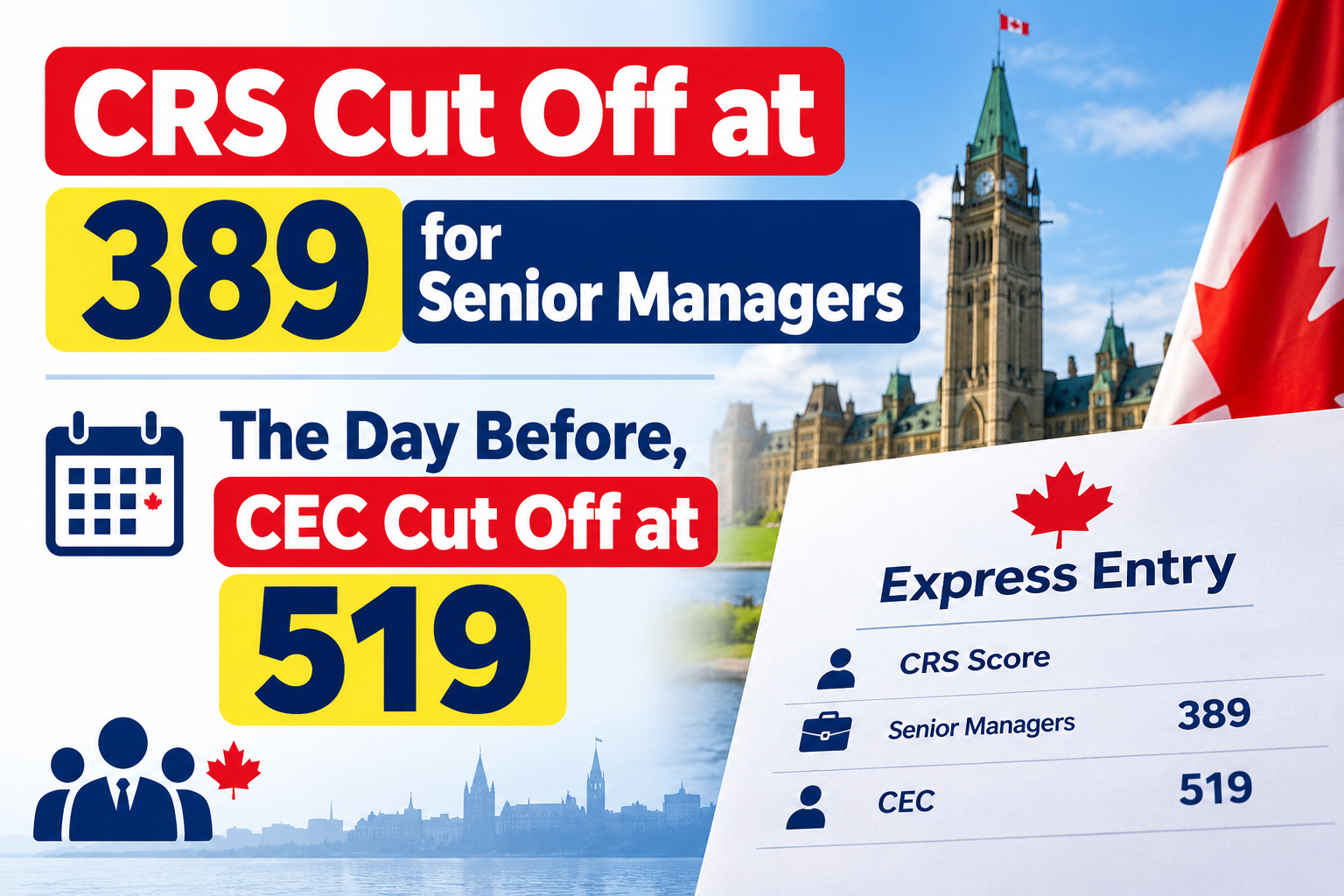
On September 16, IRCC invited 250 senior managers to apply for permanent residence. The cut-off was 389. The day before, the Canadian Experience Class round cut off at 519.
That is a 130-point gap between two draws held 24 hours apart, and it is the third consecutive time the senior manager cut-off has come down. The category has run three rounds all year and issued 1,000 invitations in total — fewer than IRCC hands out in a single French-language draw.
The score is not falling because the category is getting easier. It is falling because the category is running out of people. Here is what the round data actually shows.
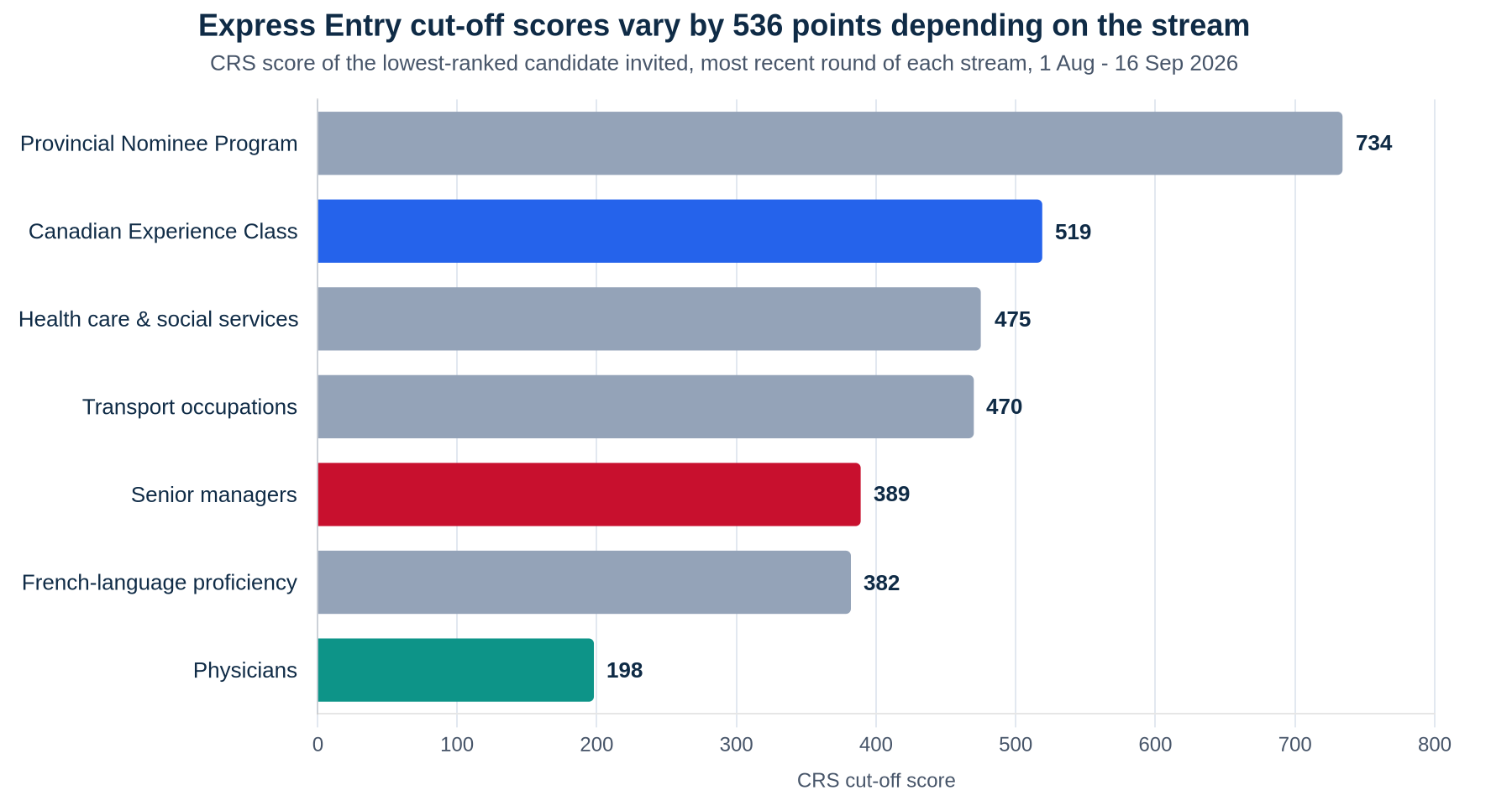
A 536-point spread in six weeks
Every bar above is a real round of invitations held between August 1 and September 16, 2026. The lowest-ranked candidate invited to the physicians round on September 3 scored 198. The lowest-ranked candidate invited to the Provincial Nominee Program round on September 14 scored 734.
The PNP number is less dramatic than it looks, because a provincial nomination is worth 600 CRS points by itself. Strip that out and a 734 in a PNP round is a candidate scoring 134 on their own merits.
What matters is the rest of the chart. Five of these seven streams cut off below 500. The general CEC round — the one most people on a work permit are waiting for — is the second-hardest door in the system. We covered why the CEC cut-off keeps climbing earlier this month: IRCC cut general draw sizes, the queue did not shrink to match, and the score went up.
The senior manager score has fallen at every round
Senior managers with Canadian work experience is one of five categories IRCC added for 2026, announced on February 18 alongside medical doctors, researchers, transport occupations and skilled military recruits. It has run three times.
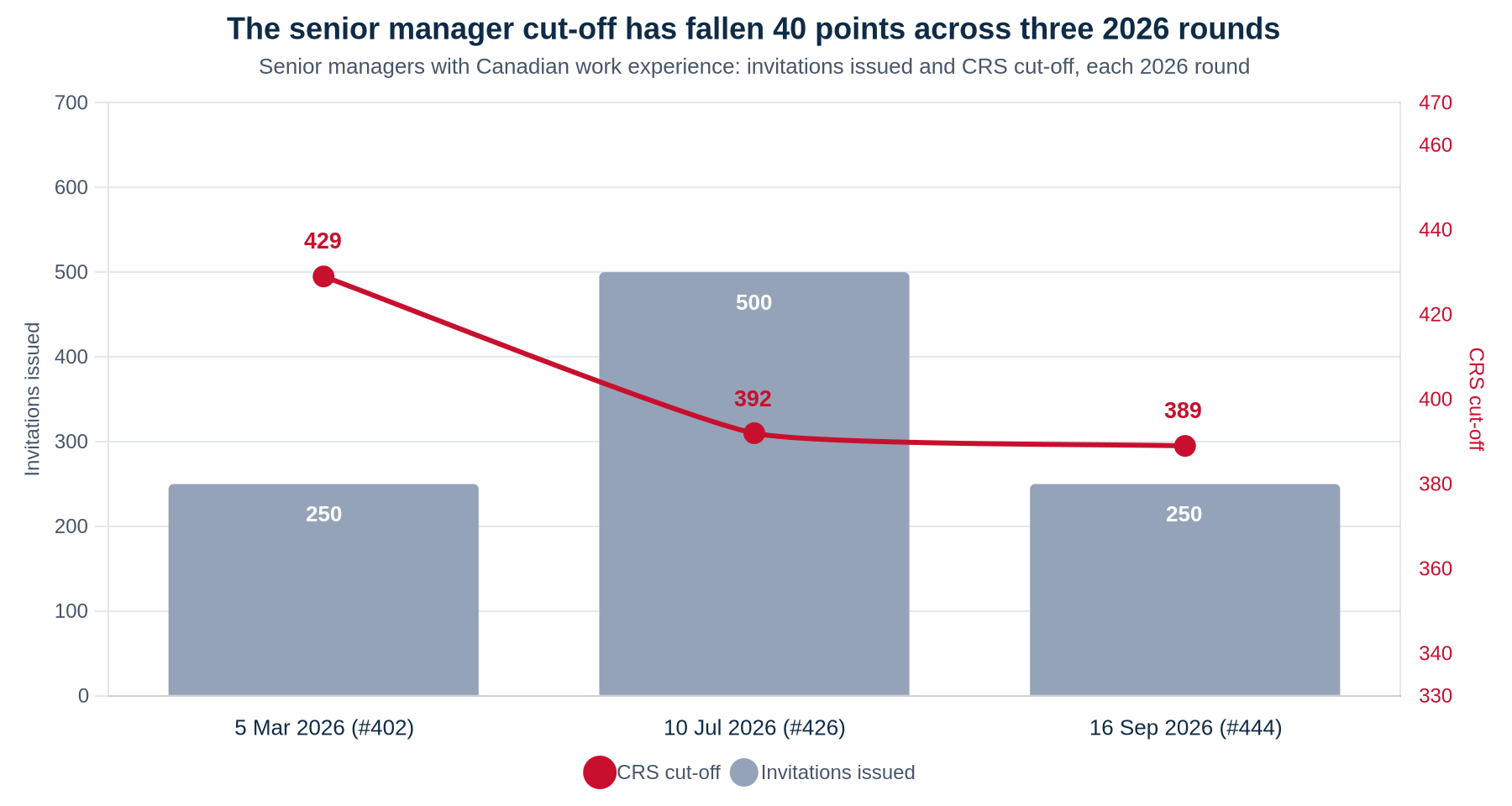
March 5: 250 invitations at 429. July 10: 500 invitations at 392. September 16: 250 invitations at 389. A 40-point drop from the first round to the third.
Why a smaller draw produced a lower score
This is the part worth understanding, because it works backwards from how Express Entry normally behaves.
A CRS cut-off is not a pass mark. It is the score of the last person who fit inside the round. So the usual rule is simple: shrink the draw and the cut-off rises, because you stop further up the ranked list.
In July, IRCC issued 500 invitations and reached down to 392. In September, it issued half as many — 250 — and still reached down to 389. A draw half the size went deeper into the list.
The most plausible reading is that the eligible pool thinned out. Everyone invited in March and July left the category. If only a few hundred qualifying senior managers were in the pool to begin with, IRCC now has to scrape closer to the bottom of a much shorter list to fill even a modest round. That is what a category looks like when demand for it is running dry, and it is the opposite of a category getting more competitive.
IRCC does not publish a candidate count per category, so this is inference from the round sizes and scores rather than something the department has confirmed. It is the reading the numbers support, not a fact IRCC has stated.
Who is actually in this category
Here is where you should be careful, and where a lot of what is circulating online is worth nothing.
IRCC names the category, in every round it publishes, “Senior managers with Canadian work experience.” Consultant blogs and law-firm briefings have filled in the detail — typically NOC codes 00012 through 00015 and twelve months of experience — but they do not agree with each other on the single most important point: whether that experience has to be Canadian at all. At least one major firm’s 2026 summary says the experience can be gained “in Canada or abroad,” which contradicts the name IRCC puts on the draw.
We could not confirm the NOC list or the experience rule on canada.ca, so we are not going to print it as fact. Confirm your eligibility against IRCC’s own category page or with a licensed representative before you pay anyone to “optimise” your profile for this category.
The bad advice to ignore is the post that reads “Express Entry cut-off drops to 389.” It did not. The CEC cut-off is 519. A category cut-off applies only to people already inside that category, and IRCC verifies the claim at the application stage. A low number in a category you do not belong to is not an opportunity — it is a statistic about somebody else. The same trap ran in June and September around the physicians draw at CRS 198.
What this means for you
If you manage people and you have never checked your NOC: do it this week. The gap between a management NOC and the occupation you were hired under is often a job title and a set of duties on a reference letter, not a career change. Nothing else in Express Entry offers a 130-point swing for an afternoon of paperwork. But the NOC has to be honestly yours — the duties on your employment letter have to match, and IRCC checks.
If you are between 451 and 500: a general CEC round is still not coming for you at current volumes. Category selection remains your realistic route, and the practical question is which category you can genuinely enter — not which one has the lowest number. Work through the 2026 list against your actual occupation before you assume you are shut out.
If you are already in the senior manager category: do not wait for the score to fall further. Three rounds in seven months is a thin, irregular schedule, and a category that is running out of candidates is also a category IRCC can quietly stop running. Get the profile in and keep it accurate.
If you are counting on a specific next cut-off: nobody knows what it will be, including us. Three data points across seven months is not a trend you can extrapolate from, and a single larger round would push the score back up. Anyone publishing a confident prediction for the next senior manager draw is guessing.
What to watch next
The variable to watch is not the score. It is whether a fourth round happens at all, and how big it is. A round larger than 500 would tell you IRCC has found more candidates. Another 250 would confirm the pool is thin.
The bigger question sits above all of this. IRCC is consulting on merging Express Entry’s three programs into one and rebalancing as much as 135 CRS points. If that goes ahead, the arithmetic behind every number in this article changes — including which categories exist.
Related reading
- The CEC Cut-Off Climbed 16 Points Since March: What Express Entry Actually Looks Like in September 2026
- CRS 198 This Week, Canada Invited Physicians. Here Is Who That Actually Applies To.
- IRCC Wants to Merge Express Entry’s Three Programs Into One — and 135 CRS Points Are on the Table
Round figures are as published by IRCC in its rounds of invitations data, covering rounds up to and including round 444 on September 16, 2026. The 2026 category list is as announced by IRCC on February 18, 2026. The 130-point gap, the 40-point drop and the 1,000-invitation total are our own arithmetic on those published figures, not numbers IRCC has published. The explanation for why the September round went deeper than the July round is our inference from the round data, not a statement by IRCC. This article is general information, not legal advice. For guidance on your own case, consult a licensed immigration lawyer or an RCIC. Verify current requirements on canada.ca before you act.
Discover more from CanadianUpdates
Subscribe to get the latest posts sent to your email.