
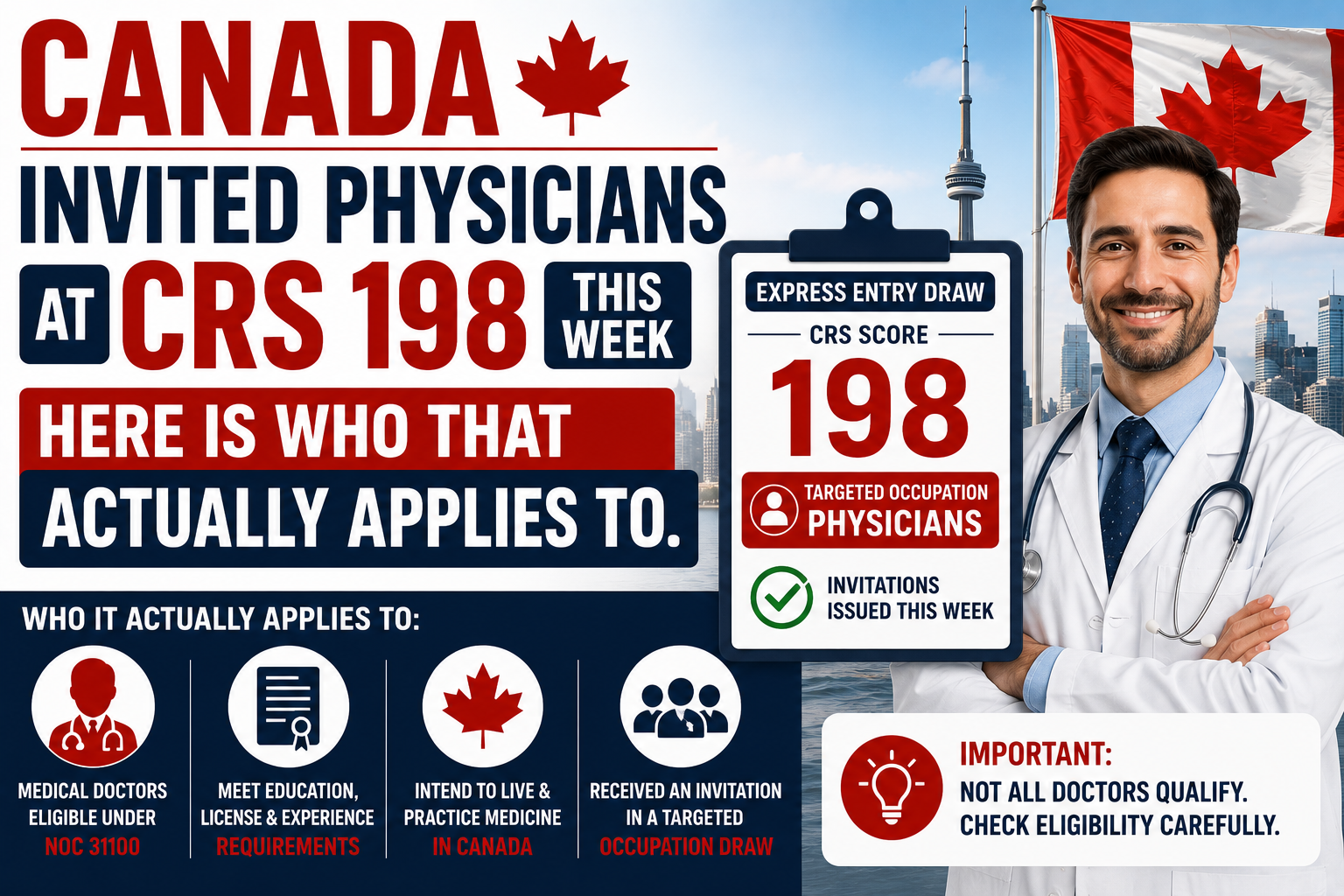
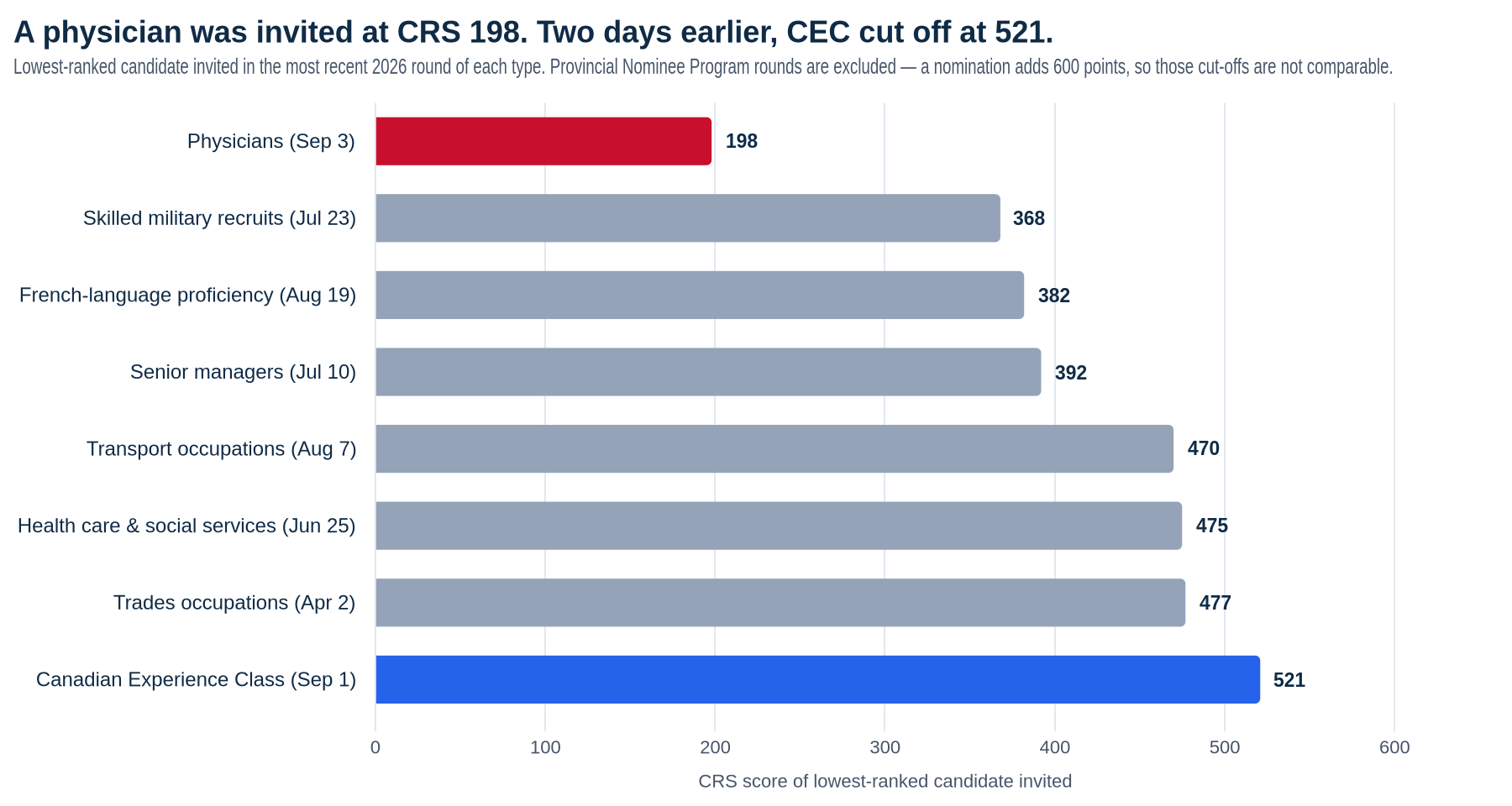
On September 3, 2026, Canada invited 229 physicians to apply for permanent residence. The lowest-ranked candidate invited had a CRS score of 198. Two days earlier, in a Canadian Experience Class round, the cut-off was 521.
That is a 323-point gap between two draws held in the same week. It matters because it is being reported as proof that Canada has dropped its standards, and it is not that. It is a narrow door for a very specific group of people, and almost everyone reading a headline about it does not qualify.
Here is what the physicians category actually requires, why the cut-off lands where it does, and what it changes for you.
The requirement is Canadian experience as a doctor, not a medical degree
To be invited in a physicians round, you need at least 12 months of full-time work experience — or the part-time equivalent — accumulated within the past three years, in Canada, in one of exactly three occupations:
- NOC 31100 — Specialists in clinical and laboratory medicine
- NOC 31101 — Specialists in surgery
- NOC 31102 — General practitioners and family physicians
The experience does not have to be continuous. But it does have to be in Canada, and you have to already be in the Express Entry pool, which means you already qualify for the Canadian Experience Class, the Federal Skilled Worker Program or the Federal Skilled Trades Program on your own merits. The category does not create a new way into the pool. It only changes who gets picked out of it.
So if you are a doctor practising in Lagos, Manila or Mumbai with no Canadian work history, this draw did nothing for you. Not less than you hoped — nothing. That is the single most common misreading of these results, and it is being repeated on immigration pages that should know better.
Why the cut-off is 198, and why that is not leniency
In a category-based round, IRCC does not lower the bar. It ranks only the candidates who meet the category’s criteria, then invites down that list until it hits its target number.
The pool of people who meet the physicians test is small — a few hundred candidates who are working as doctors in Canada right now and happen to be sitting in Express Entry. When the number of invitations is close to the size of that pool, the cut-off falls to whatever the lowest-ranked eligible person happens to score. A 198 is not a threshold IRCC chose. It is the arithmetic of a small pool.
You can see this in how unstable the number is. The three physicians rounds held in 2026 came in at CRS 169 in February, 223 in June and 198 in September. There is no trend there to plan around. Anyone telling you the next physicians cut-off will be near 200 is guessing.
The same mechanism, in the other direction
It works the same way when the pool is large. The Canadian Experience Class pool has tens of thousands of candidates, so a 2,000-invitation round barely scratches the top of it and the cut-off stays high. That is the story we covered earlier this week, when the CEC cut-off climbed 16 points since March. Same rule, opposite result.
The physicians category is 0.73% of everything Canada has issued this year
Scale is the part the headlines leave out. Between January 1 and September 3, 2026, Canada issued 122,082 invitations to apply across all Express Entry rounds. The physicians category accounted for 891 of them.
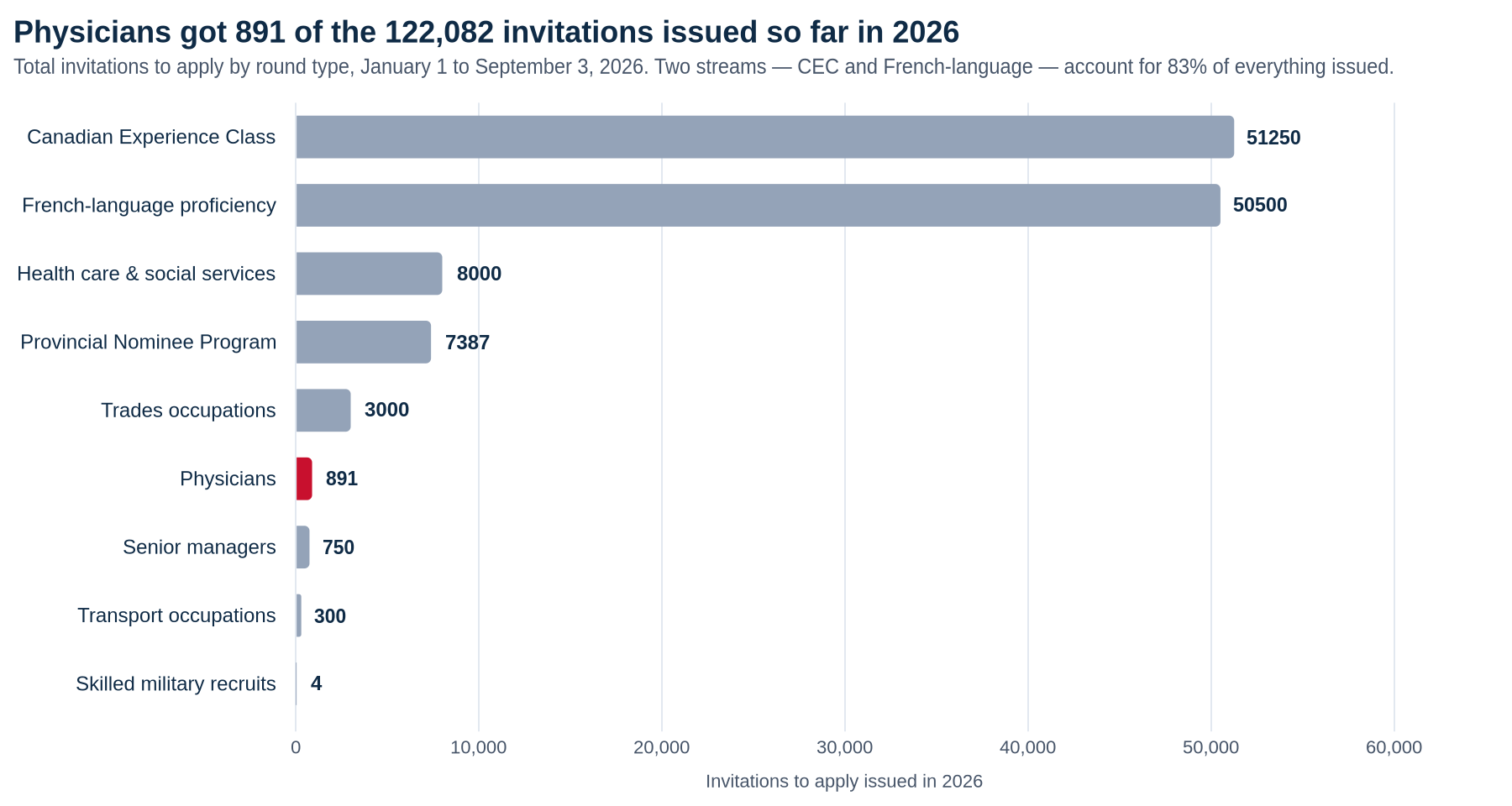
Two streams — the Canadian Experience Class and French-language proficiency — account for 83% of every invitation issued this year. The nine specialist categories together are a rounding error next to them.
This is worth holding on to, because there are ten category-based selection categories in effect for 2026 and each new one generates a wave of coverage suggesting a fresh route in. Physicians, senior managers and researchers with Canadian experience, transport occupations and skilled military recruits were all announced on February 18, 2026, alongside the continuing health care, trades and French-language categories. Set the French-language category aside and the other nine have produced 12,945 invitations between them this year. Your odds still rest overwhelmingly on your CRS score, your French, or a provincial nomination.
What this means for you
If you are a doctor already working in Canada: check your NOC code against the three listed above before anything else. If you are working under a different code — as a medical resident, a clinical fellow, or in a research post — your experience may not count for this category even though you are a physician. Get your employment letters to state your duties clearly, because the duties are what determine the code, not your title.
If you are a doctor outside Canada: this category is not your route, and no amount of CRS improvement changes that. Your realistic paths are a provincial nominee stream that targets physicians, a job offer that gets you into Canada on a work permit first, or provincial licensure processes that some provinces have shortened for internationally trained doctors. Start with the province where you want to practise, not with Express Entry.
If you are in the pool at 451 to 500: nothing here helps you unless you are a physician. Every CEC round in 2026 has cut off between 507 and 523, and the last four have all been 516 or higher. Your leverage is still language retesting, a second qualifying year of Canadian experience, or a provincial nomination — which is why Ontario’s Workforce Priority stream is worth understanding properly rather than treating as a lottery ticket.
If you are on a work permit and counting on renewing it: your timeline is the risk, not your score. Employer-dependent permits are getting harder to renew in some regions, and the low-wage LMIA freeze now covers 30 census metropolitan areas. Know your permit expiry date before you plan around any draw.
What to watch next
IRCC does not publish the date or size of the next round in advance, and it has held exactly three physicians rounds this year — February, June and September. There is no schedule you can rely on.
The number actually worth watching is the CEC cut-off, because that is where most invitations go. It rose from 507 in March to 521 on September 1 while round sizes shrank. If IRCC returns to 4,000-invitation CEC rounds, that number falls. If it keeps issuing 1,000 to 2,000 at a time, it does not.
Nobody outside IRCC knows which way that goes. Anyone publishing a predicted cut-off for the next draw is making it up.
Related reading
- The CEC Cut-Off Climbed 16 Points Since March: What Express Entry Actually Looks Like in September 2026
- The OINP Was Rebuilt in 2026: What Replaced Ontario’s Nine Streams
- 30 Canadian Cities Where Low-Wage LMIAs Are Frozen This Quarter
Draw data is current to September 4, 2026 and comes from IRCC’s published Express Entry rounds of invitations. Category eligibility is as stated on IRCC’s category-based selection page, last modified June 22, 2026. The 2026 totals in the second chart — 122,082 invitations overall and the per-category figures — are our own arithmetic, summing IRCC’s published round sizes from January 1 to September 3, 2026; IRCC does not publish those subtotals. This article is general information, not legal advice. Immigration rules change without notice and individual eligibility turns on facts we cannot see. Consult a licensed Canadian immigration lawyer or an RCIC before acting, and verify every requirement on canada.ca.
Discover more from CanadianUpdates
Subscribe to get the latest posts sent to your email.