
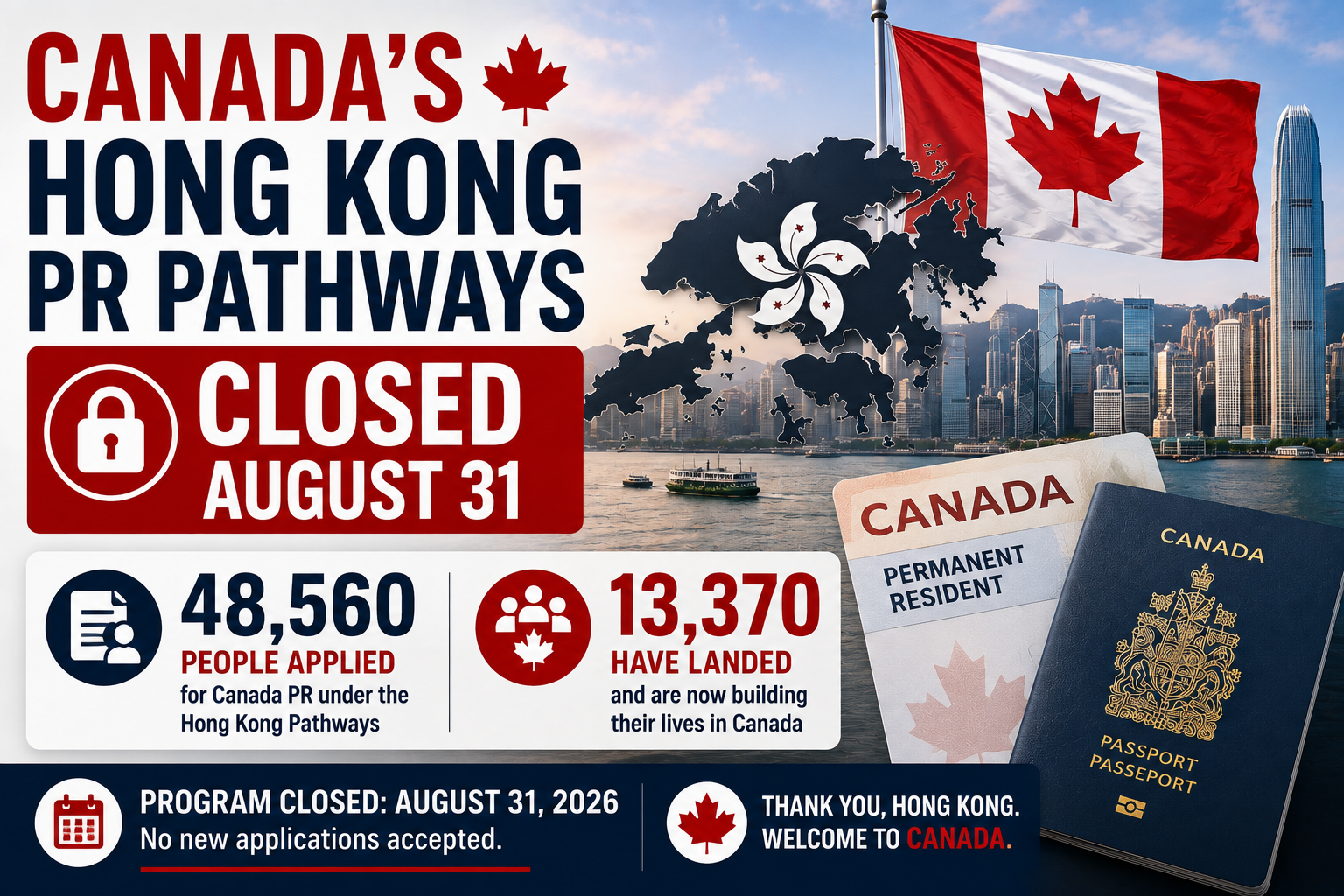
Canada’s two Hong Kong permanent residence pathways stopped accepting new applications on August 31, 2026. IRCC confirmed the closure in a notice published on August 28. The pathways had been open since June 1, 2021.
By June 30, 2026, IRCC had received roughly 30,315 applications covering 48,560 people. More than 8,600 of those applications, covering 13,485 people, had been approved. About 13,370 people had actually landed as permanent residents.
If you filed by August 31, your application is still being processed. If you did not, this door is shut, and nothing IRCC has published suggests it reopens.
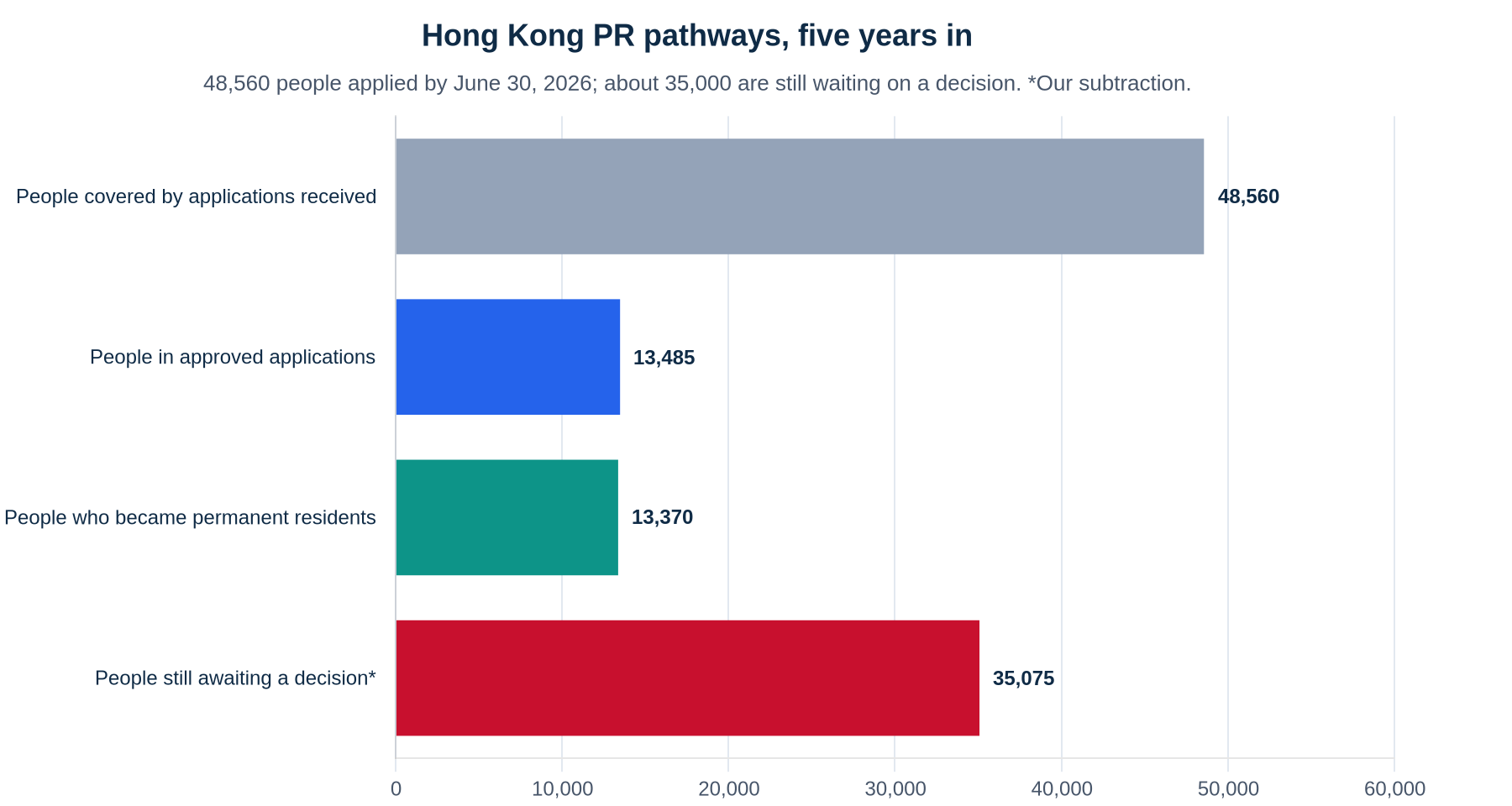
One caution on that fourth bar: IRCC did not publish a “still waiting” number. We got it by subtracting approvals from applications received, so it also captures anyone refused or withdrawn. Treat it as the outer edge of the backlog, not a headcount.
What actually closed on August 31
The pathways ran under a temporary public policy, not under the immigration regulations. That distinction matters: a public policy carries an expiry date from the day it is signed, and this one expired on schedule. There was no vote, no reversal, no last-minute extension. It ran out.
Stream A: in-Canada graduates
Stream A was for people who had graduated from a designated learning institution in Canada in the three years before applying — a degree, a diploma of at least two years, or a graduate or post-graduate diploma of at least one year, with at least half the program completed in Canada.
Stream B: Canadian work experience
Stream B was for people who had worked in Canada for at least 1,560 hours in total and held a Canadian work permit for at least a year, both within the three years before applying.
Both streams required a valid Hong Kong SAR or British National (Overseas) passport, CLB or NCLC level 5 in all four skills, physical presence in Canada with valid temporary resident status when applying and when landing, and an intention to settle outside Quebec.
Who this hits, and who it doesn’t
If your application was received on or before August 31, nothing changes for you. IRCC states plainly that applications received by the deadline will continue to be processed. You are in the queue, and closure of intake does not reopen or reassess your file.
This hits the people who were still building eligibility. A Hongkonger who graduated in spring 2026 and planned to file Stream A next year has lost that route. So has anyone ten months into a job, counting on reaching 1,560 hours for Stream B. There is no grandfathering for candidates who were on track but had not filed. It also hits anyone refused for a fixable reason: under an open program you refile, and now there is nothing to refile into.
The open work permit is the part people get wrong
Two separate Hong Kong work permit measures existed, and consultancy pages routinely mash them together.
The open work permit for Hong Kong recent graduates — the one you could apply for on the strength of a recent foreign or Canadian credential, without a PR application — expired on February 7, 2025. It is closed. Pages still advertising it as a live route are more than eighteen months stale. If a consultant tells you to apply for it today, that is a signal about the consultant.
The measure still running is the optional open work permit for people who already applied under the Hong Kong PR pathways. Effective May 27, 2024, it remains available until May 2029 and gives a permit valid for up to three years. To qualify you must have applied for PR under one of the two pathways, have held a work or study permit in the three years before that application, be in Canada, and be otherwise eligible for a work permit.
The distinction to hold onto: May 2029 is not a PR application deadline. PR intake ended on August 31, 2026. The 2029 date only governs how long existing applicants can keep pulling work permits off the back of a filed application. Anyone selling “you have until 2029 to apply” is reading the wrong page.
Why there is no replacement pathway coming
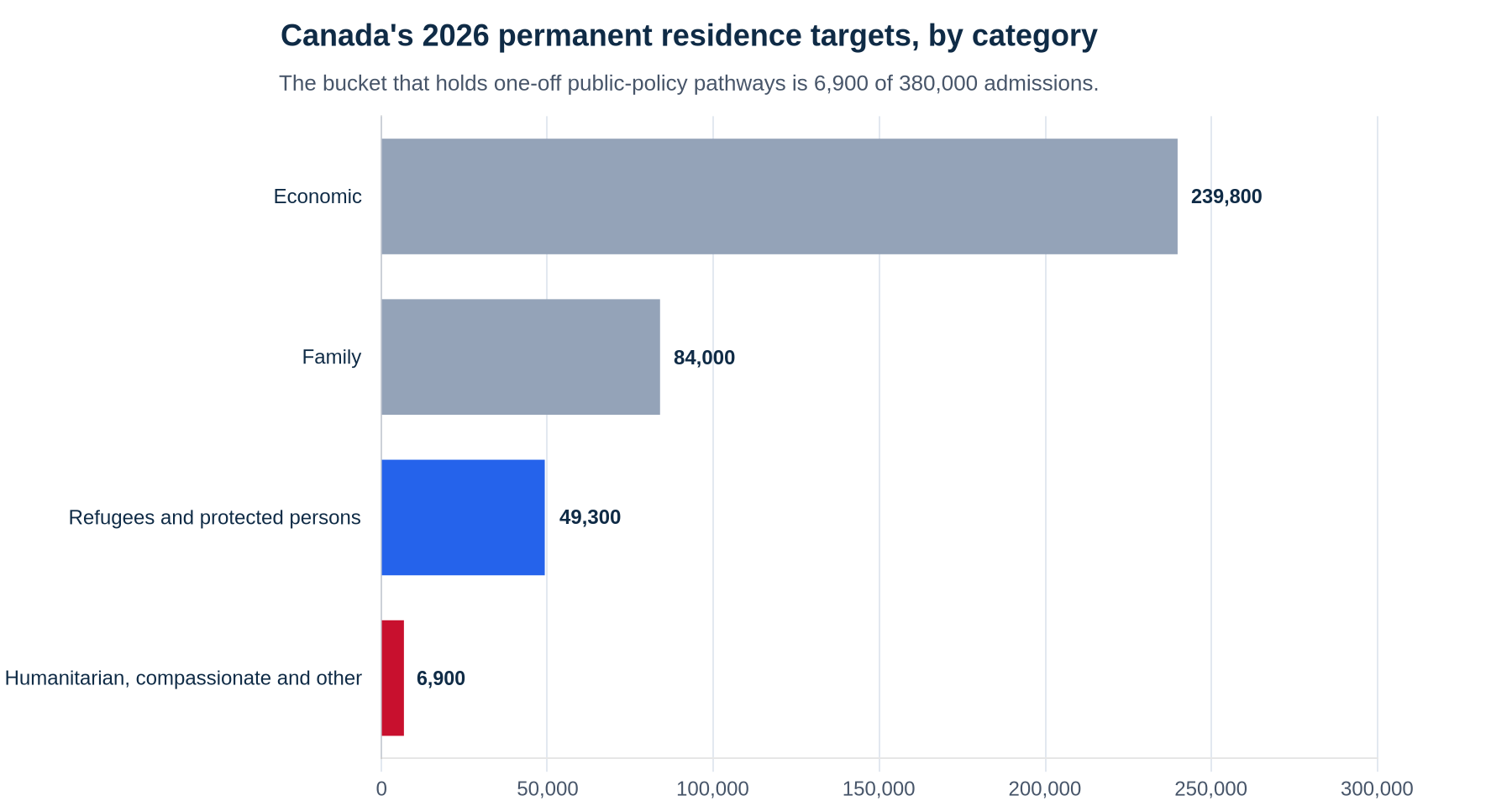
Canada’s 2026–2028 Immigration Levels Plan sets permanent residence admissions at 380,000 in each of the three years, with a planning range of 350,000 to 420,000. Within the 2026 target, economic immigration takes 239,800 spaces, family reunification 84,000, and refugees and protected persons 49,300.
The line where one-off public-policy pathways like the Hong Kong streams are counted — humanitarian, compassionate and other — is 6,900 spaces in 2026, falling to 5,000 in each of 2027 and 2028. That is the whole budget for every discretionary and public-policy admission Canada plans to make. A pathway that has already accepted applications for 48,560 people does not fit inside a shrinking 5,000-space line.
That mechanism explains a pattern, not a single decision. Canada is not singling out Hongkongers; it is winding down bespoke pathways generally and pushing people back toward the standing economic programs — the same logic behind the tightening in our look at where Canadian immigration is heading in 2026.
What to do about it
If your PR application is already filed: do nothing dramatic. Keep your status valid, tell IRCC if your address, passport or family composition changes, and apply for the optional open work permit if you qualify and have not already. Losing status while you wait is what costs people their file — not the closure.
If you missed the deadline and you are in Canada on a work permit: your realistic route is now Express Entry. A year of skilled Canadian work experience in the previous three years is the core Canadian Experience Class requirement — confirm the current wording on canada.ca before you rely on it — and the cut-off scores are published draw by draw, so we track where they have landed in our September 2026 CEC cut-off breakdown. Calculate your score honestly before you spend money on anything else.
If your Express Entry score is not competitive: a provincial nomination is worth 600 points and effectively guarantees an invitation. Ontario rebuilt its program this year, and the eligibility logic changed substantially — our guide to the OINP’s Workforce Priority stream walks through what replaced the old nine streams. Other provinces run their own streams with their own occupation lists.
If you need to extend a work permit first: check whether your employer’s region and wage level are still viable before you plan around an LMIA. Low-wage LMIA processing is frozen in a long list of census metropolitan areas this quarter, which we set out in today’s rundown of where low-wage applications are being refused. A plan that depends on an LMIA in one of those cities is not a plan.
If you are being offered a “special Hong Kong route” by a consultant: ask them to send you the canada.ca page. There isn’t one. Verify the person is a licensed immigration lawyer or an RCIC in good standing before you pay anything.
What to watch next
The number that matters now is how fast IRCC clears what it already holds: roughly 30,315 applications went in over five years, and just over 8,600 had been approved by June 30, 2026. Closing intake frees processing capacity, so approvals could accelerate — but that is an expectation, not a commitment, and IRCC has published no target date for clearing the inventory. Watch the published processing times rather than any promise; we track them in our IRCC processing times updates.
The second thing to watch is whether the open work permit measure survives to May 2029 in its current form. It is a public policy, which means it can be amended or ended early the same way this pathway ended on schedule. If you are relying on it to bridge a three-year wait, build a fallback.
Related reading
- The CEC cut-off climbed 16 points since March: what Express Entry looks like in September 2026
- The OINP was rebuilt in 2026: what replaced Ontario’s nine streams
- IRCC processing times: the current picture
Application and admission figures are as reported by IRCC as of June 30, 2026, and were published in its notice of August 28, 2026. Admissions targets are from the 2026–2028 Immigration Levels Plan. The figure of roughly 35,075 people “still awaiting a decision” is our own arithmetic (48,560 people in applications received minus 13,485 people in approved applications) and is not an IRCC-published number; it includes refused and withdrawn cases. This article is general information, not legal advice. Immigration rules change quickly — consult a licensed Canadian immigration lawyer or an RCIC before acting on anything here, and verify current requirements on canada.ca.
Discover more from CanadianUpdates
Subscribe to get the latest posts sent to your email.