
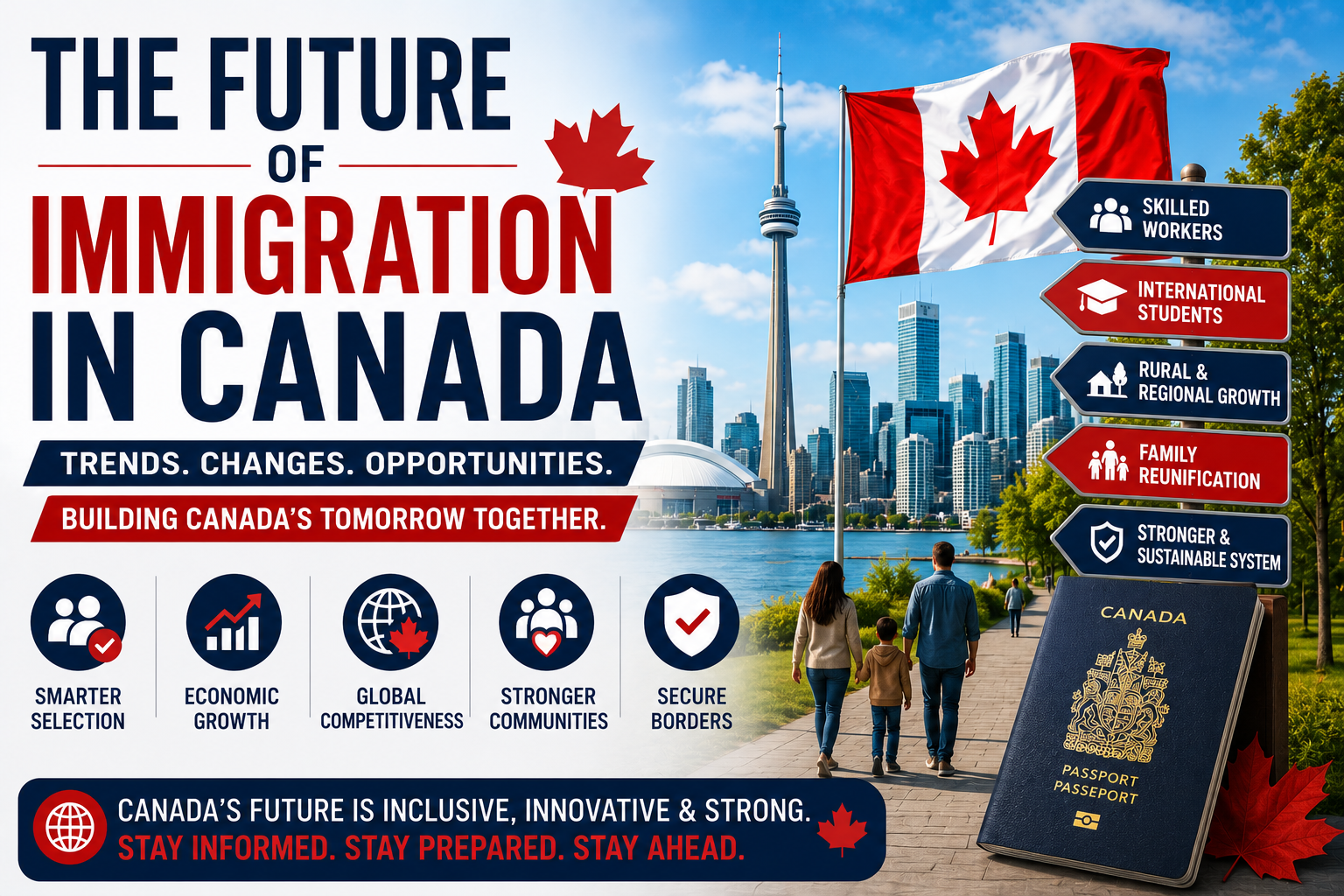
For three years, every immigration headline in this country has been about cuts. Fewer students. Fewer work permits. Lower targets. If that is the story you have been following, you have been reading the wrong one.
The cuts are real, and they are mostly finished. What is happening now is bigger: Canada is rebuilding the machinery of immigration itself. Express Entry — the system that has decided who gets permanent residence since 2015 — is being dismantled and reassembled. Provincial programs are being torn down and replaced. The rules that will govern who moves to Canada in 2028 are being written right now, in the second half of 2026.
This is a forward look, not a recap. Where the numbers land through 2028, what the Express Entry overhaul actually changes, which pathways are quietly getting easier while the headline ones get harder, and what any of it means if you are sitting in the pool right now waiting for an invitation.

The numbers that define the next three years
The 2026–2028 Immigration Levels Plan is the document that governs everything else. Its central move is a split decision: hold permanent residence steady, cut temporary residence hard.
| Measure | 2026 | 2027 | 2028 |
|---|---|---|---|
| Permanent resident admissions | 380,000 | 380,000 | 380,000 |
| New temporary resident arrivals | 385,000 | 370,000 | 370,000 |
| Economic share of PR admissions | ~59% | 64% | 64% |
| Francophone target outside Quebec | 9% | 9.5% | 10.5% |
Three things in that table matter more than the rest.
Permanent residence is stable. 380,000 a year, three years running. After the whiplash of 500,000 targets being revised down to 395,000 and then to 380,000, stability is itself the news. If you are planning a multi-year path to PR, the ground under you has stopped moving.
Temporary residence is being cut to the bone. New temporary arrivals drop from 673,650 in 2025 to 385,000 in 2026 — a reduction of more than 288,000 people in a single year, according to IRCC’s own departmental plan. The goal is to bring the non-permanent resident population below 5% of Canada’s total by the end of 2027. The Parliamentary Budget Officer projects that share falling from its 2024 peak of 7.6% to just under 5% — meaning the target will actually be met.
The economic share is climbing. From roughly 59% to 64% by 2027. In a fixed 380,000 pot, raising economic immigration means everything else gets proportionally smaller. Family class holds at about 21–22%, with 84,000 admissions in 2026 falling to 81,000 in 2027 and 2028. Parents and Grandparents stays capped at 15,000 a year.
Put plainly: the door is not closing. It is narrowing to a specific shape. If your profile fits the economic template Canada is now selecting for, your odds may actually be improving. If it does not, the competition has become brutal.
The Express Entry overhaul nobody is ready for
This is the story that will define Canadian immigration for the rest of the decade, and most candidates have not heard about it.
IRCC is proposing to merge all three Express Entry programs into one. The Federal Skilled Worker Program, the Federal Skilled Trades Program and the Canadian Experience Class — the three separate doors into the pool since 2015 — would become a single program with one set of minimum requirements. No more working out which stream you qualify under before you can even build a profile.
A public consultation on the proposal ran until May 24, 2026, asking Canadians to weigh in on minimum eligibility requirements and on which Comprehensive Ranking System factors should gain or lose points. One element under discussion: dropping the education threshold significantly below the current FSW requirement of a one-year post-secondary credential.
If it goes ahead, this is the most significant structural change to Express Entry since category-based selection arrived in 2023 — arguably since the system launched.
Three caveats worth holding onto. Nothing is final: these are proposals under active consultation, and no decisions have been announced. Any change must be published in the Canada Gazette before taking effect. And separate consultations on category-based selection priorities are expected later in 2026, meaning the categories themselves may shift again.
Implementation is expected in fall 2026 or early 2027. Which brings us to a practical problem.
Why draws are slowing down this fall
Rebuilding a live system requires switching it off. When IRCC implements the merger, Express Entry draws are expected to pause — potentially for several weeks.
Industry projections put total 2026 invitations somewhere between 120,000 and 145,000, depending on how long the pause runs and whether currently inactive categories get draws before it starts. If you built your expectations around the pace of January through March, recalibrate now.
The specific casualty: the window for high-volume Canadian Experience Class draws has effectively closed. The general CEC cut-off has been sitting around 508. For anyone below roughly 515, category-based draws and provincial nominee programs are now the realistic routes — not the general pool.
The first half of 2026 was a sprint. The second half is a controlled walk.
Category-based selection is now the front door
Here is the shift almost nobody has internalised: your occupation now matters more than your CRS score.
IRCC runs ten active occupational categories in 2026 — five renewed from 2025, five brand new this year. The new arrivals:
- Medical doctors with Canadian work experience
- Senior managers with Canadian work experience
- Researchers with Canadian work experience
- Transport occupations
- Skilled military recruits
Now look at what those categories did to cut-off scores. The lowest CRS score issued in any 2026 draw was 169, in the physicians category on February 19. Senior managers drew for the first time on March 5 at a cut-off of 429.
Against a general CEC cut-off around 508, that is not a small difference. A physician with a CRS score that would never surface in a general draw received an invitation in the first quarter of the year. The mechanism is simple: category draws pull from a narrower sub-pool, so the minimum score needed often falls dramatically.
Two changes tighten the screws. The minimum work experience requirement rose to 12 months, up from six in 2025. And the Agriculture and Agri-Food category was removed entirely for 2026 — a reminder that categories are set annually by the Minister and can vanish.
You do not apply for a category. Draws run automatically against profiles already in the pool. Which means the single highest-leverage thing you can do is make sure your NOC code and work history are recorded accurately.
International students: smaller, but not closed
The student numbers look grim on the surface. Canada will issue up to 408,000 study permits in 2026 — 7% below the 2025 target of 437,000 and 16% below 2024’s 485,000. Study permit holders fell from over one million in January 2024 to roughly 725,000 by September 2025.
But the composition tells a more useful story. Of that 408,000, roughly 155,000 are new arrivals and 253,000 are extensions for students already here. Only 180,000 permits fall under the provincial attestation letter system, distributed to provinces by population.
And there is a genuine opening. As of January 1, 2026, master’s and doctoral students at public designated learning institutions are exempt from the cap entirely — no PAL or TAL required, per the official IRCC allocation notice. Graduate students can apply even after a province’s allocation is exhausted.
Pair that with $1.7 billion committed over 13 years to recruit international researchers and doctoral students, and the message is unmistakable: Canada is not reducing students so much as re-sorting them. Undergraduate and college intake is squeezed. Graduate and research intake is being actively courted.
One piece of rare good news for anyone already studying: the PGWP eligible fields of study list is frozen for all of 2026. No programs added, none removed. After two years of shifting eligibility, that stability is worth something when you are choosing a program.
The quiet advantage of already being here
Buried inside the Levels Plan are two one-time initiatives that would accelerate roughly 148,000 people already in Canada on temporary status into permanent residence over the next two years — a figure confirmed in the Parliamentary Budget Officer’s analysis.
This is the through-line of the entire plan. Canada is reducing new arrivals while creating dedicated routes for people who are already here, already working, already paying tax and already integrated. We covered the mechanics of one of these routes in our breakdown of Canada’s 33,000 PR pathway.
If you hold a valid work permit in Canada today, you are on the favoured side of that line. The strategic implication is uncomfortable but clear: maintaining status matters more than optimising your CRS score. A lapsed permit does not just cost you a job — it moves you out of the group the system is being redesigned to prioritise.
French is the most underrated strategy in Canada
Francophone immigration outside Quebec is targeted at 9% of admissions in 2026, rising to 9.5% in 2027, 10.5% in 2028, and 12% by 2029. Those are floors the government has committed to hitting.
The effect on draws has been dramatic. French has been the dominant category of 2026, round after round, with CRS cut-offs landing roughly between 379 and 446 depending on the size of the draw.
Compare that to a general cut-off around 508. A candidate with functional French can be invited at a score more than 100 points lower than one without. There is no other single factor in Canadian immigration that produces a swing that large — not a master’s degree, not a job offer, not five more years of experience.
French takes eighteen months to two years to reach a testable level from a standing start. If your PR timeline runs past 2027, it is arguably the highest-return investment available to you.
What this means for you, by situation
You are in the Express Entry pool right now
Continue under existing rules — the merger has not happened and may change before it does. Verify your NOC code matches an active category. If you are below 515, treat category draws and PNP as your primary route rather than waiting for a general draw that may not reach you.
You are an international student in Canada
Your PGWP field-of-study list is stable through 2026. Master’s graduates now qualify for a three-year PGWP regardless of program length. Use that runway to accumulate the 12 months of Canadian experience that category draws now require.
You are outside Canada planning to apply
This is the hardest position, and honesty serves you better than optimism. Nearly every advantage in the redesigned system flows to people already in Canada. Graduate study at a public institution is the clearest remaining entry point, since it sits outside the cap. Francophone candidates face a materially easier path.
You are sponsoring family
Spousal and dependent sponsorship targets hold at 69,000 in 2026 and 66,000 in 2027–2028. Parents and Grandparents stays at 15,000. Demand far exceeds supply, and nothing in this plan suggests that changes.
You are targeting a specific province
Provincial programs are being rebuilt alongside the federal system. Ontario replaced its entire program structure in 2026 — see our full breakdown of the new OINP points system, where region and wage now outweigh education.
Frequently asked questions
Is Canada still accepting immigrants in 2026?
Yes. Canada will admit 380,000 permanent residents in 2026 and the same number in 2027 and 2028. Despite the reductions, these levels remain above pre-pandemic targets.
Will Express Entry really merge into one program?
It is proposed, not confirmed. IRCC consulted the public until May 24, 2026 on merging FSW, FST and CEC into a single program. Any change requires publication in the Canada Gazette before taking effect, and implementation is expected in fall 2026 or early 2027.
Will Express Entry draws stop?
A temporary pause is expected when the system changes are implemented, potentially lasting several weeks. Draws are projected to resume afterward under the new structure.
What CRS score do I need in 2026?
It depends entirely on the draw type. General CEC rounds have sat around 508. French category draws have ranged roughly 379 to 446. The physicians category issued invitations as low as 169. Always confirm actual figures on IRCC’s official rounds of invitations page.
Is it harder to come to Canada as a student now?
For undergraduate and college programs, yes — the cap is tighter and provincial allocations are limited. For master’s and doctoral students at public institutions, it is easier: they are exempt from the cap and the PAL/TAL requirement as of January 1, 2026.
Should I learn French to improve my chances?
If your timeline extends past 2027, it is likely the single highest-value investment available. Francophone targets rise every year through 2029, and French category draws have consistently carried cut-offs far below general rounds.
The bottom line
The era of cuts is ending. The era of restructuring has started, and it will reshape more lives than the cuts did.
Canada is not becoming a country that takes fewer immigrants. It is becoming a country that takes different immigrants — selected by occupation rather than résumé, favouring people already inside the country over those applying from outside, and rewarding French at a scale no other factor comes close to matching.
If your plan was built on the logic of 2022 — get a degree, score well on IELTS, wait for your CRS to clear a general draw — that plan is expiring. The candidates who do well between now and 2028 will be the ones who read the new signals early: category over score, inside over outside, French over almost everything.
The rules are being rewritten this year. Read them before your competition does.
Bookmark CanadianUpdates.ca — we will publish the moment the Express Entry merger is confirmed and the first post-reform draw results land. You can also read our earlier coverage of June 2026’s major policy changes and where Bill C-3 currently stands.
This article is general information based on the 2026–2028 Immigration Levels Plan and IRCC announcements current as of July 2026. It is not immigration or legal advice. Proposed changes to Express Entry are under consultation and may change before implementation. Always confirm current requirements on canada.ca, and consult a licensed immigration consultant or lawyer about your own situation.
Discover more from CanadianUpdates
Subscribe to get the latest posts sent to your email.