
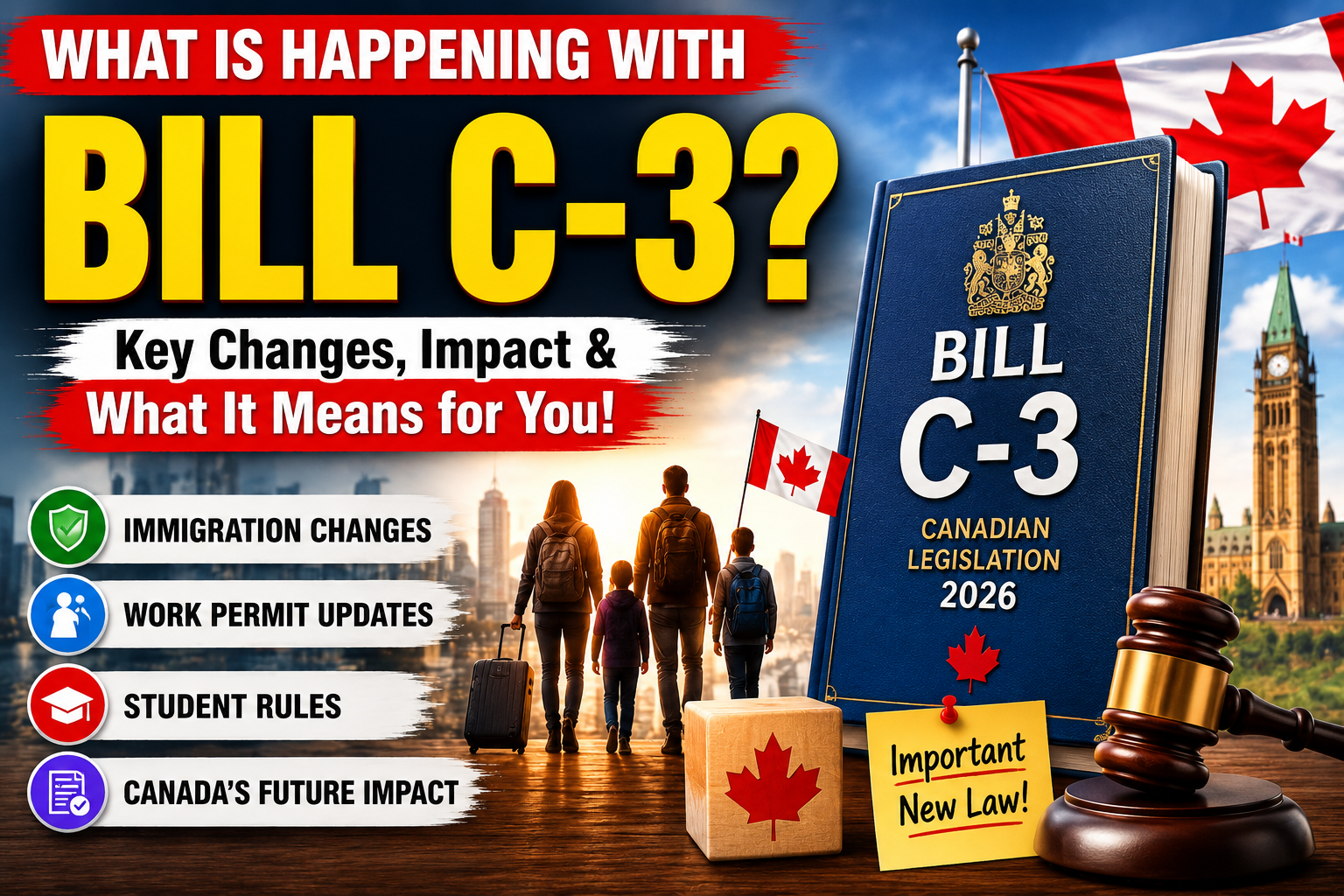
If you have Canadian roots — or know someone who does — Bill C-3 may be one of the most important pieces of legislation you need to understand in 2026. This landmark law has already changed the lives of thousands of people, opened a genuine path to citizenship for millions more around the world, and is now at the centre of a growing controversy involving suspended certificates. Whether you are a Canadian living abroad, a newcomer trying to understand the system, or someone with distant Canadian ancestry, here is everything you need to know — explained clearly from start to finish.
What Is Bill C-3?
On June 5, 2025, the Government of Canada introduced Bill C-3, An Act to Amend the Citizenship Act (2025), to extend citizenship by descent beyond the first generation in a way that is more inclusive and protects the value of Canadian citizenship. The bill received Royal Assent on November 20, 2025, and came into force on December 15, 2025. Canada.ca
In plain terms: before this law existed, if your parent was born outside Canada — even if your grandparent was a Canadian citizen — you could not automatically claim Canadian citizenship. That rule, known as the first-generation limit, has now been removed for most people born before December 15, 2025. This is one of the most significant changes to Canadian citizenship law in decades, and its effects are still unfolding.
Why Was the Old Law Changed? A Brief History
To understand why Bill C-3 matters, you need to understand what came before it.
Since 2009, Canadian law imposed the first-generation limit: only the first generation born outside Canada to a Canadian parent could inherit citizenship. If your parent was born in Canada, you were Canadian. But if your parent was also born outside Canada — even if their parent (your grandparent) was born in Canada — citizenship could not pass to you. This rule created a class of people known as “Lost Canadians” — individuals who had Canadian ancestry and should have been citizens, but were excluded by the generational cutoff. The Way Immigration
The unfairness of this rule was particularly visible for families with long and deep Canadian roots. Generations of Canadians who emigrated for work, military service, or family reasons found that their grandchildren and great-grandchildren were locked out of citizenship entirely — not because of anything they had done, but simply because of the mechanics of when and where they were born.
On December 19, 2023, the Ontario Superior Court of Justice found that parts of the Citizenship Act relating to the first-generation limit were unconstitutional. The Government of Canada did not appeal the decision, recognizing that the law had unacceptable outcomes for Canadians whose children were born outside the country. Canada.ca
Bill C-3 was then introduced as a successor to the earlier Bill C-71, which had attempted to fix this issue but died when Parliament was prorogued in March 2025. By the time Bill C-3 passed, there was widespread agreement across party lines that the old rules needed to go. CBC News
What the New Law Actually Does
Bill C-3 is built around a critical dividing line: December 15, 2025 — the date the law came into force. Where you fall relative to that date determines which rules apply to you.
If You Were Born Before December 15, 2025
Individuals born or adopted outside Canada before December 15, 2025, may be recognized as Canadian citizens automatically if they had a Canadian citizen parent at the time of birth or adoption. The previous first-generation limit no longer applies, and no physical presence or “substantial connection” requirement is needed. This change operates as a retroactive fix for many people who were previously excluded from citizenship. Canada.ca
This is enormous. It means that if you can trace an unbroken line of descent to a Canadian citizen — whether that is your parent, grandparent, or great-grandparent — you may already be a Canadian citizen right now. For these legacy generations, the process is not an application to become a citizen; it is simply a documentation exercise to request the certificate that proves you already are one. Canadim
If You Were Born On or After December 15, 2025
Second-generation born-abroad children will only receive citizenship by descent if their parent successfully demonstrates that they meet the 1,095-day residency requirement, or the so-called “substantial connection” test. Importantly, this residency requirement only applies to the parent of the born-abroad child and not the born-abroad child themselves. As long as their parent can prove a substantial connection to Canada, the child will be a Canadian citizen, regardless of their residency. Canada Immigration
Bill C-3 introduced this new requirement: if the Canadian parent was born abroad (obtained citizenship by descent), they must have accumulated at least 1,095 days — three years — of physical presence in Canada before the child’s birth in order to pass citizenship to that child. Canadian Immigration Experts
Who Counts as a “Lost Canadian”?
The term “Lost Canadian” has become central to conversations around Bill C-3, but it applies to a broader group of people than many realize.
A “Lost Canadian” is someone who either lost or never obtained Canadian citizenship due to technicalities or outdated provisions in the 1947 Canadian Citizenship Act. This typically affected individuals born abroad, those subject to old retention rules, or cases involving historical gender discrimination in citizenship laws. Mercan
Before 2009, for example, women who married non-Canadian men sometimes automatically lost their Canadian citizenship. Children born to Canadian mothers and foreign fathers were often not recognized as Canadian at all. Families who emigrated and never formally renewed citizenship under older retention requirements found themselves and their descendants cut off. Bill C-3 addresses all of these legacy situations in one sweeping fix for anyone born before December 15, 2025.
The American Rush to Claim Canadian Citizenship
One of the biggest and most unexpected effects of Bill C-3 has been an extraordinary surge of interest from Americans seeking to claim Canadian citizenship through ancestry.
Amid rising tensions in the United States, many Americans are looking to Canada — and their roots — for a possible way out. One Massachusetts resident with family ties to Quebec and Nova Scotia dating back centuries said she’s worried about the political situation in her country: “It’s not just me, many of us are concerned.” MLT Aikins
The numbers back this up. In January 2025, one Quebec archive had 32 requests for certified copies of vital records; in January 2026, that number jumped to over 1,000 — with most of those requests coming from Americans. Nova Scotia, New Brunswick, Ontario, and British Columbia have all reported similar surges. MLT AikinsCanada.ca
The American surge: one Quebec archive
Requests for certified copies of vital records, January 2025 vs January 2026
A more than 30-fold increase in a single year, with most requests coming from Americans. Source: MLT Aikins.
This historic update opens the door for millions of Americans with Canadian ancestry to claim dual citizenship through a grandparent via a restored chain of descent, allowing them to gain a Canadian passport without facing Canadian tax obligations unless they choose to relocate. Canada.ca
Importantly, individuals claiming citizenship by descent under Bill C-3 do not have to pass a Canadian history test, a language test, or undergo criminal background checks to obtain their certificate — unlike those going through the standard naturalization route as permanent residents. The Way Immigration
What’s Happening Right Now: The Surrender Letter Controversy
This is where things get complicated — and critically important if you have already applied or received a citizenship certificate.
On June 13, 2026, Immigration, Refugees and Citizenship Canada (IRCC) emailed several self-represented applicants who recently received citizenship-by-descent certificates under Bill C-3, directing them to surrender their documents pending a file review. These notices, signed by the Registrar of Canadian Citizenship, Peggy Sun, targeted a portion of the roughly 4,075 individuals — about half of them born in the United States — who had obtained certificates after the new law took effect. canadianupdates
IRCC’s alleged concern is that these applicants did not submit original source records — such as documents directly from vital statistics agencies or civil registries — to prove their Canadian lineage. Instead, the department implies applicants relied on informal records from genealogy sites like Ancestry.ca or FamilySearch, such as screenshots or photocopies without verifying metadata. canadianupdates
However, immigration lawyers are pushing back hard against IRCC’s position. A May 25, 2026, response to the House of Commons confirmed that alternative evidence — such as hospital and baptismal records, census entries, and boat manifests — is perfectly acceptable to meet the legal burden of a “balance of probabilities.” There are also extensive Federal Court precedents holding that applicants are legally entitled to rely on the instructions provided by IRCC itself. Parliament of Canada
The advice from legal professionals is consistent and clear: if you received a surrender letter, do not surrender your documents without speaking to a licensed immigration lawyer or regulated immigration consultant first. Your citizenship may be valid and enforceable, and surrendering documents prematurely could harm your position.
How to Apply: A Step-by-Step Overview
If you believe you may qualify under Bill C-3, here is how the process works:
Step 1 — Establish your lineage. Start with the Canadian ancestor’s birth certificate and work forward through each generation. Contact Canadian provincial archives and vital statistics offices early, as processing times have increased due to demand. Liberty Immigration
Step 2 — Gather long-form documents for every generation. You will need a long-form birth certificate for every person in the chain — yourself, your parent, your grandparent, and potentially further back. The wallet-sized short-form certificate most people have on hand is insufficient because it does not list both parents. Long-form birth certificates establish the parent-child link at each step of the descent. Canada.ca
Step 3 — Complete the application form. Use IRCC Form CIT 0001, the Application for a Citizenship Certificate for Adults, available on the IRCC website. Liberty Immigration
Step 4 — Pay the fee and submit. The government filing fee for a Canadian citizenship certificate is CAD $75 per person as of April 2026. Additional costs typically include certified copies of Quebec or provincial birth and marriage records (CAD $25–$50 each). Parliament of Canada
Step 5 — Wait for processing. As of early 2026, IRCC estimates that proof of citizenship applications are taking between 11 and 15 months to process, depending on the complexity of the historical documents provided. The surge in applications since the law came into force has created significant backlogs, and these timelines may continue to lengthen. The Way Immigration
Step 6 — Apply for a passport once approved. You cannot apply for a Canadian passport until you have your official Citizenship Certificate in hand. Once your Bill C-3 application is approved and the certificate is mailed to you, you can then use it as the foundational document to apply for your new Canadian passport. The Way Immigration
Key Facts and Common Questions
Does my spouse automatically become Canadian if I qualify?
No. Canadian citizenship by descent requires a direct biological or legal adoptive relationship. Once your citizenship is confirmed, you would need to utilize the Spousal Sponsorship program to bring a non-Canadian spouse to Canada as a Permanent Resident. The Way Immigration
Will I owe Canadian taxes?
Canada uses a residency-based tax system, not a citizenship-based one. If you successfully claim your Canadian citizenship under Bill C-3 but continue to live, work, and reside entirely outside of Canada, you do not owe Canadian income tax simply for holding a passport. The Way Immigration
Can citizenship pass through a naturalized Canadian, not just someone born in Canada?
Yes. A naturalized Canadian citizen can pass citizenship to children born abroad just as a Canadian-born citizen can. The key is obtaining documentation of their naturalization, which is maintained by IRCC and its predecessor departments. Canadian Immigration Experts
Key Dates at a Glance
| Date | Event |
|---|---|
| December 19, 2023 | Ontario Superior Court declares first-generation limit unconstitutional |
| June 5, 2025 | Bill C-3 introduced in Parliament |
| November 20, 2025 | Bill C-3 receives Royal Assent |
| December 15, 2025 | Bill C-3 comes into force |
| June 13, 2026 | IRCC begins sending surrender letters to some certificate holders |
Bottom Line
Bill C-3 is a landmark shift in Canadian immigration and citizenship law — one that restores long-overdue rights to thousands of Lost Canadians, opens a genuine pathway for descendants around the world, and has triggered one of the biggest surges in citizenship applications in Canadian history. But the recent controversy over suspended certificates is a reminder that this process is not as simple as filling out a form. Documentation quality matters, original records carry more weight than genealogy screenshots, and the stakes are high enough that professional guidance is worth the investment.
If you believe you may qualify, the time to act is now — but act carefully, document thoroughly, and do not surrender anything without legal advice.
Have questions about Canadian citizenship, settlement services, or immigration pathways? Browse our resources at SettlementAlerts.ca.
Discover more from CanadianUpdates
Subscribe to get the latest posts sent to your email.