
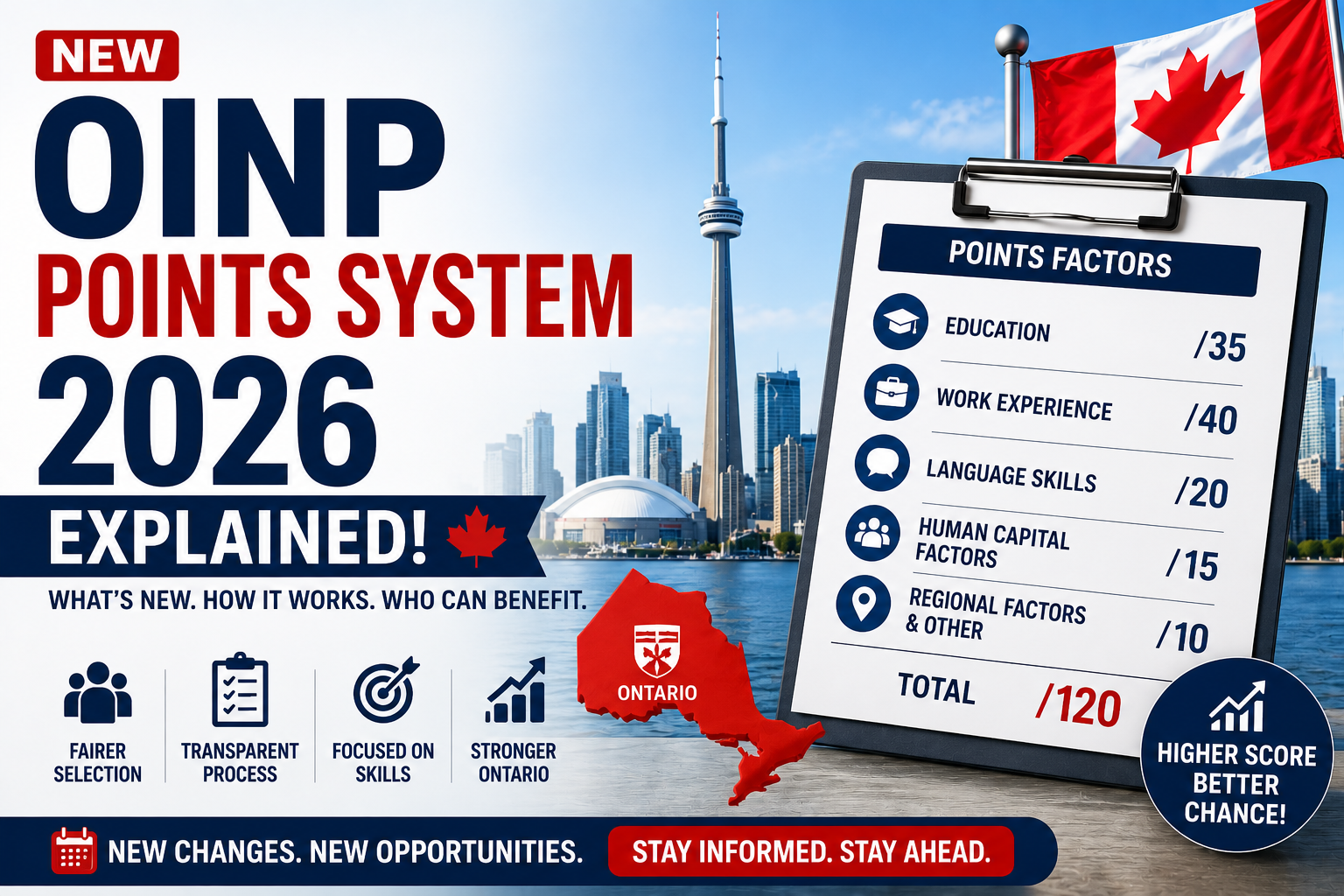
If you have been waiting to find out how Ontario will actually rank candidates after tearing down its entire immigration program, the wait is over. On July 20, 2026, the Ontario Immigrant Nominee Program published the full scoring grid for the Ontario Workforce Priority Stream — and the new OINP points system looks nothing like the one it replaced.
The headline number is 130. That is the maximum score a candidate can reach. But the more interesting story is where those points come from. Under the old system, human capital did the heavy lifting: your degree, your age, your language test. Under the new grid, a nurse in Sudbury can outscore a Toronto office worker with the same credentials by more than 40 points — purely on geography, wage, and sector.
This guide walks through every factor in the new ONIP scoring grid, with the exact point values, two worked examples, and a realistic plan for raising your score before the expression of interest system reopens.
Table of contents
- What happened to the old OINP
- The full 130-point grid, factor by factor
- Two worked examples: 113 vs 67 points
- How to raise your OINP score
- What score will you need?
- When does the EOI system reopen?
- Frequently asked questions
What happened to the old OINP
A quick recap, because the new grid only makes sense against what came before.
Ontario retired all of its old provincial immigration pathways on May 30, 2026. On June 26, 2026, Phase 1 of the redesign took effect: the eight remaining OINP streams were replaced by a single new stream, the Ontario Workforce Priority Stream (OWPS), which now serves as the main employer-driven route to provincial nomination.
The expression of interest system closed on June 25, 2026. Profiles that were sitting in the pool without an invitation were withdrawn. Applications already submitted before June 26 continue to be assessed under the rules that applied when they were received.
The OWPS has three pathways:
- TEER 0–3 pathway — higher-skilled occupations, job offer required
- TEER 4–5 pathway — lower-skilled occupations, job offer required
- Self-employed physicians — physicians eligible to bill OHIP
Ontario has also announced three more streams still to come — Priority Healthcare, Entrepreneur, and Exceptional Talent — but has not published launch dates or criteria for any of them. The OWPS is the only new stream with full eligibility rules on the table.
The full 130-point grid, factor by factor
Here is every factor, with the point values published on the official Ontario Workforce Priority Stream page.
1. Work region — up to 15 points
This is the single most consequential change. Where the job is located now carries as much weight as your language test.
| Region | Points |
|---|---|
| Northern Ontario (Sudbury, Thunder Bay, Algoma, Cochrane, Kenora, Muskoka and more) | 15 |
| Eastern Ontario (Ottawa, Kingston area, Peterborough and more) | 10 |
| Central Ontario outside the GTA (Waterloo, Wellington, Simcoe, Grey, Dufferin) | 10 |
| Southwestern Ontario (Hamilton, London, Windsor, Niagara and more) | 10 |
| Within the GTA but outside Toronto (Peel, York, Durham, Halton) | 5 |
| City of Toronto | 0 |
A job in Toronto scores zero here. The same job in Thunder Bay scores 15. That is a 15-point swing before anything else is considered.
2. Occupation skill level (NOC TEER) — up to 9 points
| NOC TEER | Points |
|---|---|
| TEER 0 (management) and TEER 1 (university degree roles) | 9 |
| TEER 2 and TEER 3 (college diploma, apprenticeship, supervisory) | 6 |
| TEER 4 and TEER 5 | 0 |
3. Compensation — up to 15 points
| Hourly wage | Points |
|---|---|
| $40 or more | 15 |
| $35 – $39.99 | 12 |
| $30 – $34.99 | 10 |
| $25 – $29.99 | 8 |
| $20 – $24.99 | 5 |
| Under $20 | 0 |
4. Occupational category — up to 10 points
| Broad category | Points |
|---|---|
| Health | 10 |
| Trades, transport and equipment operators | 8 |
| Natural and applied sciences | 6 |
| Management, business and finance, education and social services, natural resources, manufacturing | 4 |
| Art, culture, recreation and sport; sales and service | 2 |
5. Ontario work experience — up to 18 points
The highest-value single factor in the grid, and it rewards staying in the job you were hired for.
| Experience | In the job offer position | Other Ontario experience |
|---|---|---|
| More than 24 months | 18 | 12 |
| 13 – 24 months | 15 | 9 |
| 6 – 12 months | 12 | 6 |
| Under 6 months | — | 0 |
6. Canadian income tax history — up to 8 points
Based on your highest annual income in the past five years, confirmed by a CRA Notice of Assessment.
| Highest annual income | Points |
|---|---|
| $70,000 or more | 8 |
| $50,000 – $69,999 | 6 |
| $30,000 – $49,999 | 4 |
| Under $30,000 | 0 |
7. Level of education — up to 10 points
| Highest credential | Points |
|---|---|
| Doctorate, or degree in medicine, dentistry, veterinary medicine or optometry | 10 |
| Master’s degree | 8 |
| Bachelor’s degree, or university certificate above bachelor’s level | 6 |
| College or CEGEP diploma, apprenticeship or trades certificate, Ontario College Graduate Certificate | 5 |
| Below college or trade certificate | 0 |
Note how compressed this is. A doctorate is worth 10 and a trades certificate is worth 5 — a five-point gap. Under the old human-capital model, that gap was far wider.
8. Canadian educational credentials — up to 10 points
| Canadian post-secondary credentials | Points |
|---|---|
| Two or more | 10 |
| One | 5 |
| None | 0 |
To count, a credential must come from an eligible Canadian institution and a program of at least one year full-time.
9. Highest official language proficiency — up to 15 points
| Minimum CLB across all four abilities | Points |
|---|---|
| CLB 9 or higher | 15 |
| CLB 8 | 12 |
| CLB 7 | 8 |
| CLB 6 | 4 |
| CLB 5 or lower | 0 |
Your test must have been completed within the past two years.
10. Bilingualism — up to 10 points
Ten points for CLB 6 or higher across all four abilities in both English and French; five points for one language.
11. Temporary resident status — up to 10 points
| Status | Points |
|---|---|
| Valid work permit | 10 |
| Valid study permit | 5 |
| Neither | 0 |
Candidates with neither permit still need legal immigration status to qualify at all.
Self-employed physicians are not scored on hourly wage, and use an alternate Ontario work experience scale based on cumulative months of medical practice in the province.
Two worked examples: 113 vs 67 points
Numbers on a page are abstract. Here is what the grid does to two real-world profiles.
Candidate A — registered nurse, Sudbury
Northern Ontario (15) + TEER 1 (9) + $42/hour (15) + health category (10) + 14 months in the job offer position (15) + $72,000 income (8) + bachelor’s degree (6) + one Canadian credential (5) + CLB 9 (15) + English only (5) + work permit (10) = 113 out of 130.
Candidate B — marketing coordinator, Toronto
Toronto (0) + TEER 2 (6) + $26/hour (8) + business and administration category (4) + 8 months in the job offer position (12) + $38,000 income (4) + bachelor’s degree (6) + no Canadian credential (0) + CLB 8 (12) + English only (5) + work permit (10) = 67 out of 130.
A 46-point gap, and almost none of it comes from education or effort. It comes from region, wage, and sector. That is the policy signal: Ontario is selecting for labour market need, not for résumés.
How to raise your OINP score
Some factors you cannot change quickly. Several you can.
- Look for work outside Toronto. Moving a job search to Northern Ontario is worth 15 points instantly. Southwestern, Eastern, or Central Ontario outside the GTA is worth 10.
- Negotiate the wage across a band boundary. Going from $29.50 to $30.00 an hour is worth 2 points. From $39 to $40 is worth 3. Bands, not gradual increases, are what count.
- Stay in the same position. Experience in your job offer position scores 18 at the top end versus 12 for other Ontario experience. Job-hopping costs you points.
- Retake the language test. Moving from CLB 7 to CLB 9 is 7 points. It is usually the fastest single gain available.
- Add French. CLB 6 in French on top of English is worth 5 extra points.
- Keep your tax filings clean. The income factor runs off CRA Notices of Assessment, so unfiled returns cost you up to 8 points.
Employers matter too. Since May 30, 2026, employers supporting an OINP candidate must register with the OINP Director before an application can be made, and for job-offer pathways the employer initiates the expression of interest — not the candidate.
What score will you need?
Nobody knows yet, and any site telling you otherwise is guessing.
Ontario has not held a single draw under the new system, so there are no cutoff scores, no historical trend, and no reliable calculator. Published grids tell you how points are awarded; only draw results tell you what you need. Treat any “OINP calculator 2026” promising an invitation prediction with heavy scepticism.
What we do know is that Ontario has strengthened its authority to run targeted draws — rounds where only candidates matching a specific occupation, region, or attribute are ranked at all. A 90-point candidate in a targeted occupation may be invited ahead of a 110-point candidate outside it.
When does the EOI system reopen?
The OINP expression of interest system is currently closed. Ontario says it is expected to reopen later in summer 2026. Draws are anticipated to begin once it does.
Use the closure. Book a language test, get your credential assessment in order, file outstanding tax returns, and have conversations with employers about registration and about roles outside Toronto. The candidates who move first when the system reopens will be the ones who prepared during the gap.
Frequently asked questions
How many points is the new OINP system out of?
130 points across 11 factors under the Ontario Workforce Priority Stream.
Is it OINP or ONIP?
The correct acronym is OINP — Ontario Immigrant Nominee Program. ONIP is a very common misspelling and refers to the same program.
Do I get points for working in Toronto?
No. The City of Toronto scores zero on the work region factor. The rest of the GTA scores 5, and Northern Ontario scores the maximum 15.
Does age count under the new OINP points system?
Age is not a scored factor in the published OWPS grid. This is a significant departure from the old human-capital model and from federal Express Entry.
Do I need a job offer?
Yes, for both the TEER 0–3 and TEER 4–5 pathways. Only the self-employed physician pathway does not. The forthcoming Priority Healthcare stream is not expected to require one, but its criteria have not been published.
What happens to my old EOI profile?
Profiles in the pool that never received an invitation were withdrawn when the system closed on June 25, 2026. You will need to create a new EOI once the system reopens.
The bottom line
The new OINP points system is a labour market instrument wearing the clothes of a human capital grid. Region, wage, sector, and time spent in the job carry 68 of the 130 available points. Education, in all its forms, carries 20.
If your plan for Ontario immigration was built around a degree and a strong IELTS score, it needs revisiting. If your plan involves a healthcare or skilled trades role outside the GTA, you are better positioned today than you were in May.
Bookmark CanadianUpdates.ca — we will publish the moment the EOI system reopens and the first OWPS draw results are released.
This article is general information based on criteria published by the Government of Ontario on July 20, 2026. It is not immigration or legal advice. Always confirm current requirements on ontario.ca, and consult a licensed immigration consultant or lawyer for advice on your situation.
Discover more from CanadianUpdates
Subscribe to get the latest posts sent to your email.