
Key facts at a glance
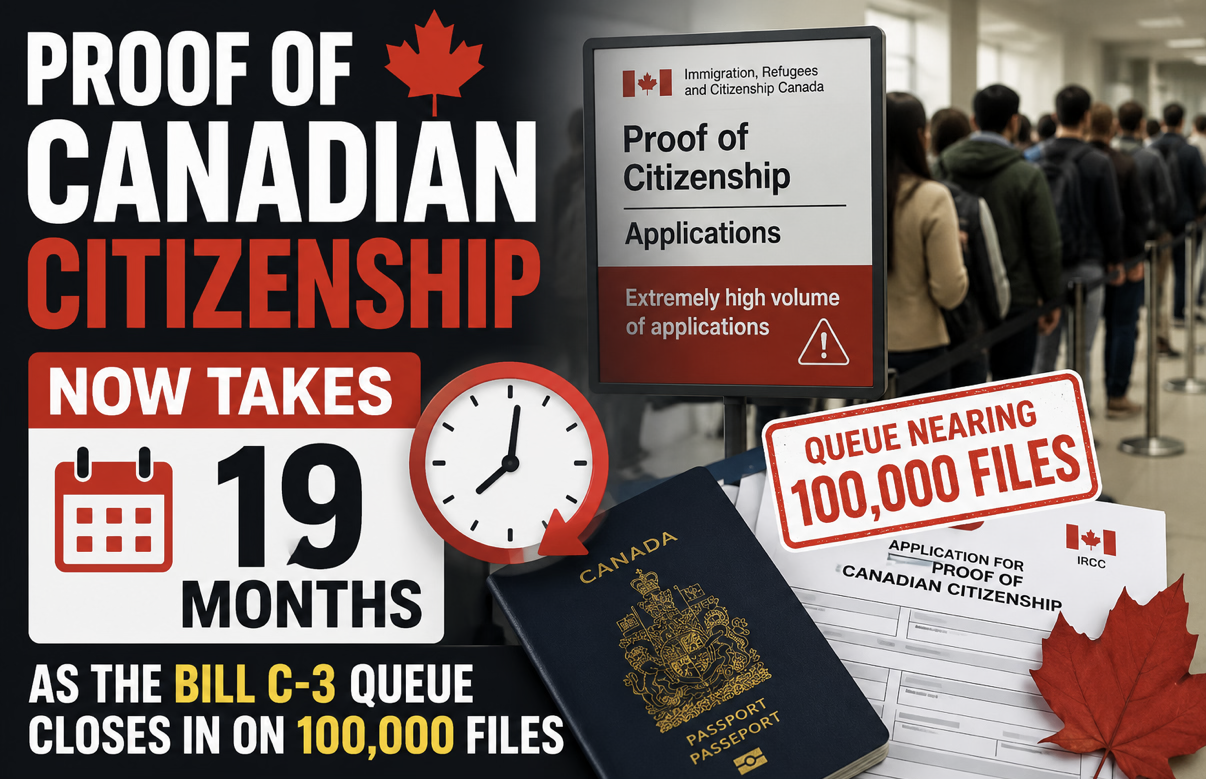
- Proof of citizenship now shows a 19-month processing estimate — roughly double the wait from late 2025.
- IRCC reported 82,020 proof-of-citizenship applications not yet finalized as of May 31, 2026, with more recent reporting putting the queue close to 100,000.
- 28,940 certificates were finalized between January 1 and May 31, 2026.
- The surge traces back to Bill C-3, in force since December 15, 2025, which removed the first-generation limit on citizenship by descent.
- IRCC’s review of roughly 6,500 already-issued descent certificates wrapped up on June 30, 2026.
If you applied for a Canadian citizenship certificate this year, the wait you were quoted at the time is almost certainly no longer the wait you are facing. IRCC’s published estimate for proof of citizenship has climbed to about 19 months — one of the steepest single-category deteriorations anywhere in the department’s processing data, and a direct consequence of a law that opened the door to an enormous new pool of eligible applicants.
Here is what the numbers actually say, why the queue is growing faster than IRCC can clear it, and what applicants can realistically do about it.
What’s in this article
- What changed in the July 2026 data
- The numbers, side by side
- Why the queue exploded: Bill C-3
- The certificate review that paused finalizations
- Citizenship grant vs. proof of citizenship
- A worked example: what 19 months looks like
- What applicants should do now
- Scam warning: nobody can jump the queue
- Frequently asked questions
- Sources
What changed in the July 2026 data
IRCC refreshed its published processing times on July 7, 2026, and followed up on July 21 with an inventory snapshot showing how many applications sit finalized versus waiting. The two releases measure different things, which is worth understanding before comparing any figures you see quoted elsewhere.
Processing times are rolling estimates. They are recalculated against recently completed cases, so they describe how long finished applications actually took — not a promise about your file. Inventory counts, by contrast, are a straight headcount of open applications on a fixed date.
Both moved in the wrong direction for proof of citizenship. The processing estimate reached 19 months. The inventory count showed 82,020 open files as of May 31, 2026, and the queue added roughly 17,500 applicants in a single reporting cycle. Reporting later in July placed the working total near 100,000 — the gap between that figure and the 82,020 snapshot is mostly a matter of the cut-off date, not a contradiction.
The contrast with the rest of the system is stark. Economic permanent residence streams, inland work permits, and several family sponsorship categories all improved in the same release. Proof of citizenship is the outlier.
The numbers, side by side
| Measure | Figure | As of |
|---|---|---|
| Proof of citizenship — published processing estimate | ~19 months | July 2026 |
| Proof of citizenship — same estimate before Bill C-3 | ~9 months | November 2025 |
| Proof of citizenship applications not yet finalized | 82,020 | May 31, 2026 |
| Proof of citizenship applications finalized | 28,940 | Jan 1 – May 31, 2026 |
| Growth in the queue, most recent reporting cycle | ~17,500 | July 2026 |
| Citizenship grant applications not yet finalized | 326,365 | May 31, 2026 |
| Descent certificates reviewed by IRCC | ~6,500 | Review closed June 30, 2026 |
Why the queue exploded: Bill C-3
Before December 2025, Canadian citizenship by descent stopped at the first generation born abroad. If your parent was a Canadian citizen born outside Canada, and you were also born outside Canada, you were generally shut out — regardless of how strong the family connection was.
Bill C-3 removed that limit. Since it came into force on December 15, 2025, a Canadian ancestor further back in the family tree can establish eligibility, provided the statutory conditions are met. The practical effect was to make a very large number of people citizens who had not previously understood themselves to be citizens — a great many of them in the United States.
Recognition alone, though, is not usable. To get a Canadian passport, enrol in provincial health coverage, or prove status to an employer, a person needs a physical citizenship certificate. That means every newly recognized citizen who wants to act on their status has to file a proof-of-citizenship application. The law changed the eligibility rules; it did not change IRCC’s certificate-issuing capacity. The backlog is what sits in that gap.
Notably, IRCC publishes a formal 12-month service standard for citizenship grants but has no equivalent benchmark for proof of citizenship. That absence is part of why this category has been free to swing so widely without triggering the internal pressure a missed service standard would create.
If you’ve been following our earlier coverage of what is happening with Bill C-3, this backlog is the downstream consequence we flagged when the law took effect.
The certificate review that paused finalizations
In mid-2026, IRCC temporarily stopped finalizing new citizenship-by-descent applications while it audited roughly 6,500 certificates it had already issued under the new law, checking whether the supporting documentation held up. Some recipients received letters asking them to return certificates pending that review — an alarming piece of mail to open, and one that generated considerable anxiety.
The review closed on June 30, 2026. The outcome was narrower than the panic suggested:
- 100 certificates were flagged for potentially insufficient documentation.
- 33 were reinstated once IRCC confirmed the underlying evidence supported the claim.
- 67 — roughly one percent of certificates issued under the new law — remained unresolved, with those applicants expected to be reinstated or contacted directly.
In other words, the overwhelming majority of certificates issued under Bill C-3 survived scrutiny untouched. But the pause itself consumed weeks of processing capacity on top of an already-climbing caseload, and that overlap is part of why July’s published wait jumped as sharply as it did.
Citizenship grant vs. proof of citizenship
These two application types get confused constantly, and the distinction determines which queue you are actually in.
| Proof of citizenship | Citizenship grant | |
|---|---|---|
| Who applies | People who are already citizens and need documentation confirming it | Permanent residents becoming citizens for the first time |
| Typical route | Citizenship by descent, including under Bill C-3 | Naturalization after meeting residency requirements |
| Outcome | Canadian citizenship certificate | Citizenship ceremony and certificate |
| Service standard | None published | 12 months |
| Current direction | Deteriorating sharply | Slightly improved |
A worked example: what 19 months looks like
Consider someone who discovers in August 2026 that a Canadian grandparent makes them eligible under Bill C-3, and who needs a Canadian passport for a job starting the following year.
| August 2026 | Begins gathering vital records — the ancestor’s birth certificate, the parent’s documents, the applicant’s own long-form birth certificate. For older or foreign records this stage alone often runs 2–4 months. |
| November 2026 | Application submitted. The 19-month clock starts here, not in August. |
| ~June 2028 | Certificate issued, assuming no request for additional documents. Any request typically resets the applicant to the back of an internal queue. |
| ~July 2028 | Passport application filed. Passport processing is separate and has remained comparatively stable. |
The lesson is that the document-gathering phase is the part applicants control, and it is frequently the part that adds the most avoidable delay.
What applicants should do now
- File as early as you can. The queue is growing, so a file submitted this month sits ahead of one submitted next quarter.
- Order vital records before you apply, not after. Incomplete documentation is the single largest driver of individual-file delay. Provincial vital statistics offices have their own turnaround times — build those into your plan.
- Check your IRCC portal regularly. Requests for additional documents come with deadlines, and a missed deadline is far costlier than the wait itself.
- Do not book non-refundable travel on the assumption a certificate will arrive by a given date.
- Treat published estimates as weather forecasts, not contracts. They are recalculated regularly and describe completed files, not yours.
- If you received a surrender letter during the review and have not heard back, follow up through official IRCC channels rather than third parties.
Scam warning: nobody can jump the queue
⚠️ Be careful who you pay
Long, visible backlogs attract fraud. A 19-month wait combined with millions of newly eligible people is close to ideal conditions for it. Watch for:
- Anyone promising expedited, priority, or guaranteed processing for a fee. No such paid option exists for proof of citizenship.
- Unsolicited emails or texts claiming your certificate is on hold pending a payment. IRCC does not collect fees by text message or e-transfer.
- Websites that mimic canada.ca branding and charge for the free application forms.
- “Consultants” who are not licensed by the College of Immigration and Citizenship Consultants (CICC), or who are not lawyers in good standing with a provincial law society. Licensing is verifiable — check it.
Frequently asked questions
Is the 19-month figure a guarantee?
No. It is a rolling estimate based on how long recently completed applications actually took. Your file may finish sooner or later depending on its complexity and documentation.
Why do some sources say 15 months and others say 19?
Because the estimate is recalculated frequently and different articles were published against different snapshots. The most recent July 2026 reporting places it at approximately 19 months.
Has IRCC resumed finalizing citizenship-by-descent applications?
The review that prompted the pause closed on June 30, 2026, and IRCC indicated finalizations would resume shortly afterward. Confirm current status on IRCC’s official channels before making decisions.
Does the backlog affect citizenship grant applications?
Not directly. Grants and certificates are tracked as separate categories with separate queues. Grant timelines improved slightly in the same release.
I already have a certificate issued under Bill C-3. Should I worry?
The completed review flagged roughly one percent of issued certificates, and a third of those were reinstated on closer examination. If you were not contacted by IRCC, there is no indication your certificate is affected.
Can I apply for a Canadian passport while waiting?
No. A passport application requires proof of citizenship. The certificate has to come first.
Sources
- IRCC, published processing times release, July 7, 2026 — canada.ca
- IRCC, “Inside IRCC’s application processing system,” July 21, 2026 — canada.ca
- Canada.ca, changes to citizenship by descent rules under Bill C-3
- CIC News reporting on the July 2026 proof-of-citizenship figures and the completed certificate review
Disclaimer: This article is journalism, not legal or immigration advice. Immigration rules and processing estimates change frequently. Verify every requirement directly on canada.ca before applying, and consult a licensed immigration lawyer or CICC-regulated consultant for advice on your individual circumstances.
Last updated: July 25, 2026.
Discover more from CanadianUpdates
Subscribe to get the latest posts sent to your email.