
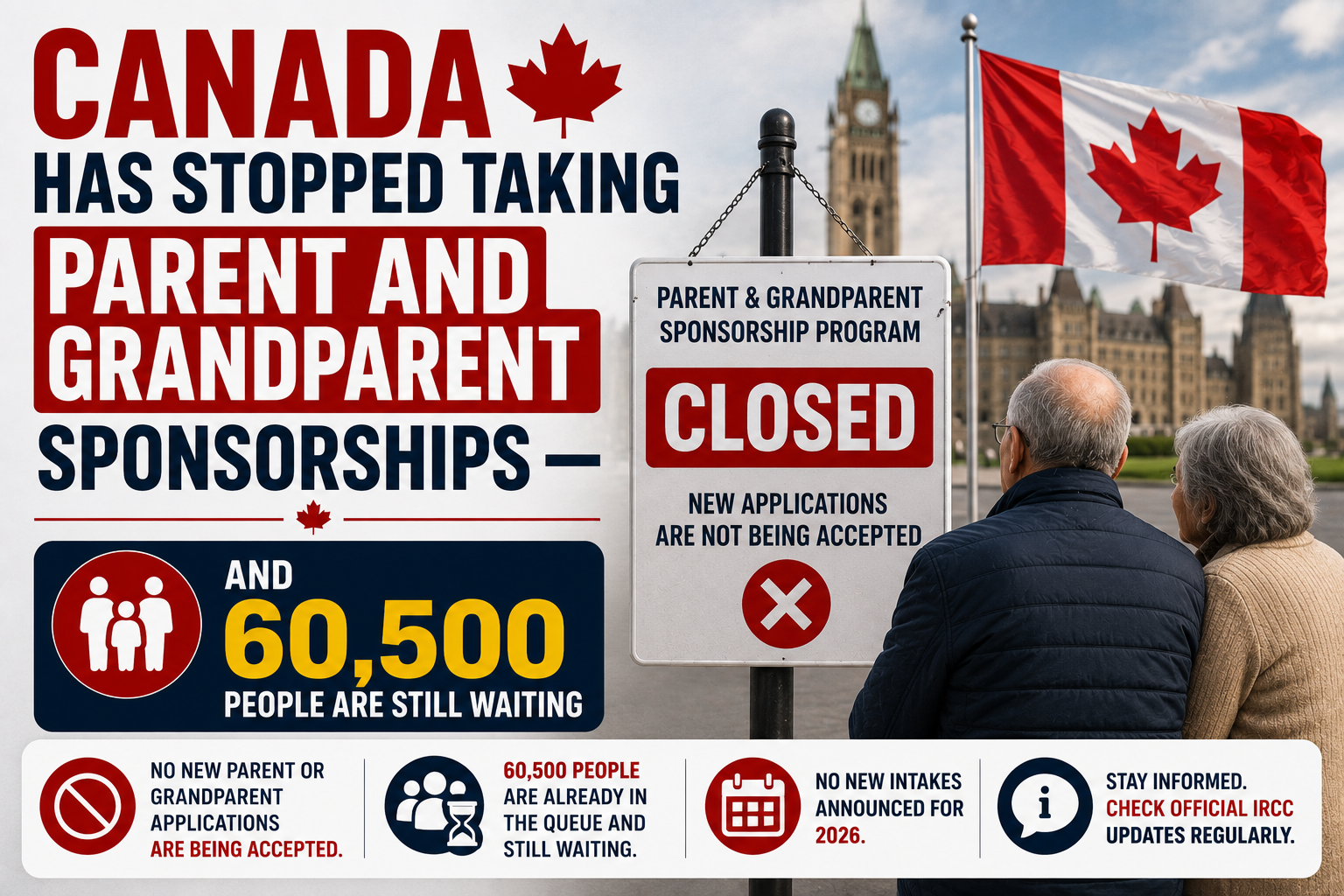
Canada is no longer accepting anyone new into the line to sponsor a parent or grandparent for permanent residence. On July 15, 2026, IRCC said it was pausing intake under the Parents and Grandparents Program, and that it “will not receive new interest to sponsor forms or invite potential sponsors to apply until further notice.” The program page on canada.ca still carries that status today.
That is not a slow month or a closed round. There is no queue you can join right now, at any price, from any country.
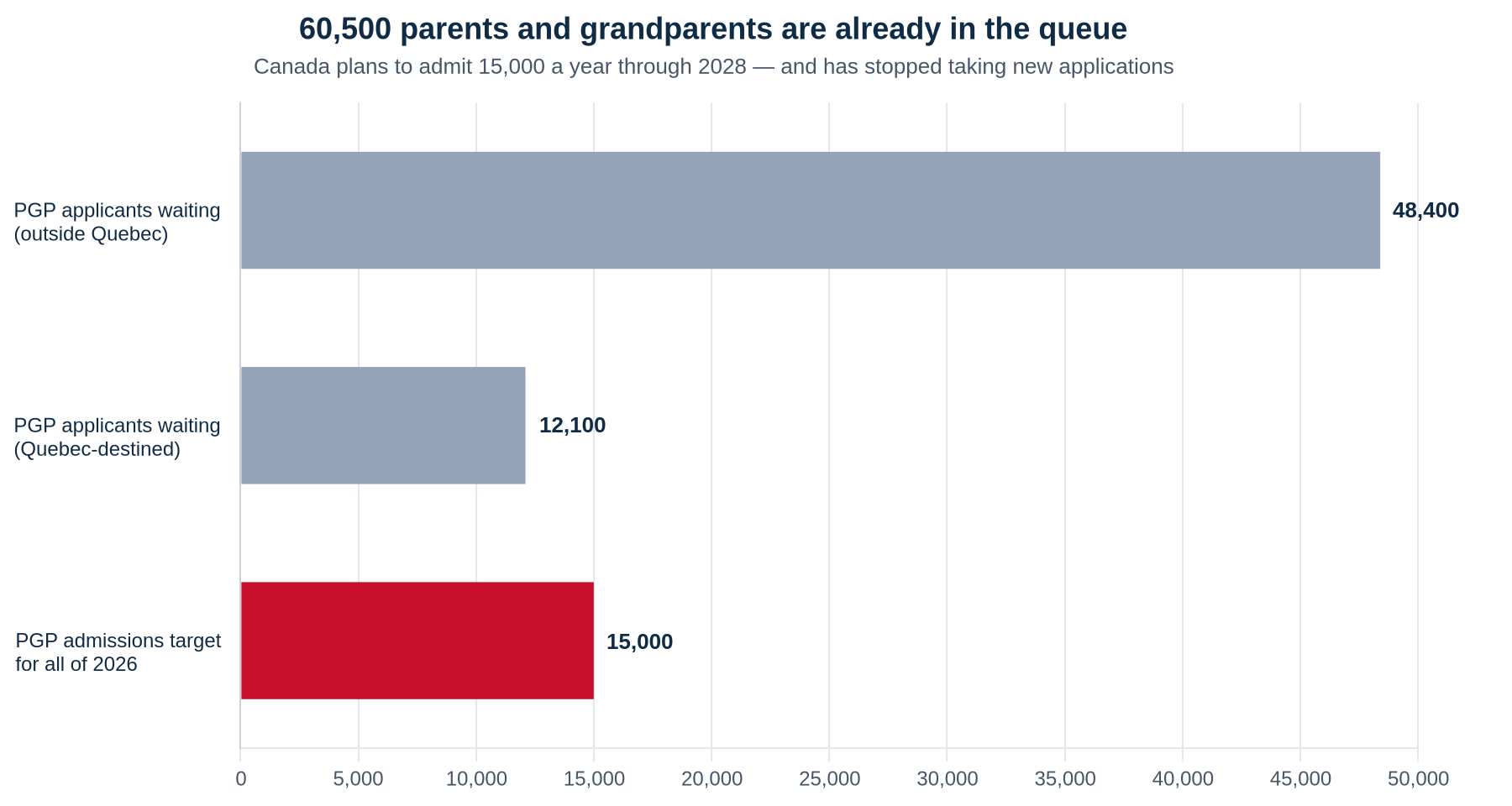
Meanwhile the people already in the system are not going anywhere fast. As of January 31, 2026, IRCC counted roughly 48,400 parents and grandparents waiting for a decision outside Quebec, plus another 12,100 destined for Quebec. Canada plans to admit 15,000 of them per year through 2028.
What IRCC actually announced
Read the notice narrowly, because the wording matters. IRCC paused intake. It did not cancel the program, and it did not touch applications already submitted. Three separate things happen at once:
No new interest to sponsor forms. The form that put you in the pool is not being collected. No new invitations. IRCC is not drawing from the remaining 2020 pool the way it did in past years. Existing applications keep processing. If your file is already in, it stays in and continues toward a decision.
The last time the door opened was July 2025, when IRCC invited 17,860 potential sponsors from the pool of interest to sponsor forms submitted back in 2020, aiming to accept up to 10,000 complete applications. That 2020 pool is the only source IRCC has used for years. If you never filed a form in 2020, you have not been eligible to apply since — the 2026 pause simply makes that permanent for now rather than annual.
The arithmetic is the story
Add the two inventory figures and about 60,500 people are waiting on a PGP decision. Divide that by an admissions target of 15,000 a year and you get roughly four years of intake already sitting on the shelf — before a single new sponsor is added. That is the reason for the pause, and IRCC more or less says so: it is managing the program to the 2026–2028 Immigration Levels Plan.
The levels plan puts the family class at 84,000 admissions in 2026, falling to 81,000 in 2027 and 2028, inside an overall permanent residence target of 380,000 a year. Parents and grandparents get 15,000 of that in each of the three years. Spouses, partners and children get 69,000 in 2026 and 66,000 in each of the next two years. Family reunification is not being cut so much as reweighted — the spousal side is being protected and the parent side is being rationed.
What the wait actually looks like
A parent or grandparent file already moves far more slowly than a spousal one, and Quebec-destined files are in a category of their own.
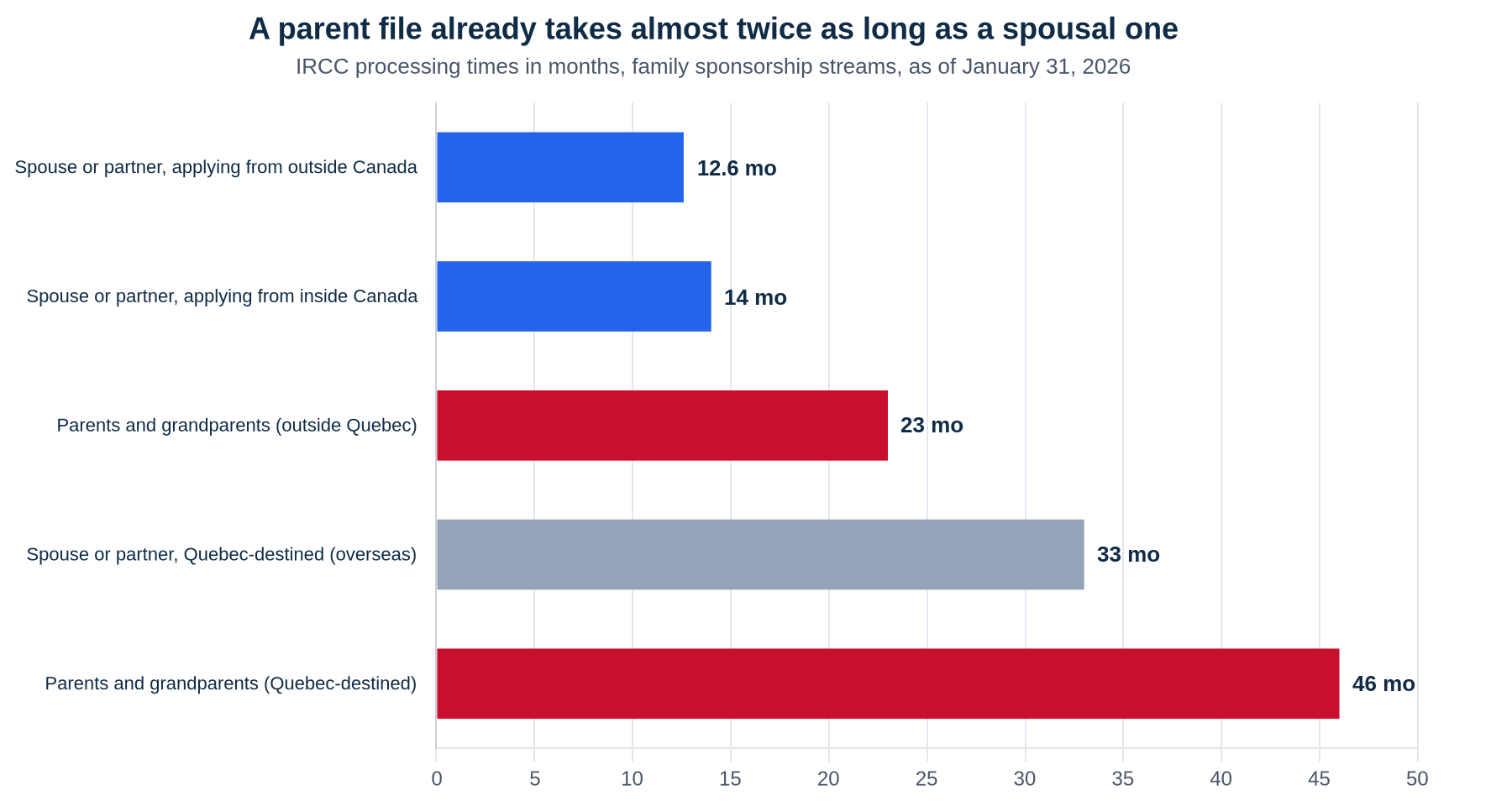
Those are IRCC’s own figures as of January 31, 2026: 23 months for a parent file outside Quebec, 46 months for a Quebec-destined one, against roughly 12.6 months for a spouse applying from overseas. Published times move, so check the current number before you plan around it — we track the pattern in our IRCC processing times breakdown. The takeaway is the ratio, not the decimal: a parent file is a multi-year commitment even after it is accepted.
The super visa is the fallback, and it got easier in March
IRCC’s answer to the pause is the super visa, and it is a real answer — Canada issued roughly 52,900 of them in 2025. It is a visitor visa, not permanent residence, but it lets a parent or grandparent stay for five years at a time and apply for two-year extensions from inside Canada.
Two changes took effect on March 31, 2026 that most people applying today still do not know about. First, you can now meet the income requirement using either of the two taxation years immediately before you apply — one weak year no longer sinks the application. Second, if you meet a required minimum share of the income yourself, your visiting parent’s or grandparent’s own income can be added to cover the rest. IRCC applied both to files already in processing on that date, not only to new ones.
What has not changed
The insurance requirement is unchanged and it is where applications fail. You need medical coverage of at least $100,000, valid for a minimum of one year from the date of entry, covering health care, hospitalization and repatriation. It must come from a Canadian insurer or from an insurer outside Canada that the Minister has approved — a travel policy from any foreign company will not do. Applicants also need an immigration medical exam.
Income is measured against the low income cut-off for large urban areas. The table canada.ca currently publishes runs from $30,526 for a family of one to $56,724 for a family of four. Count the visiting parents in your family size — that is the step people get wrong.
What to do about it
If you already have a PGP application in: do nothing dramatic. Keep your address, marital status and family composition updated with IRCC, keep your income documentation current in case they ask, and expect the wait shown on the processing times page rather than the one you were quoted in 2025. Withdrawing now means losing a place you cannot get back.
If you were waiting for the 2026 round: there isn’t one, and no one can register you for it. If a consultant offers to submit an interest to sponsor form, put you on a priority list, or reserve a spot for the reopening, that is a sale, not a service — IRCC is not collecting those forms. This is the same pattern we saw when the Hong Kong PR pathways closed: the official page said closed while third-party sites kept taking applications.
If you need your parents here soon: build the super visa file properly instead of waiting. Get the insurance quote first, because a compliant $100,000 policy is the expensive part and it determines whether the rest is worth assembling. Then pick your stronger of the last two tax years, and check whether your parent’s income closes any gap.
If your income is borderline: the March change may have already fixed your problem. A refusal from 2025 on income grounds was decided under the old single-year rule, and a fresh application now is assessed under the new one. That is worth a second look with a licensed representative before you assume the answer is still no.
Where this goes next
“Until further notice” is doing a lot of work in that notice. IRCC has not committed to a reopening date, and the arithmetic argues against a quick one: at 15,000 admissions a year against a 60,500-person inventory, the queue does not clear inside the current levels plan. The realistic trigger for reopening is the inventory falling far enough that a new intake would not immediately rebuild it — which is the same logic that has kept other backlogged streams shut, as with the proof of citizenship queue.
Watch three things. The next levels plan, due in the fall, will show whether 15,000 holds or moves. The published PGP processing time is the cleanest public signal of whether the inventory is actually shrinking. And watch the economic side of the ledger — Canada has kept inviting selectively there even while family intake tightens, as this week’s CRS 198 draw for physicians showed. The department is not slowing down across the board. It is choosing.
Related reading
- Canada’s 2026 study permit cap is 408,000 — and Ontario and Quebec hold two thirds of the spaces
- The CEC cut-off climbed 16 points since March: Express Entry in September 2026
- The future of immigration in Canada, 2026
Figures in this post are current as of September 4, 2026. Inventory and processing time figures are IRCC’s own, as of January 31, 2026; admissions targets are from the 2026–2028 Immigration Levels Plan. The combined inventory total of about 60,500 and the resulting “roughly four years” estimate are our arithmetic from IRCC’s separate published figures, not numbers IRCC publishes in that form. Processing times and income tables change without notice — verify every figure on canada.ca before you act on it. This is general information, not legal advice. For advice on your own file, consult a licensed immigration lawyer or an RCIC in good standing with the CICC.
Discover more from CanadianUpdates
Subscribe to get the latest posts sent to your email.