
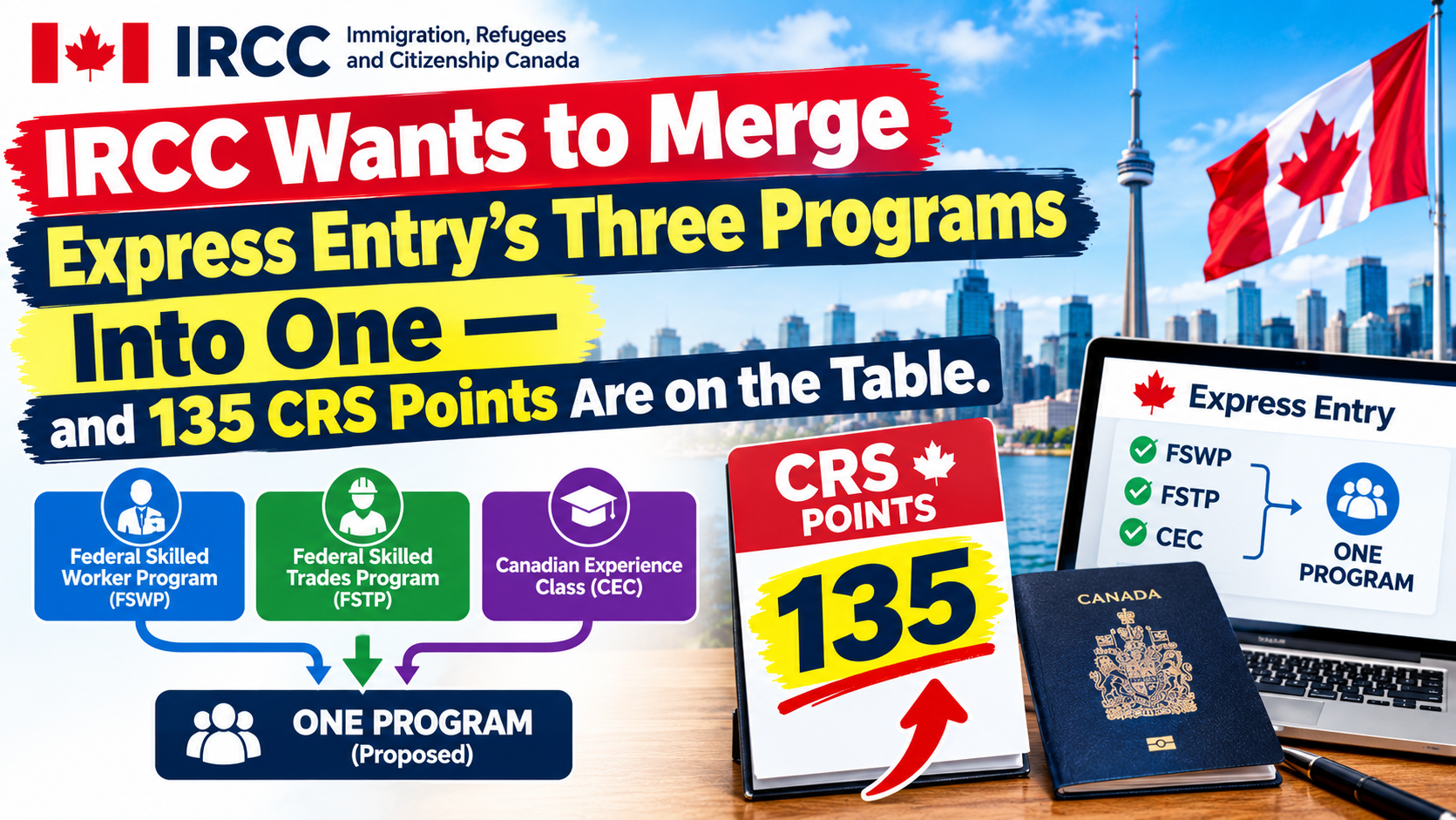
IRCC has put the architecture of Express Entry itself on the table. Its 2026 consultation proposed collapsing the Canadian Experience Class, the Federal Skilled Worker Program and the Federal Skilled Trades Program into a single program, and rebuilding the Comprehensive Ranking System around evidence about which candidates actually do well in the Canadian labour market.
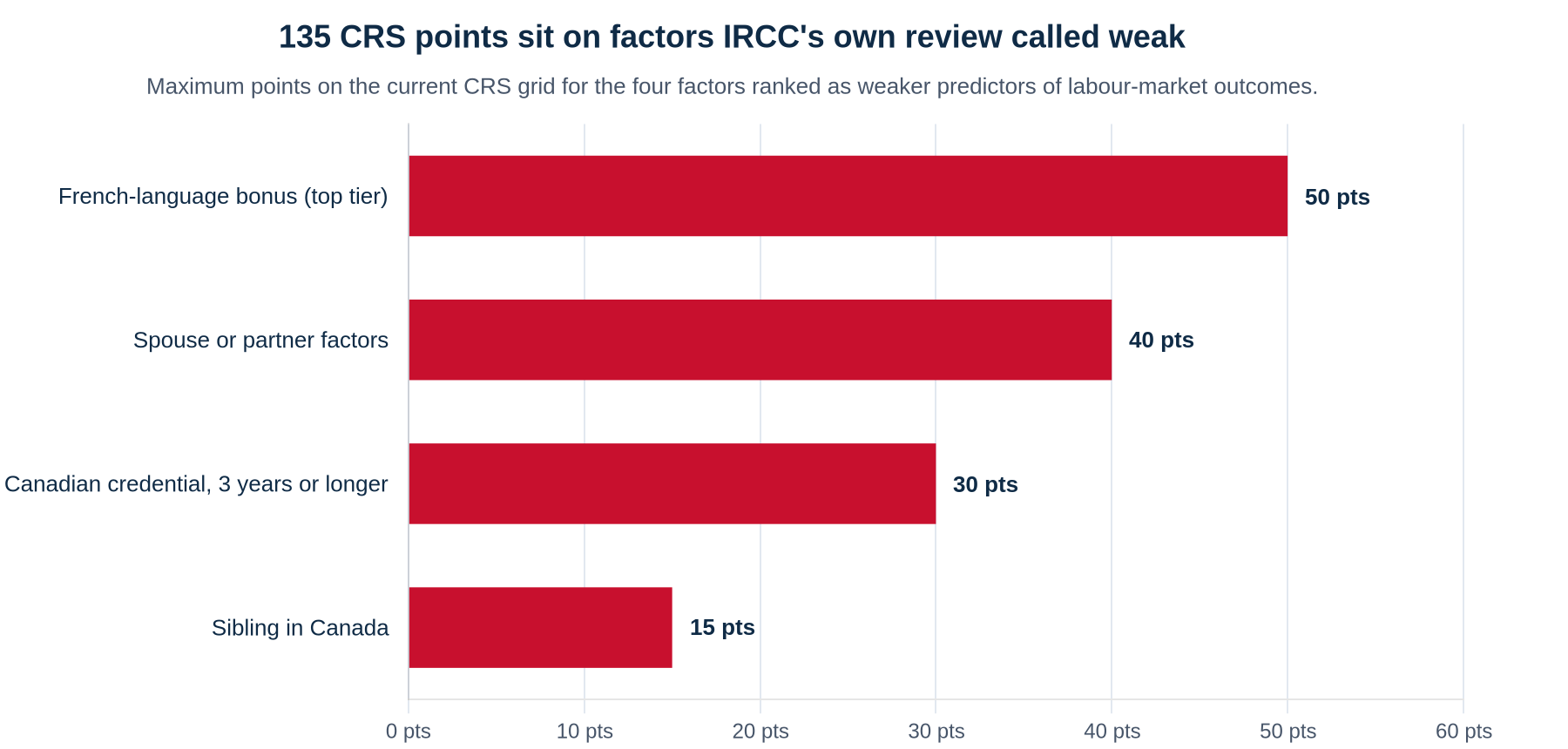
Four CRS factors were named as weaker predictors of those outcomes: spousal points, the sibling-in-Canada bonus, the French bonus, and points for studying in Canada. Together those are worth up to 135 points on the current grid. If you built your plan around any of them, this is the document to read.
Nothing has changed. The consultation closed on May 24, 2026, no reform has been enacted, and IRCC says any program change will be published in the Canada Gazette before it takes effect. But this is the clearest signal yet of the direction, and it arrives as the 2027–2029 Immigration Levels Plan is due to be tabled this fall.
One program instead of three
The three federal economic programs inside Express Entry have always had different front doors. The proposal replaces them with one set of minimum criteria:
- Education: “Canadian high school or foreign equivalent”
- Language: “intermediate language ability in reading, writing, speaking, and listening – Canadian Language Benchmarks (CLB) / Niveaux de compétence linguistique canadien (NCLC) 6”
- Work experience: “1 year of skilled work experience in Canada or elsewhere in the past three years” at TEER 0–3
Read that against what exists today and it cuts in two directions at once.
For Federal Skilled Worker candidates, the language bar drops. FSW currently requires CLB 7 in all four abilities — below CLB 7 you are simply not eligible. The proposed floor is CLB 6. The FSW 67-point selection grid, a separate hurdle before you even reach the CRS, is not part of the proposed minimums.
For Canadian Experience Class candidates, a new bar appears. CEC today has no education requirement at all. Under the proposal, everyone needs at least a high school credential. And CEC’s defining feature — that the year of experience must be Canadian — dissolves, because the merged criteria accept a year of skilled work “in Canada or elsewhere.”
That last point is the structural change hiding inside a tidy bullet list. Canadian work experience would stop being an entry ticket and become a scoring factor like any other.
What IRCC says actually predicts success
The more consequential half of the consultation is the CRS reweighting, which IRCC frames as following the evidence on employment outcomes rather than on assumptions about merit. It sorts the factors into three tiers.
Strongest predictors
“Strong language skills in English, or both English and French,” and “high earnings as a temporary resident.” The second is striking. It is not a factor the CRS currently scores directly, and it implies a system that looks at what you were actually paid in Canada rather than what your credentials suggest you might earn.
Moderate predictors
“Canadian work experience,” “a Canadian job offer,” “education at the university level,” and “younger age.” These are the load-bearing pillars of the current CRS, and the review places them in the middle tier rather than the top.
Weaker predictors
“Spousal points (for a spouse’s education, language skills, and Canadian work experience),” “sibling in Canada points,” “French bonus points,” and “education in Canada points.”
On today’s grid those carry up to 40, 15, 50 and 30 points respectively — 135 in total, and that is our addition of IRCC’s published maximums, not a figure IRCC has stated. The consultation does not propose removing any of them. It says the evidence ranks them weakest, which is the sort of sentence that precedes a reweighting.
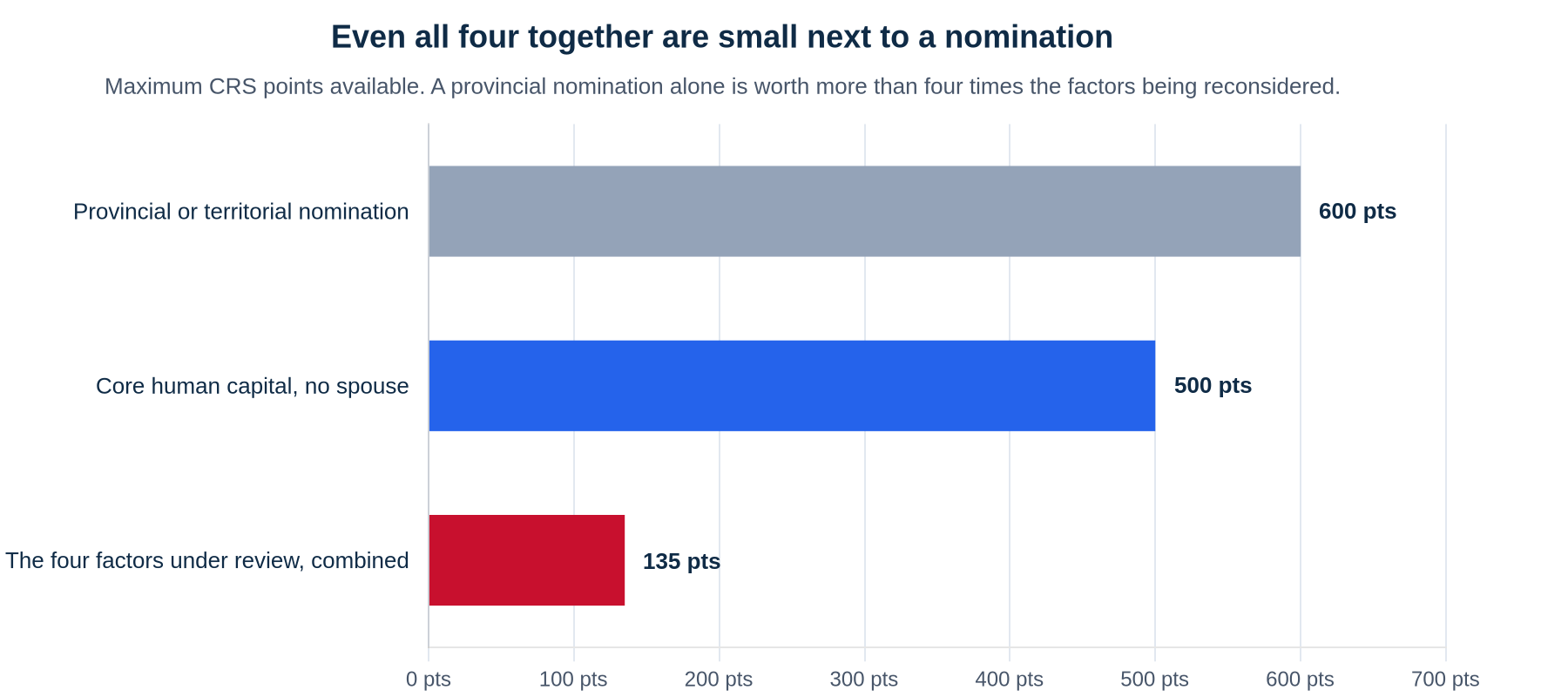
Keep the scale in view. A provincial nomination is worth 600 points on its own, and core human capital tops out at 500 without a spouse. Even the maximum possible swing from all four flagged factors is smaller than either. For most candidates the practical effect of losing one of them is a handful of points, not a collapse — though at a tight cut-off, a handful of points is the whole story.
Job offer points may come back, narrowed
IRCC removed CRS points for a job offer in March 2025. The consultation proposes bringing them back, but “only for job offers in high-wage occupations,” alongside new points for Canadian work experience in a high-wage occupation.
The definition on offer is a comparative one: an occupation where the median wage is higher than the median wage of all Canadians. That is a moving line, recalculated as wages move, and it means the value of your job offer would depend on where your occupation sits against the national median in the year you are assessed — not on having an offer at all.
It also fits the pattern visible elsewhere in the system, where eligibility increasingly turns on wage level and location rather than on occupation alone — the same logic behind the 30 cities where low-wage LMIAs are frozen this quarter.
Why this is landing now
A second consultation ran from May 12 to June 30, 2026, on immigration levels, feeding the 2027–2029 plan due to be tabled in fall 2026. Its stated targets: reduce the temporary population to less than 5% of Canada’s population by the end of 2027, and keep permanent resident admissions below 1% of the population after 2027.
Those two consultations are the same project seen from different ends. If the number of permanent residents admitted is being held down, the question of which candidates get selected carries more weight, not less. Reweighting the CRS is how a department changes who gets in without changing how many.
It is the same dynamic that has already reshaped the study and work streams, from the 408,000-permit study cap to the frozen PGWP field-of-study list.
What this means for you
Nothing has changed today. The current programs, the current minimums and the current CRS all still apply. Do not withdraw a profile, delay a test or restructure an application on the strength of a consultation document.
If your score leans on the flagged factors, know how much it leans. Add up what you currently draw from spousal points, a sibling in Canada, the French bonus and a Canadian credential. That total is your exposure if the weights move. Knowing the number beats worrying about it.
Language remains the safest investment. It sits in the top tier of the review, it is already the largest single block of core human capital points, and it is the one factor you can still improve by your own effort. A retest is the highest-leverage thing most candidates can do.
French speakers should not panic. The bonus was ranked a weak predictor of earnings. That is a statement about labour-market outcomes, not about francophone immigration policy, which is driven by separate targets and separate legislation. No proposal to remove the bonus has been made.
Watch the Canada Gazette, not the forums. IRCC has said plainly that any program change will be published there. Until a regulatory amendment appears, everything else is a proposal, a leak or a guess.
What to watch next
Three things, in order. The 2027–2029 Levels Plan, tabled this fall, sets the volume the selection system has to work within. A Canada Gazette Part I publication would be the first binding sign that consolidation is real, and would open a comment period. And a change to the CRS grid on canada.ca is what actually moves scores — the grid is the law of the pool, and it is amended without ceremony.
What nobody can tell you is when, or in what final shape. IRCC has published options and an evidence base, not a decision. Anyone giving you a date for the new CRS is inventing it.
Related reading
- The CEC Cut-Off Climbed 16 Points Since March: What Express Entry Actually Looks Like in September 2026
- CRS 198 This Week, Canada Invited Physicians. Here Is Who That Actually Applies To.
- Canada’s 2026 Study Permit Cap Is 408,000 — And Ontario and Quebec Hold Two Thirds of the Spaces
- IRCC Finished 31,980 Citizenship Proofs in Six Months. 99,520 Are Still Waiting.
Proposals, quoted criteria and predictor rankings in this article are from IRCC’s archived “2026 consultations on potential Express Entry reforms” page, which ran April 23 to May 24, 2026, and its archived “2026 consultations on immigration levels” page, which ran May 12 to June 30, 2026, both retrieved September 8, 2026. CRS point values and Federal Skilled Worker and Canadian Experience Class minimum requirements are as published on canada.ca and retrieved the same day. The 135-point total is our addition of IRCC’s published maximums, not an IRCC figure. None of these proposals is in force, and no implementation date has been announced. This article is general information, not legal advice. For guidance on your own case, consult a licensed immigration lawyer or an RCIC, and verify current requirements on canada.ca before you act.
Discover more from CanadianUpdates
Subscribe to get the latest posts sent to your email.