
IRCC’s own page says it in one line: “For 2026, we won’t add or remove any eligible fields of study.” That sentence governs whether hundreds of thousands of college programs in Canada lead to a work permit or to a plane ticket home. The list it refers to holds 920 fields of study, fixed on July 4, 2025, and nothing you do between now and January will get your program added to it.
The field of study requirement is the single most misread rule in the international student system. It does not apply to everyone. It has nothing to do with how good your college is, and nothing to do with whether your school appears on the designated learning institutions list. It turns on a six-digit code.
Here is how the post-graduation work permit actually works in September 2026, which graduates the field of study rule catches, and the two places people lose a PGWP they thought they had.
Who the field of study rule actually catches
The requirement attaches to the date you applied for your study permit, not the date you graduate. If you applied for your study permit on or after November 1, 2024, and you did not graduate with a degree, your program’s field of study has to be on IRCC’s eligible list.
Four groups are exempt outright. Graduates of a bachelor’s, master’s or doctoral degree do not need to meet the field of study requirement at all. Graduates of PGWP-eligible flight schools are exempt. Anyone who submitted their PGWP application before November 1, 2024 is exempt regardless of level of study. And anyone whose study permit application predates November 1, 2024 is outside the rule.
That leaves the group the rule was built for: college, polytechnic and other non-university graduates, plus students in non-degree university programs, who applied for a study permit from November 2024 onward. Those students are now reaching graduation in volume. This is the first full graduating season where the rule bites.
“My college is PGWP-eligible” is not the same claim
This is the error that costs people the most. Institutional eligibility and program eligibility are separate tests, and clearing one tells you nothing about the other. Your school can be a designated learning institution whose graduates qualify for PGWPs while your specific diploma falls outside the 920 fields. Recruiters blur this constantly, because “we’re a PGWP-eligible college” is technically true and sells better than “check your CIP code.”
The code is what matters. IRCC uses six-digit Classification of Instructional Programs codes based on the CIP Canada 2021 standard. Your institution knows yours. Ask for it in writing, then check it against IRCC’s currently eligible list yourself — the eligible fields cluster in health care and social services, education, agriculture and agri-food, STEM, trades and transport.
What the July 2025 rebuild did, and why the freeze matters
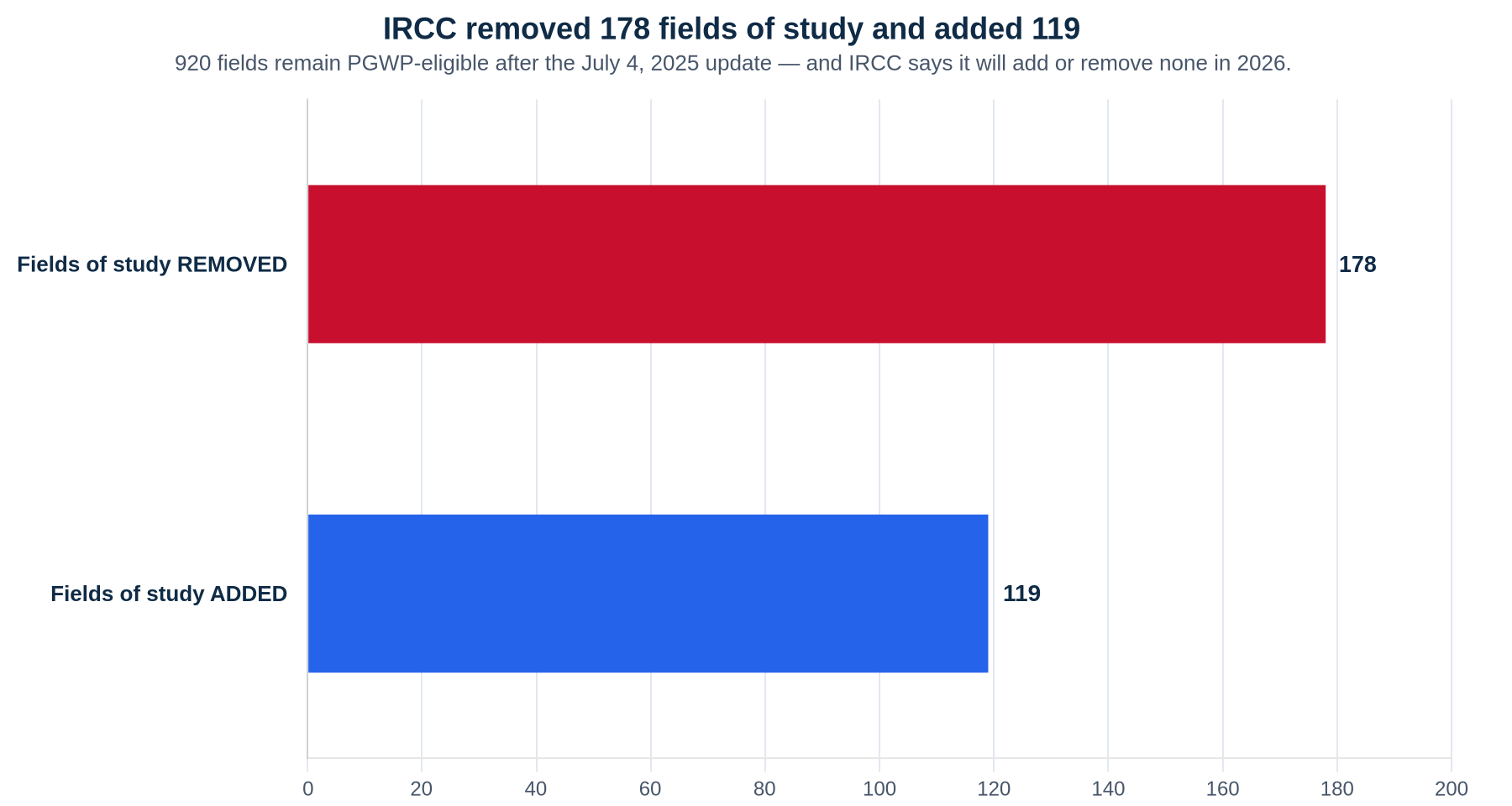
On July 4, 2025, IRCC rewrote the list. It added 119 new fields in health care and social services, education and the trades, and removed 178 fields it said were “no longer linked to occupations in long-term labour shortages.” The result was 920 eligible fields of study.
More programs left the list than joined it. The additions were concentrated in sectors Ottawa wants staffed; the removals fell on everything else.
The freeze cuts both ways, and it is worth being precise about which way it cuts for you. If your program is on the list, 2026 is a year of certainty — it cannot be removed out from under you. If your program is off the list, there is no appeal, no review and no add cycle to wait for this year. Waiting is not a strategy. Switching programs, or switching to a degree, is.
The language test is where degree holders get caught
Being exempt from the field of study requirement does not make you exempt from everything. If you submitted your PGWP application on or after November 1, 2024, you need a language test result, and the level depends on what you studied.
Bachelor’s, master’s and doctoral graduates need Canadian Language Benchmarks 7 in English, or NCLC 7 in French, in all four abilities. So do graduates of other university programs. College, polytechnic and non-university graduates need CLB or NCLC 5 in all four. Flight school graduates need no language test.
Note the shape of that. The graduates exempt from the field of study rule face the higher language bar, not the lower one. A master’s graduate who assumed a degree carried them past every requirement can still be refused on a reading score. All four abilities means all four — a strong overall band does not rescue a weak listening result.
The pipeline behind all of this is emptying
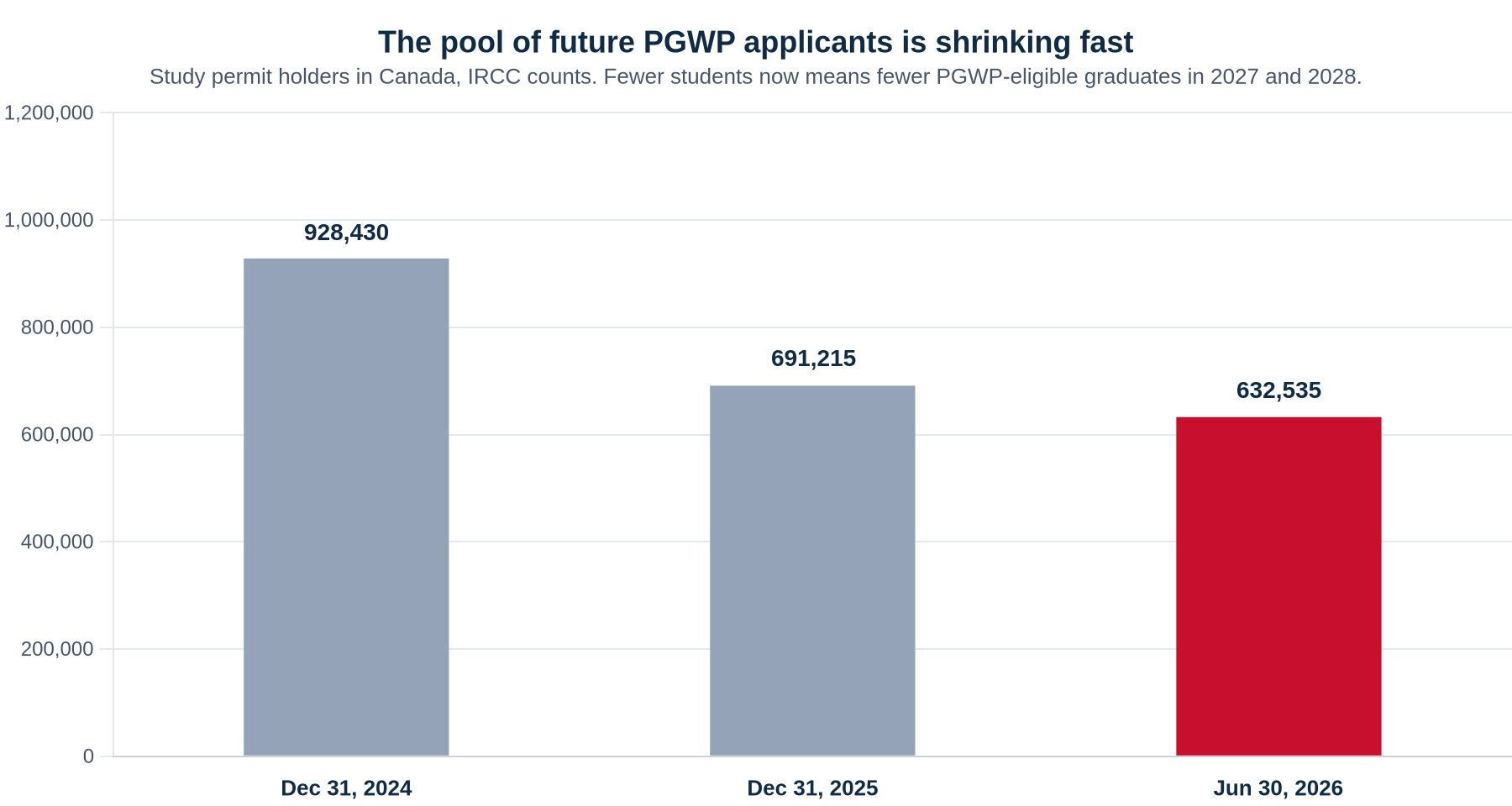
IRCC counted 928,430 study permit holders in Canada at the end of 2024, 691,215 on December 31, 2025, and 632,535 on June 30, 2026. New arrivals have fallen harder than the stock: IRCC reports 177,595 fewer new international students in 2025, and 22,405 student arrivals in the first half of 2026 against a 2026 target of 155,000.
Those two facts belong together. A shrinking student population combined with a frozen eligibility list means the number of graduates walking into a PGWP will keep falling through 2027 and 2028 — which is the point of the policy, not a side effect. It is also why the 2026 study permit cap and the collapse in study permit decisions by country matter to people already here, not just to applicants abroad.
What to do about it
If you are still choosing a program: get the CIP code before you pay a deposit, in writing, and verify it on IRCC’s currently eligible fields page yourself. Do not accept “our programs are PGWP-eligible” from a recruiter. If the institution will not give you a code, treat that as the answer.
If you have already graduated: you have up to 180 days after you graduate to apply, and if your study permit expires first, up to 90 days after that expiry. You can apply from inside or outside Canada. Do not sit on it — the 180 days is a hard edge, not a guideline.
If your program is not on the list: stop looking for a workaround and start looking at the alternatives. A degree program restarts you under the exemption. Provincial nomination, an employer-supported work permit, or a spousal route may be open to you — our breakdown of the spousal open work permit rules covers one of them. None of these are quick, which is why finding out now beats finding out at graduation.
If you are booking a language test: book it before you need it. Know your bar — CLB 7 for any university program including degrees, CLB 5 for college and non-university programs — and leave time to retake. A PGWP is issued once, for a maximum of three years, and only for as long as your passport is valid. If your passport expires in eighteen months, that is the permit you will get.
What to watch
January. The freeze is stated for 2026 only, which means the next revision window opens in 2027, and the July 2025 pattern — additions where Ottawa sees shortages, removals everywhere else — is the best available guide to what it will look like. IRCC has not committed to a review date, and nothing on canada.ca promises one.
Watch the sectors, too. The 119 additions went to health care, social services, education and the trades. That is the same signal running through where Express Entry cut-offs have landed this year and through provincial nomination streams: Ottawa is no longer selecting for education generally, it is selecting for specific occupations. The PGWP list applies that policy two years earlier in a person’s life — at the point where they choose a program, not the point where they apply for permanent residence.
Which is the honest summary. The PGWP is no longer a reward for finishing a Canadian credential. It is a reward for finishing a Canadian credential Ottawa has decided it wants.
Related reading
- Canada’s 2026 Study Permit Cap Is 408,000 — And Ontario and Quebec Hold Two Thirds of the Spaces
- Study Permit Refusal Rates by Country: Fell 67% in Two Years
- The Same Study Permit Takes 2 Weeks From France and 51 Weeks From Iran
Figures verified against Government of Canada sources as of September 7, 2026: IRCC’s post-graduation work permit eligibility, field of study requirement, currently eligible CIP codes, about and how-to-apply pages on canada.ca; the IRCC notice “Update on field of study requirement for post-graduation work permits”; the IRCC Deputy Minister Transition Binder 2026 chapter on the International Student Program; and the canada.ca page “Understanding student and temporary worker numbers in Canada.” Two cautions. IRCC’s transition binder says study permit holders “decreased by 29% year-over-year,” but the two figures it publishes — 928,430 at the end of 2024 and 691,215 on December 31, 2025 — work out to about 26% by our arithmetic; we have quoted both rather than picking one. And the 920 total is IRCC’s figure as of the July 4, 2025 update; because IRCC says it will make no changes in 2026 it should still hold, but IRCC does not restate a running total on the current list page. This article is general information, not legal advice. Immigration rules change frequently and individual circumstances differ. Consult a licensed Canadian immigration lawyer or an RCIC before acting on anything here, and verify current requirements on canada.ca.
Discover more from CanadianUpdates
Subscribe to get the latest posts sent to your email.