
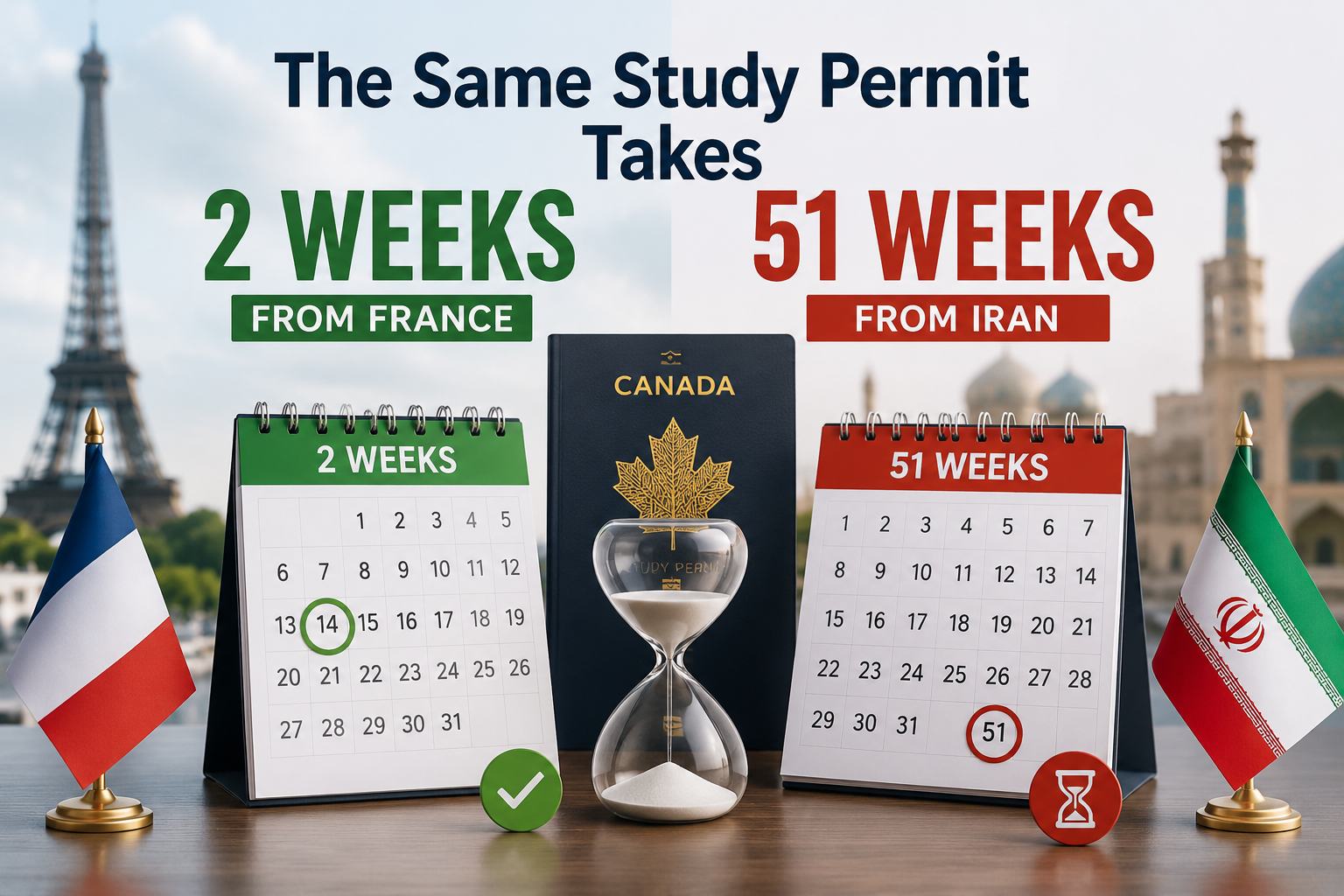
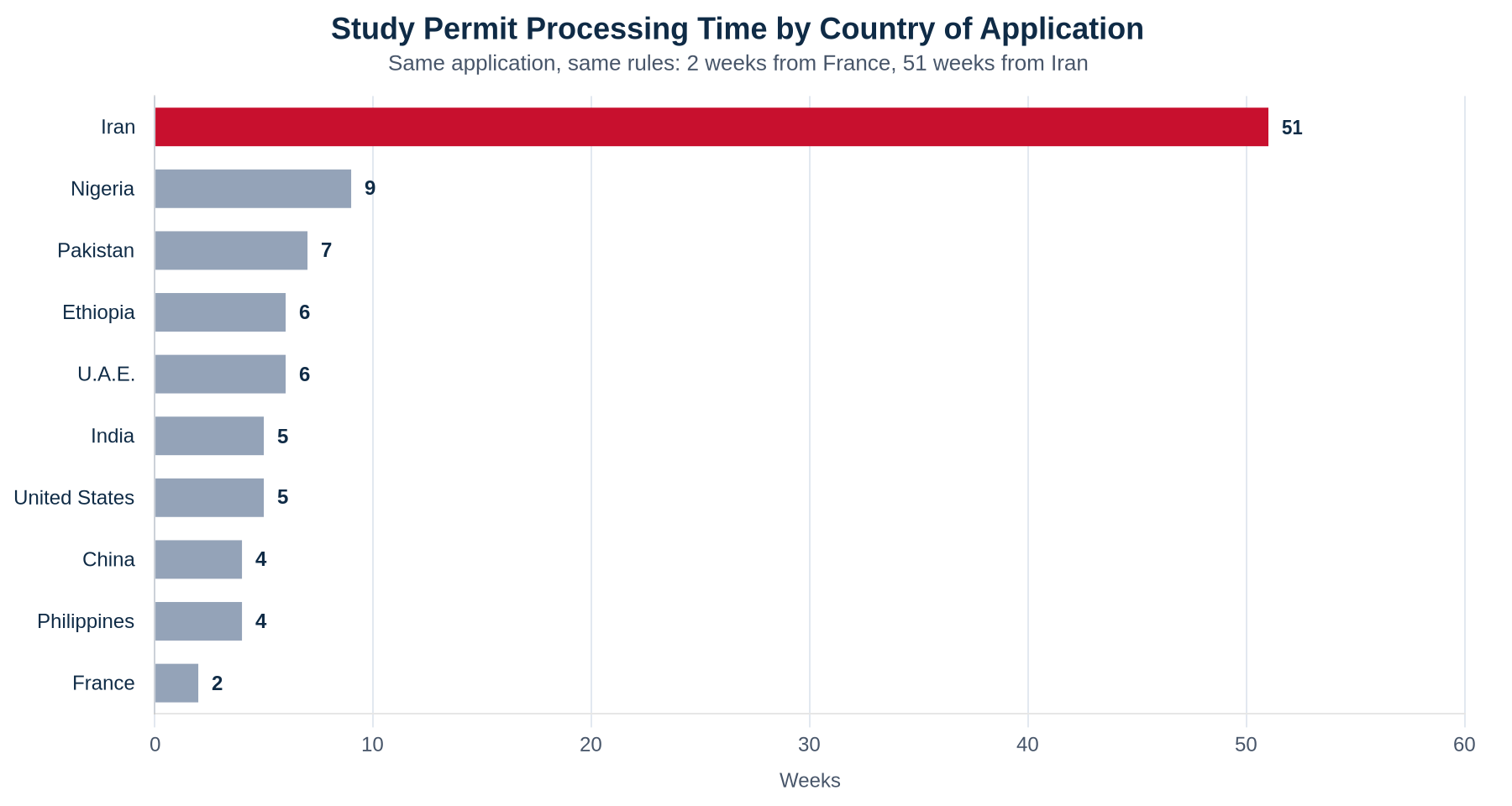
IRCC updated its processing time estimates on September 2, 2026. A study permit filed from France is now estimated at 2 weeks. The same study permit filed from Iran is estimated at 51 weeks. That is a 49-week gap on an application with identical rules, identical forms and an identical fee.
This matters because the number drives real decisions. People pick intake dates, defer offers, quit jobs and book flights against it. Most of them assume it describes how long their file will take. It does not. It describes how long the slowest of eight in ten past applicants waited at one particular visa office.
Here is what the estimate is actually measuring, why the spread between offices is so wide, and what you can and cannot do about the queue you are in.
What the number actually measures
IRCC is explicit about the method. It calculates the estimate “by checking how long it took us to process 80% of that type of application in the past.” For temporary residence applications — study permits, work permits, visitor visas — it looks back over 8 to 16 weeks of completed files. For permanent residence it uses 6 months.
Three consequences follow, and all three get missed.
It is a rear-view mirror, not a forecast. A 5-week estimate means eight in ten people who already finished waited 5 weeks or less. If the office’s workload changed last month, the number has not seen your queue yet.
It is the 80th percentile, not the average. Two in ten applicants took longer than the posted figure, and IRCC does not publish how much longer. If you land in that fifth of the queue, you are not delayed in any official sense. You are inside the normal range.
And it is the whole clock, not part of it. IRCC states the processing time “includes the time it takes to give your biometrics.” More on that below, because it is the single most common piece of bad advice on this topic.
The gap is between offices, not applicants
Widen the study permit list and the pattern holds: Mexico, South Korea and Japan at 3 weeks; China, Vietnam, the UK, Brazil and Ghana at 4; Bangladesh, Nepal and Kenya at 5; Morocco, Algeria and Colombia at 6.
Nothing in that ordering reflects applicant quality. It reflects the volume of applications a given office is holding, the staffing it has to clear them, and how much of its intake needs background and security screening that runs outside the visa office entirely. Iran’s 51 weeks is the clearest case: Canada closed its visa office in Tehran in April 2012 and has not reopened it, so those files are handled from elsewhere and carry screening steps most other caseloads do not.
Be honest about the limit, though: IRCC publishes the outcome, not the cause. It releases no per-office inventory or staffing data, so nobody outside the department can say why one office moved and another did not.
Where you apply from, not what passport you hold
The figures are keyed to the country you apply from, which is generally where you legally reside — not your citizenship. A Nigerian citizen lawfully resident in the United Kingdom is in the UK queue. That is a genuine planning fact, and it is also where a lot of dangerous advice starts: misrepresenting where you live to reach a faster queue is misrepresentation, with the consequences that carries. If your residence is genuinely changing anyway, the queue changes with it.
The stream matters as much as the office
The office is only half of it. Run the same countries for work permits and the ranking scrambles.
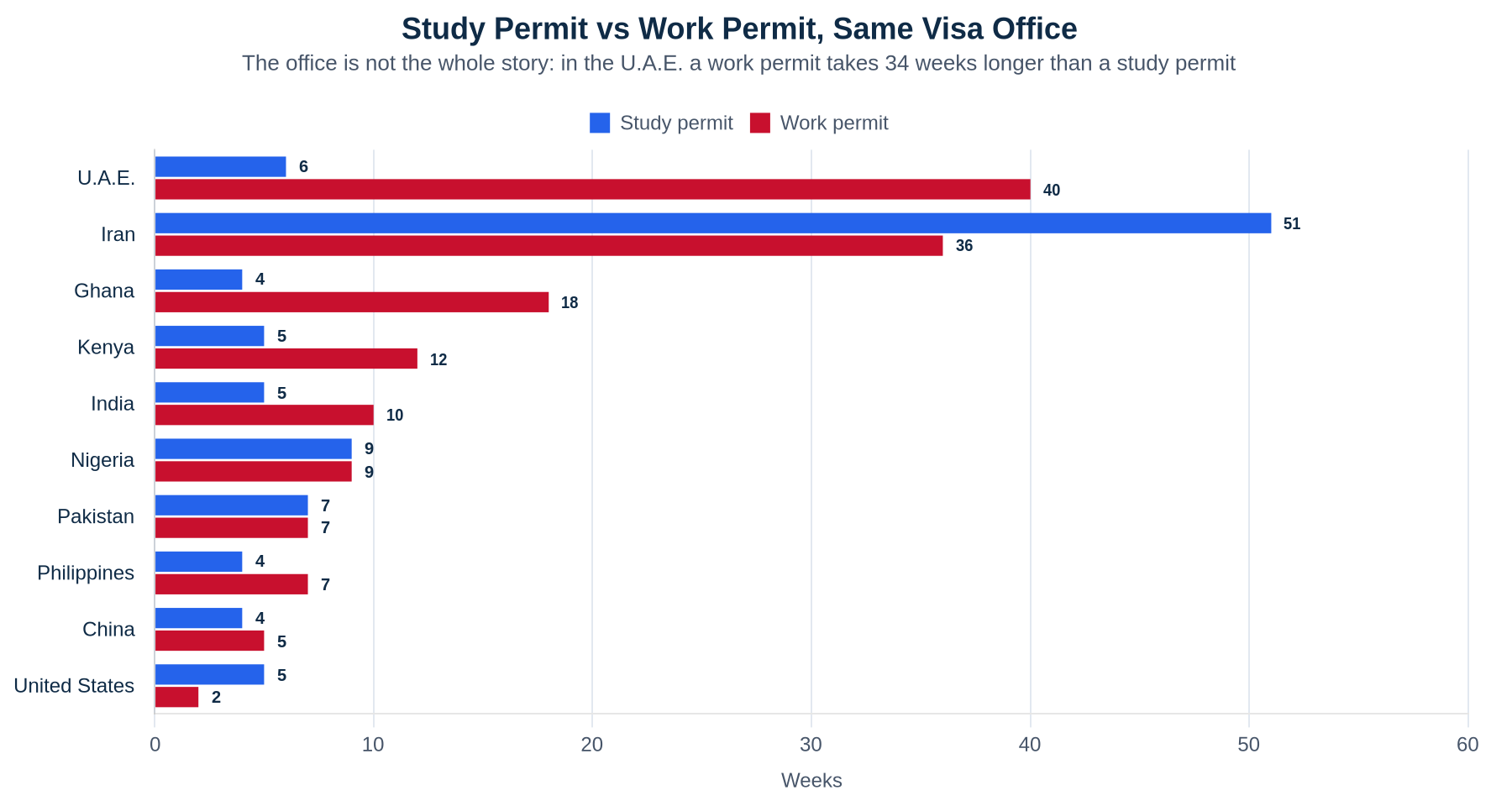
The United Arab Emirates processes a study permit in 6 weeks and a work permit in 40 — a 34-week difference at the same office. Ghana runs 4 weeks for study and 18 for work. Kenya, 5 and 12. The United States is the only one of these where the work permit is faster than the study permit, at 2 weeks against 5.
So a friend’s timeline tells you almost nothing unless they applied from your country and in your stream. Both have to match.
Visitor visas split the same way: 18 days from the Philippines, 31 from India, 78 from Pakistan, 80 from Nigeria. Super visas run longer — 66 days from India, 93 from the Philippines, 139 from Pakistan.
The advice circulating online that is simply wrong
You will see it repeated constantly in forums and on consultant social accounts: the processing clock starts after you give biometrics. It does not. IRCC’s own processing times page says the estimate “includes the time it takes to give your biometrics.”
That is not a technicality. If you believe the clock starts at biometrics, you will stack your biometrics wait on top of the posted estimate, build a timeline weeks too long, and then panic — or pay someone — when nothing has gone wrong. A slow biometrics appointment eats into the same window; it does not extend it.
The second claim worth ignoring is that a web form, a case-status enquiry or an MP’s office will move you up the queue. Nothing published by IRCC supports that, and we said the same thing when we looked at the July 2026 processing times. The figures have moved since; the mechanism has not.
What this means for you
If you are applying for a study permit for a January intake: count backwards from your country’s figure, then add margin for the two-in-ten tail. From Nigeria at 9 weeks or Pakistan at 7, a September application is comfortable. From Iran at 51 weeks, a January 2027 start is not realistic on a new application, and you should be talking to your institution about deferral now rather than in December. Remember the permit is only one of the gates — the provincial attestation letter under the 2026 cap and the higher proof-of-funds threshold both have to clear as well.
If you are already inside the posted estimate: do nothing. Enquiries do not accelerate files, and a duplicate application can complicate the one you have. Watch your email and your account for a request for additional documents, because that is the one thing that genuinely stops your clock, and answer it the day it arrives.
If you are past the posted estimate: you are in the top fifth of the queue, which is unpleasant but not abnormal and not evidence that something is wrong with your file. Check that your contact details in the portal are current — a bounced request for documents is a common and entirely avoidable cause of a stalled file.
If you are choosing between a work permit and a study route: compare both figures at your own office before you decide, not the national headline. In the U.A.E. that choice is worth 34 weeks. If permanent residence is the destination, the temporary permit is a means, not the plan — where the Express Entry cut-offs currently sit should shape which permit you chase.
What to watch next
IRCC refreshes these estimates monthly and the temporary residence figures move week to week, so the next meaningful read is the early-October update. Two things worth tracking: whether study permit figures rise as autumn intake clears — an 8 to 16 week lookback means a heavy summer shows up with a lag, not immediately — and whether the offices with double-digit work permit estimates, Ghana at 18 weeks, Iran at 36 and the U.A.E. at 40, narrow or hold.
Nobody outside IRCC can tell you what next month’s figure will be, and anyone who states one confidently is guessing. Check your own office and your own stream before you commit to a date, rather than trusting a number quoted to you from a different queue.
Related reading
- IRCC Processing Times: July 2026
- Canada’s 2026 Study Permit Cap Is 408,000 — And Ontario and Quebec Hold Two Thirds of the Spaces
- The OINP Was Rebuilt in 2026: What Replaced Ontario’s Nine Streams
All processing time figures are IRCC estimates published on canada.ca and current as of the September 2, 2026 update; they change frequently, so check your own figure before you act on it. The 49-week study permit gap and the 34-week U.A.E. study-versus-work gap are our own arithmetic on IRCC’s published figures, not numbers IRCC publishes. This article is general information, not legal advice. For guidance on your own case, consult a licensed immigration lawyer or an RCIC. Verify current requirements on canada.ca before you act.
Discover more from CanadianUpdates
Subscribe to get the latest posts sent to your email.