
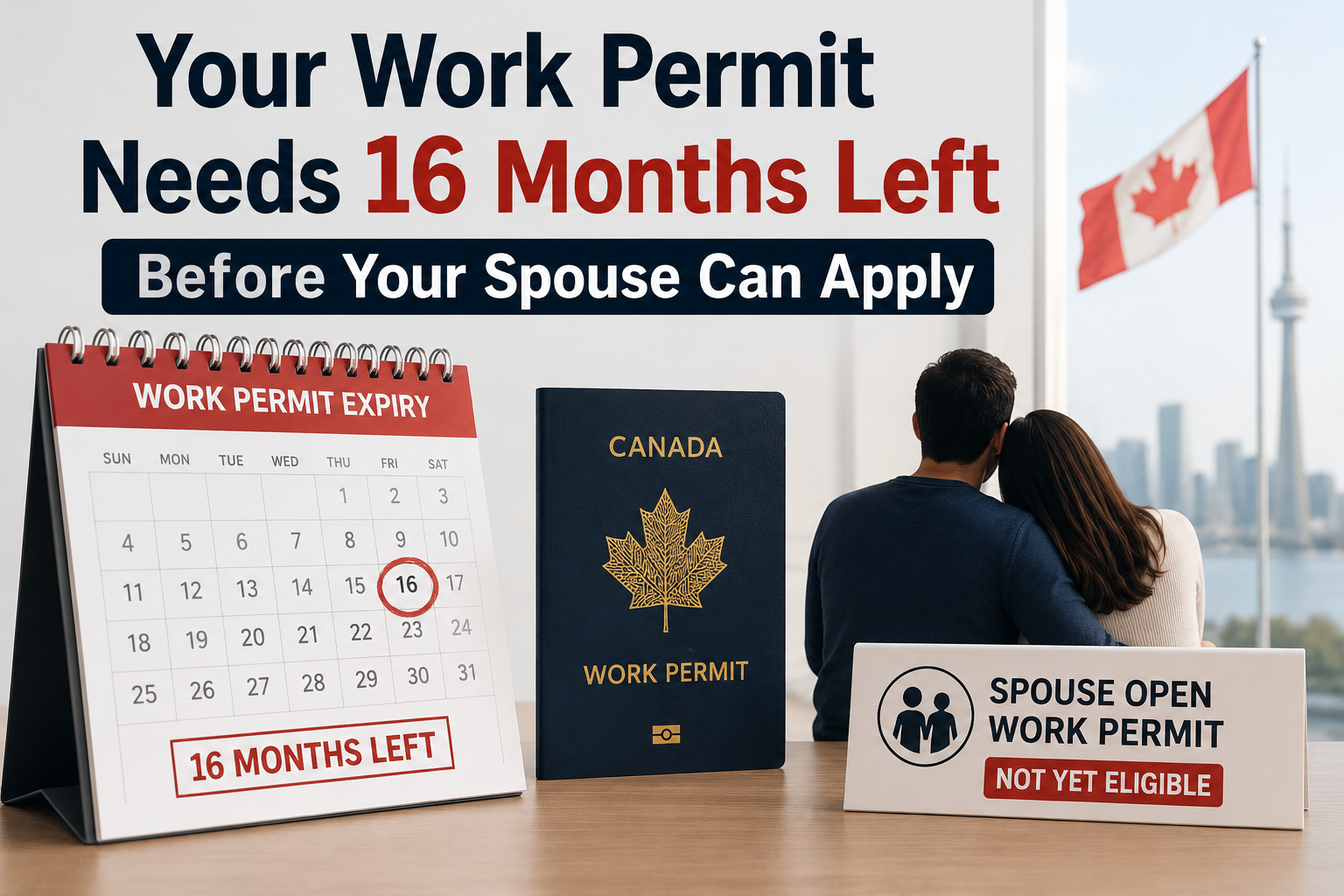
Since January 21, 2025, a spousal open work permit is not something your work permit gives you. It is something the remaining validity on your work permit gives you. IRCC requires your permit to be valid for at least 16 months after it receives your spouse’s application — not from the day you were approved, and not from the day you started the job.
That line knocks out more couples than the occupation list does, and the occupation list is already tight. Every TEER 0 and TEER 1 job qualifies. Below that, only 81 named TEER 2 occupations and 21 named TEER 3 occupations do. In TEER 4 or TEER 5, your spouse cannot apply under this measure at all.
Here is how the rule works, what changed in 2026, and why much of what you will read about spousal permits online is a year out of date.
The rule in one sentence
The worker must be employed, or about to be employed, in any TEER 0 or TEER 1 occupation or one of the specific TEER 2 and TEER 3 occupations IRCC has published, and must hold a valid work permit, an approved permit not yet issued, or authorization to work without one. Then the 16-month test is applied on the day the application is received.
Two things changed on January 21, 2025 that people still get wrong. Dependent children lost eligibility under this measure entirely; a child already holding one can extend, but no new applications are accepted. And spouses of TEER 4 and TEER 5 workers lost the ability to apply at all, a group already squeezed by the low-wage LMIA refusal rules in force this quarter.
The 16-month clock is the part people miss
Read it literally: a work permit issued for 16 months or less can never support a new spousal application, because it never has 16 months left. A one-year permit is not a narrow window. It is no window.
This bites hardest on post-graduation work permits. A PGWP holder is a work permit holder, so the worker measure applies and the TEER of the job you take decides it. But a three-year PGWP leaves only about twenty months in which the test can be met. Apply in month thirty and the answer is no, whatever your job title.
Do not apply while your own permit is pending
IRCC lists this among the disqualifiers: you are not eligible if you are applying for a PGWP and have not had a positive decision by the time your spouse’s application is decided. Filing the two together to “save time” is common forum advice and a reliable way to get a refusal. Also disqualifying: a refugee claim referred to the Immigration and Refugee Board, an unenforceable removal order, and already holding a spousal permit yourself.
81 jobs at TEER 2, 21 at TEER 3
These are not general categories but enumerated NOC codes, drawn from sectors IRCC identified as facing shortages: natural and applied sciences, construction, health care, natural resources, education, sport and the military. The TEER 2 list runs from chemical technologists (22100) to farm supervisors (82030). The shorter TEER 3 list is weighted to health care and resource work, from dental assistants (33100) to fishing occupations (83121).
Check your code against the published list rather than reasoning from the sector. “I work in construction” is not the test. The five-digit code on your offer of employment is.
Two exceptions added this year
Since March 23, 2026, spouses of workers on Significant Investment Projects in British Columbia qualify regardless of TEER level. Since May 25, 2026, foreign-trained medical professionals recruited by Quebec — nurses, respiratory therapists, lab technologists — are not held to the 16-month requirement. Both postdate most guides online.
If you are a student, this is a different rule entirely
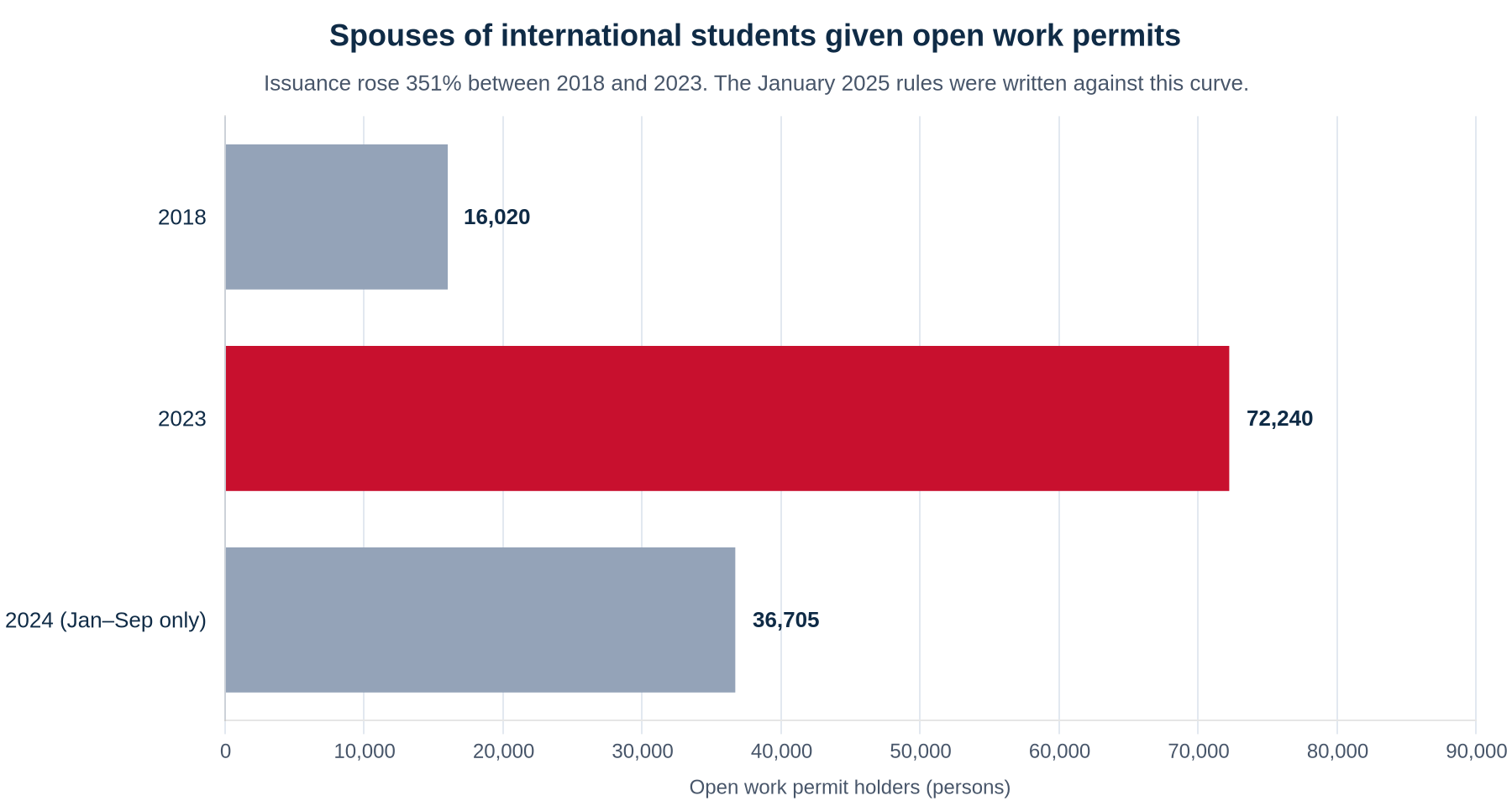
Spouses of international students fall under a separate measure. The student must hold a valid study permit and be enrolled in a master’s programme of at least 16 months, a doctoral programme, or a named professional degree: DDS or DMD, LLB, JD or BCL, MD, OD, pharmacy (PharmD, BS, BSc, BPharm), DVM, BScN, BSN, BNSc or BN, BEd, and BEng, BE or BASc. Selected pilots also qualify.
The common error here is the master’s degree. “My spouse is doing a master’s” is not enough — the programme must run at least 16 months, and a twelve-month taught master’s does not qualify. Undergraduate degrees outside the named list do not qualify, and neither do college diplomas.
The spouse’s permit is generally issued to match the study permit, so if the study permit is slow to arrive — and processing times still run from about two weeks to roughly a year depending on where you apply from — the couple’s plans move with it.
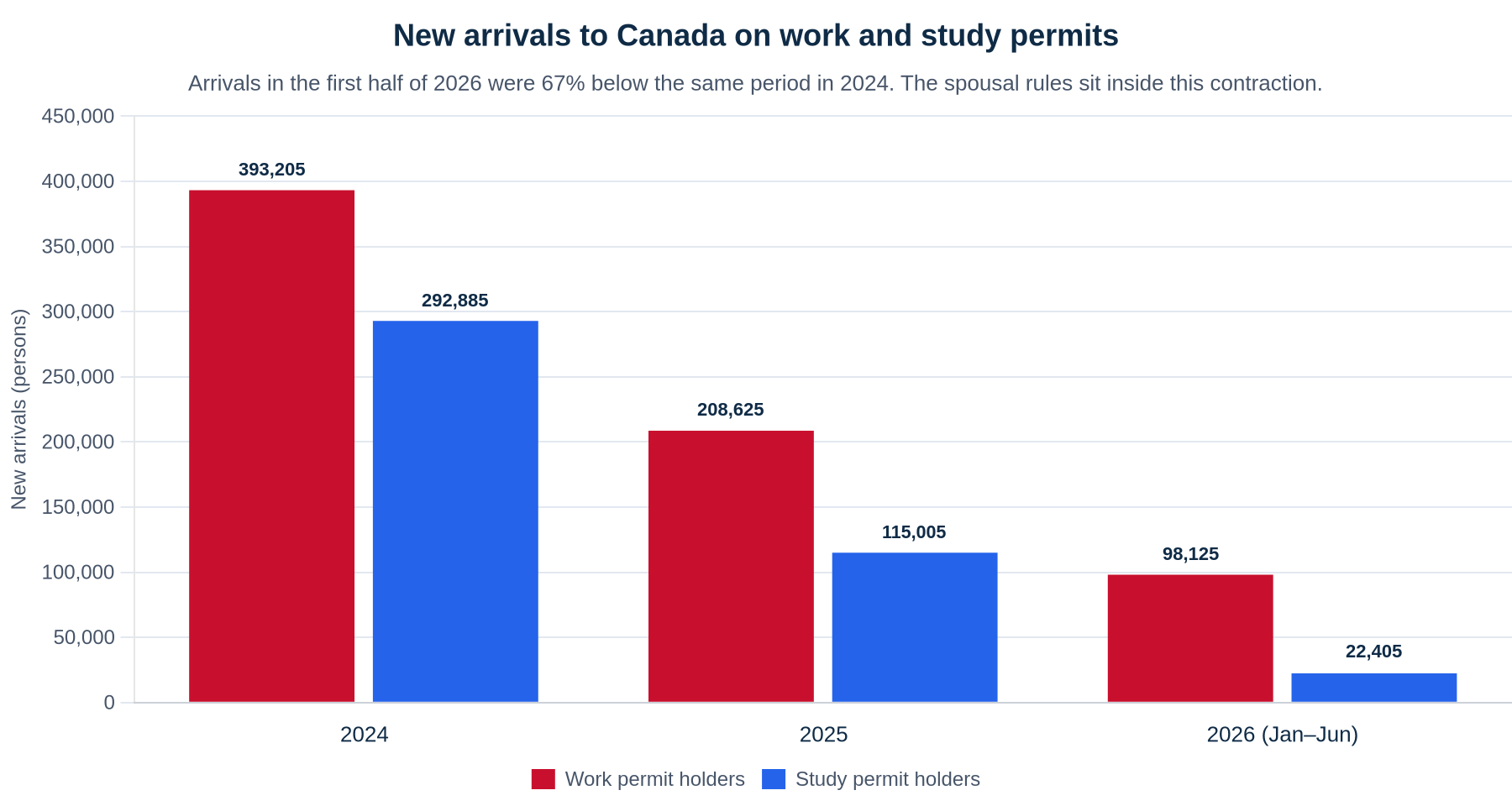
These restrictions were not a standalone decision. IRCC reports 67% fewer arrivals in the first half of 2026 than in the same period of 2024, with students down 82% and workers down 60%. The spousal rules are one instrument inside that contraction, not a measure aimed at families.
The routes that survived
The high-skilled measure is not the only door. If you have already applied for permanent residence through an eligible economic programme, your spouse and dependent children may qualify, and the validity test drops to six months. Workers on a pathway to PR who have not yet applied have a further route through select streams, including the Provincial Nominee Program and the Atlantic Immigration Program.
So the PR filing date often matters more than the job title. For many couples the fastest route to a spousal permit is getting the PR application in, not arguing about a NOC code. The CEC cut-off has been climbing all year, and a nomination through a stream like Ontario’s rebuilt OINP changes both calculations at once.
What to do about it
If you hold a PGWP: work out your 16-month date today. Take the permit’s expiry date and subtract sixteen months. That is the deadline for IRCC to receive the application, not to start preparing it. If it has passed, the worker measure is closed and the PR routes are where your attention belongs.
If your job is TEER 2 or TEER 3: find the five-digit NOC code on your work permit or offer of employment and check it against IRCC’s published list before you spend anything. Do not rely on a consultant’s summary or a blog table — several still circulate versions from early 2025.
If you are choosing a study programme: confirm the length in months, in writing, from the institution. A programme advertised as “one year” or “three semesters” is the most common reason a spousal application fails at the eligibility stage.
If you already hold a permit under the old rules: you are not being stripped of it. Permits issued before January 21, 2025 stay valid to expiry, and in-Canada renewals are possible where the same criteria are met and the duration aligns with the principal’s permit. Children holding a permit can extend, but only if they apply before it expires.
Where this is heading
Family accompaniment is now a benefit attached to skill level and a credible PR trajectory, not an automatic feature of holding a permit. Nothing suggests a reversal: the pattern since 2024 is narrow carve-outs for specific shortages while the general rule stays put.
Watch two things: whether the TEER 2 and 3 list is revised, and whether the 16-month threshold survives contact with the shorter permits IRCC is now issuing. Those numbers, not the headline policy, decide most cases.
Related reading
- Canada’s 2026 study permit cap is 408,000 — and Ontario and Quebec hold two thirds of the spaces
- Canada has stopped taking parent and grandparent sponsorships — and 60,500 people are still waiting
- IRCC processing times: July 2026
Rules and occupation lists are as published on canada.ca, current as of September 5, 2026; arrivals data is from IRCC’s August 20, 2026 update, spousal issuance figures from IRCC material dated November 4, 2024. That a permit of 16 months or less can never satisfy the validity test, and that a three-year PGWP leaves roughly twenty months to apply, are our own arithmetic from the published rule, not figures IRCC has stated. This article is general information, not legal advice. For guidance on your own case, consult a licensed immigration lawyer or an RCIC, and verify current requirements on canada.ca before you act.
Discover more from CanadianUpdates
Subscribe to get the latest posts sent to your email.