
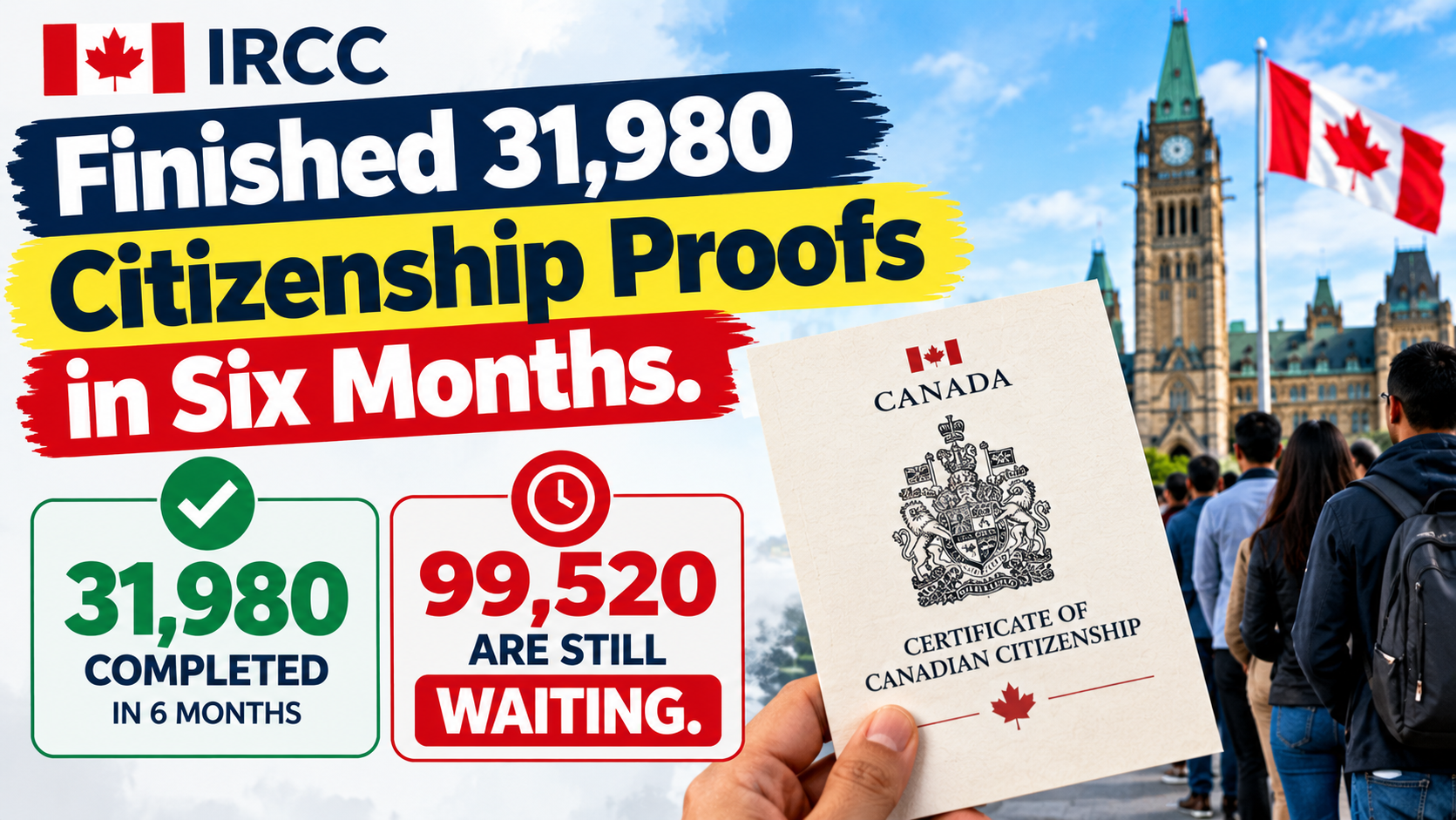
On June 30, 2026, IRCC was holding 99,520 unfinished proof-of-citizenship applications. In the six months before that date, it finished 31,980 of them. The queue is more than three times what the department managed to clear in half a year.
That document matters more than its dull name suggests. A citizenship certificate is how someone born outside Canada proves they are a citizen. Without it you generally cannot get a first Canadian passport. For the people who became citizens under the December 2025 rule change, it is the only piece of paper that turns a legal fact into something you can hand across a counter.
When we reported on this queue in July, the published estimate was 19 months and the backlog was closing in on 100,000 files. Two things have changed since: IRCC released hard inventory data, and the estimate circulating online has jumped again. Here is what the official numbers show, why this line jammed, and why this week’s headline figure deserves more caution than it is getting.
What the official numbers actually say
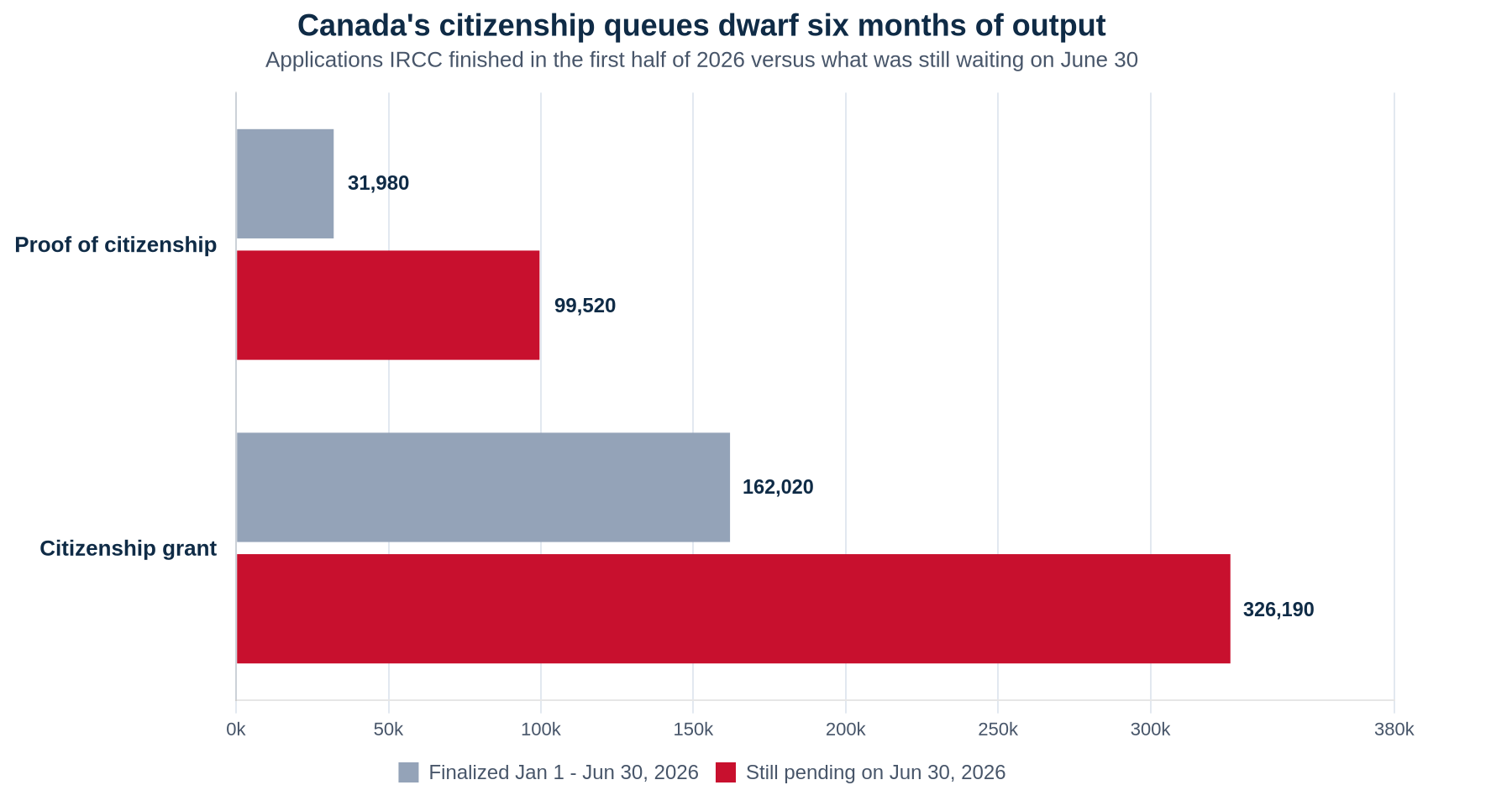
IRCC publishes its own inventory data, and it is the most solid ground available. As of June 30, 2026, the department reported 99,520 proof-of-citizenship applications not yet finalized, and 31,980 proofs issued since January 1. On the citizenship grant side — the applications filed by permanent residents who want to naturalize — 326,190 were still pending and 162,020 had been finalized in the same six months.
Divide those numbers and the pressure becomes visible. Proof of citizenship was clearing at about 5,330 files a month, so the June 30 queue alone represents roughly 19 months of work even if nothing new arrived. Citizenship grants were clearing at about 27,000 a month, putting that much larger pile at roughly 12 months. That arithmetic is ours, not an IRCC forecast, and intake never actually stops — but the comparison is the point. The smaller queue is the more congested one.
Why the proof-of-citizenship line jammed
The cause is not mysterious, and it is not incompetence. It is a law that changed.
On December 15, 2025, Bill C-3 removed the first-generation limit on citizenship by descent. Before that date, a Canadian citizen born outside Canada could not pass citizenship to a child also born outside Canada. After it, they can, provided the parent spent at least 1,095 days in Canada before the birth. Crucially, the change reached backwards: people born before December 15, 2025 in the second generation or later became citizens automatically, without applying.
That is the mechanism. Those people did not need permission — they were already citizens the moment the law took effect. What they needed was proof. A population that had been legally invisible for years arrived at one application stream, all at once, to collect a certificate. The stream was not resourced for it.
It is a familiar shape: when Canada opens or closes a door, the queue behind it moves faster than the staffing does. The same thing happened when 48,560 people applied under the Hong Kong PR pathways and only 13,370 had landed by the time they closed, and in the family stream, where 60,500 parent and grandparent sponsorships wait behind a paused intake.
About that “33 months” figure
In the first week of September, a number spread quickly: proof of citizenship now takes 33 months, up from 25 in August, 19 in July and 12 in May. It has been repeated by most of the major immigration news sites, and it may well be accurate.
We are not stating it as fact, and here is why. That figure lives inside IRCC’s online processing-times tool, which builds its estimate with JavaScript when you load the page. It is not published in any IRCC document, dataset or news release that we could retrieve. IRCC’s own machine-readable processing-times feed, last updated September 2, 2026, carries citizenship renunciation at 4 months and a search of citizenship records at 18 months — but contains no entry at all for proof of citizenship or for citizenship grants.
The tell is in the queue numbers
Look at what the same articles say about the size of the backlog. One outlet put the August queue at 121,800. Another put it at roughly 134,000 for the same month. Those cannot both be right, and neither matches the 99,520 that IRCC itself published for June 30. Nobody is inventing numbers maliciously; they are reading a live tool at different moments and rounding differently. But it means the inventory figures being quoted around the 33-month claim are not verified, and you should not plan around them.
The honest position is this: the direction is real and steep, the official inventory data supports a badly congested stream, and the exact month count is a live estimate that changes without notice. Anyone telling you confidently what your wait will be is guessing. Check the tool yourself on canada.ca on the day you need the answer, and treat any number in an article — including the ones in this one — as a snapshot with a date on it.
Citizenship is a bigger share of the system than people assume
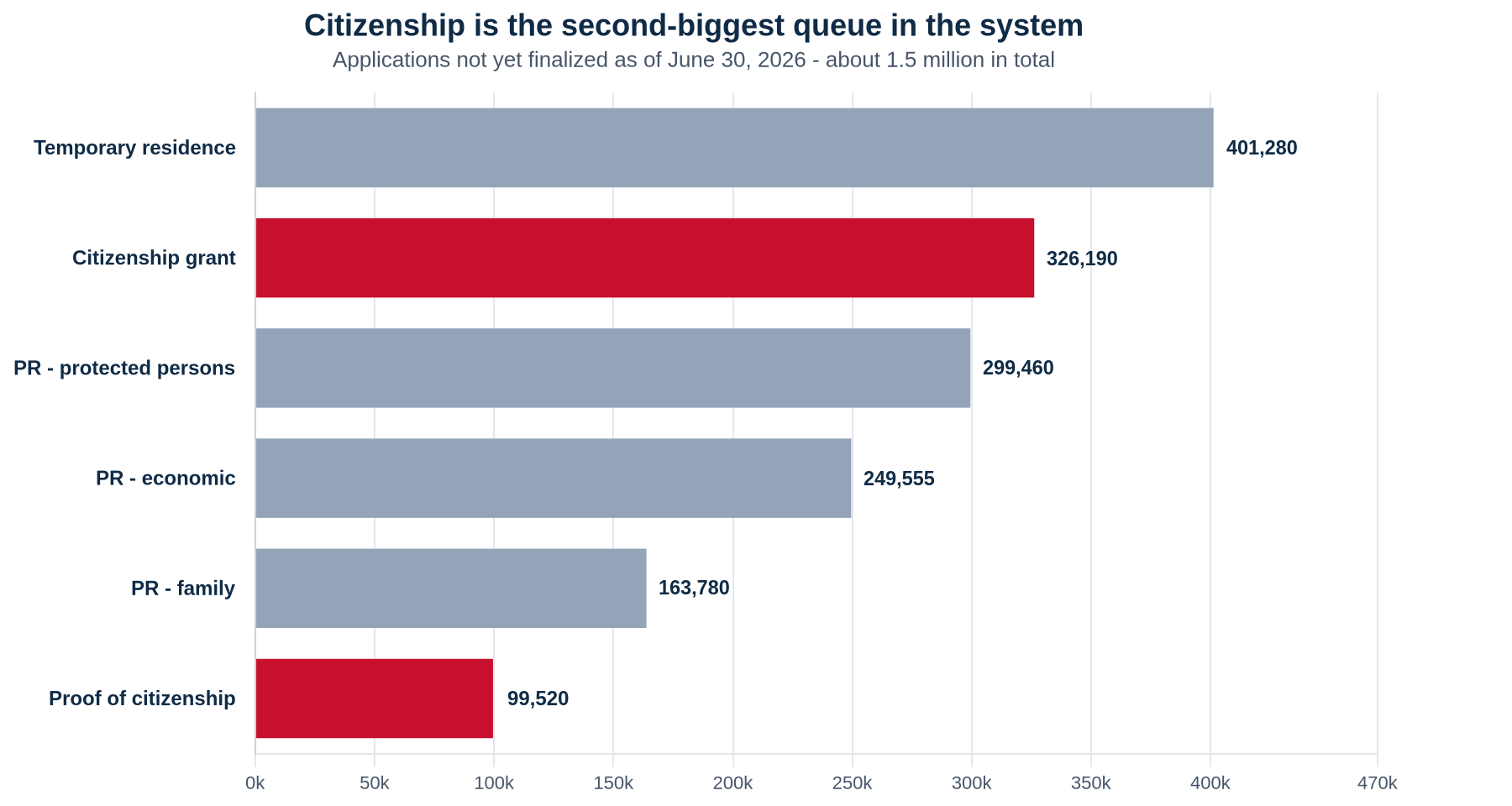
IRCC was holding roughly 1.5 million unfinished applications across all lines of business on June 30, 2026. Citizenship grants alone accounted for 326,190 — a larger queue than economic permanent residence and larger than the family class. Add proof of citizenship and the two citizenship streams together outweigh any single PR category.
Public attention goes to intake targets and to caps on things like study permits, because those are the numbers that get announced. Citizenship processing gets almost none, because there is no target to announce. It is simply the last step of a system that admitted a lot of people over the past decade, and those people are now becoming eligible.
What this means for you
If you are claiming citizenship by descent under the December 2025 rules: you are already a citizen if you qualify — the certificate confirms that, it does not confer it. Nothing about your status expires while you wait. But do not book travel that depends on a Canadian passport until the certificate is in your hand, because the passport application needs it.
If you applied for a citizenship certificate in the first half of 2026: you are somewhere inside that 99,520. Make sure IRCC can reach you. An address or email change that does not get updated is one of the few things that turns a long wait into a much longer one, and it is entirely within your control.
If you have a genuine urgent need: IRCC publishes criteria for urgent processing of citizenship applications, covering situations like a job, medical care or a death in the family. The criteria and the evidence required are specific, and they change. Read the current version on canada.ca rather than a summary of it, and send the proof with your request the first time.
If you are waiting on a citizenship grant rather than a certificate: your queue is far larger but moving proportionally faster, and it is a different operational stream. Do not read the proof-of-citizenship headlines as though they describe your file. If you are still a permanent resident, your PR card and status are unaffected by any of this.
What to watch next
The next official inventory update is the thing to wait for. It will show whether the proof-of-citizenship queue kept climbing through the summer or began to flatten as the first wave of descent claims cleared.
Two other signals matter. If IRCC adds proof of citizenship and citizenship grants back into its machine-readable processing-times feed, the monthly figures become checkable by anyone instead of depending on who loaded a web tool that morning. And if the department shifts staff toward citizenship, it will show up as a rising monthly finalization count long before it shows up as a falling estimate. Watch the output, not the estimate — output is measured, the estimate is a forecast.
Nobody currently knows how long a certificate filed today will take. IRCC has not said, and we are not going to guess.
Related reading
- Proof of Canadian Citizenship Now Takes 19 Months as the Bill C-3 Queue Closes In on 100,000 Files
- IRCC Processing Times: July 2026
- Canada Has Stopped Taking Parent and Grandparent Sponsorships — and 60,500 People Are Still Waiting
Inventory figures in this article are IRCC’s published application data as of June 30, 2026, retrieved September 8, 2026. The processing-times feed values cited were last updated September 2, 2026. The monthly clearance rates (about 5,330 proofs and about 27,000 grants per month) and the resulting “months of work” estimates are our own arithmetic from IRCC’s published totals, not IRCC forecasts. The widely reported 33-month processing estimate is attributed to IRCC’s online processing-times tool as reported by other outlets on September 4, 2026; we could not confirm it against any published IRCC source and have not treated it as verified. This article is general information, not legal advice. For guidance on your own case, consult a licensed immigration lawyer or an RCIC. Verify current requirements and processing times on canada.ca before you act.
Discover more from CanadianUpdates
Subscribe to get the latest posts sent to your email.