
Every federal pathway that let a caregiver become a permanent resident is now closed to new applicants. Not paused for a season — closed, with the governing instructions written to run until March 30, 2030.
The last one standing was the pair of Home Care Worker Immigration pilots, which opened on March 31, 2025 and stopped taking applications before their first birthday. On March 31, 2026, Ministerial Instruction 91 replaced the intake rules with instructions aimed at the “reduction of application inventories.” IRCC is still processing what it already has. It is not accepting anything new.
What is left for care workers is a temporary work permit that leads nowhere in particular. Here is the whole picture, and what it means depending on where you are standing.
Every federal caregiver route, and the date it shut
IRCC’s own caregiver landing page now reads as a closure notice. Running down it:
- Home Care Worker Immigration pilots — closed. Both streams, “workers in Canada” and “applicants not working in Canada.”
- Home Child Care Provider Pilot and Home Support Worker Pilot — last day to apply was June 17, 2024.
- Live-in Caregiver Program — closed to new applicants unless you already held a work permit under it based on an LMIA submitted before December 2014.
- Caring for Children Pilot and Caring for People with High Medical Needs Pilot — last day to apply was June 17, 2019.
- Interim Pathway for Caregivers — last day to apply was October 8, 2019.
One option on that page is still marked as open: working temporarily as a home care worker. That is a work permit, not a PR pathway, and the distinction is the entire point of this article.
The door was narrow even when it was open
The pilots are often described as though they were a major route. They were not. They were created under section 14.1 of the Immigration and Refugee Protection Act, which lets the Minister stand up an economic class for a maximum of five years with no more than 2,750 principal applicants processed in a class per year. There were two classes — Child Care and Home Support — so the statutory ceiling was 5,500 principal applicants annually, before anyone reached the eligibility criteria.
IRCC’s stated reason for pausing intake was that demand kept running past that ceiling. In the December 2025 notice, the department said interest “continues to exceed the spaces available, leading to longer wait times,” and that halting intake would “prevent further inventory growth.”
That is the same logic applied to parent and grandparent sponsorship, and it is becoming the department’s default move: when an inventory outgrows the admissions space, close the front door rather than widen the back one.
And the pool it drew from just got smaller
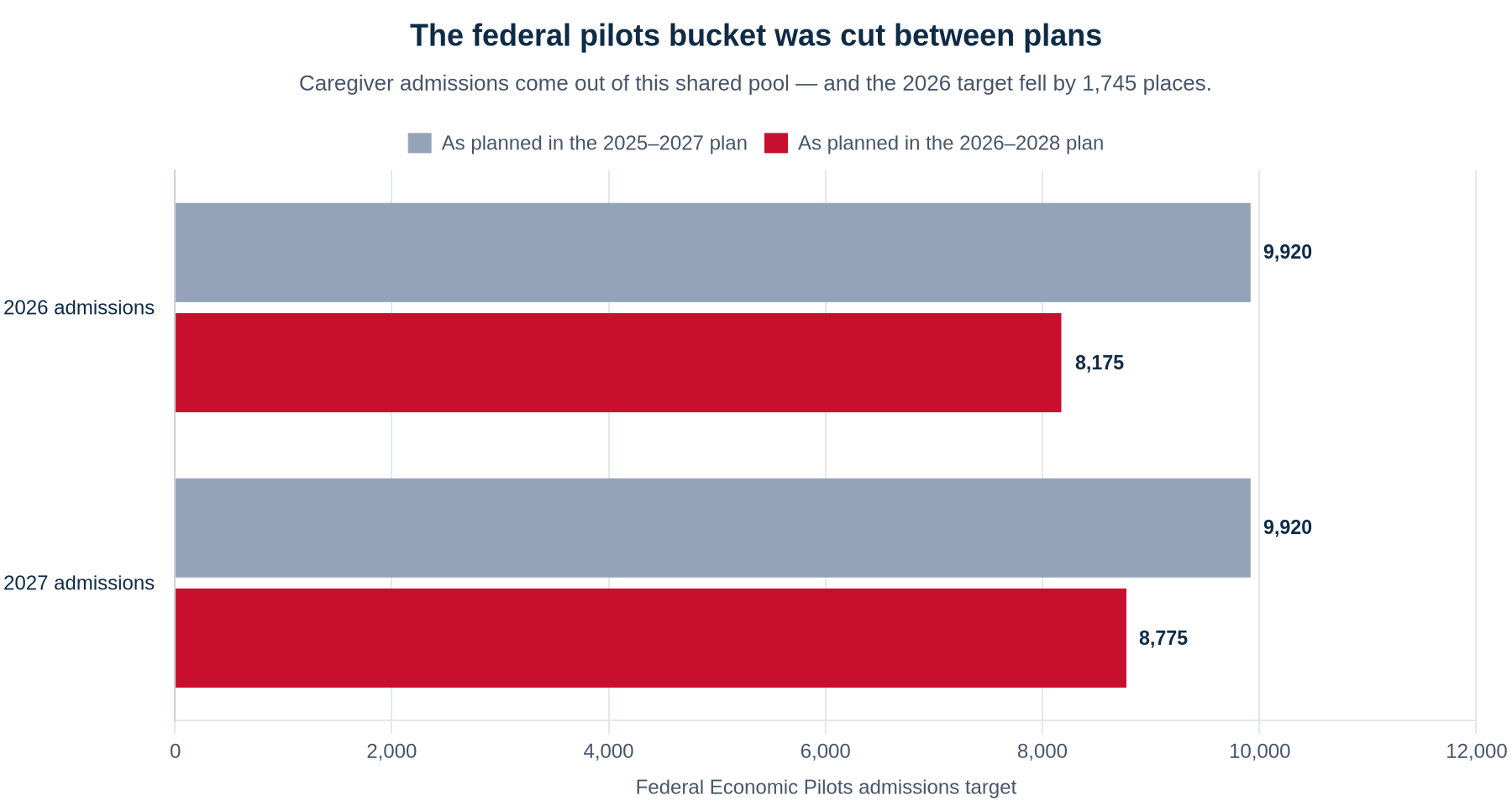
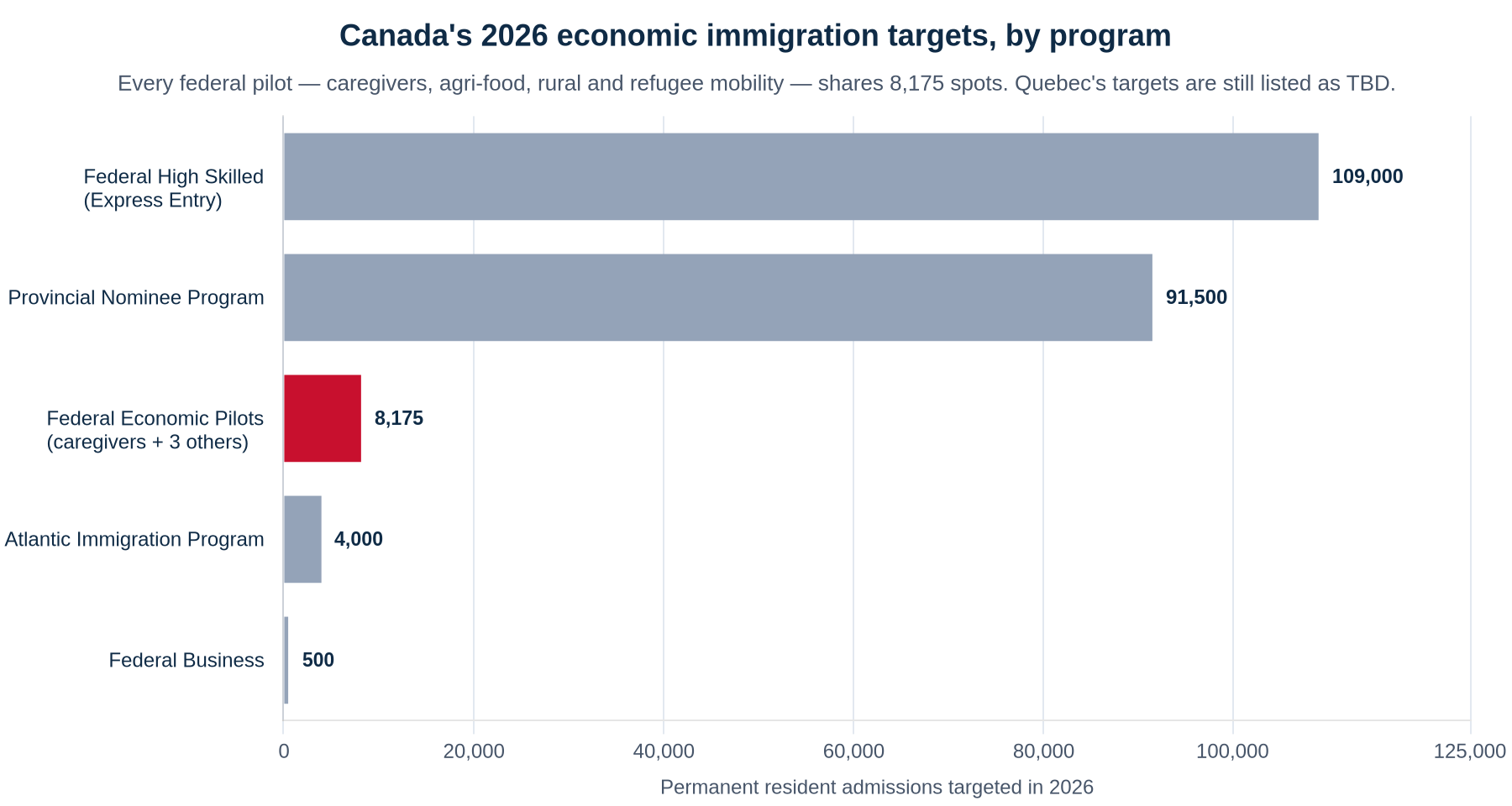
Caregiver admissions are not counted on their own. They sit inside a Levels Plan line called Federal Economic Pilots, shared with agri-food, community immigration and economic mobility pathways for refugees.
Under the 2025–2027 plan, that line was set at 9,920 admissions for both 2026 and 2027. The 2026–2028 plan cut it to 8,175 for 2026 and 8,775 for 2027 — a reduction of 1,745 places in the nearer year. Four programs are dividing that.
For scale, the same plan targets 109,000 admissions through Federal High Skilled and 91,500 through the Provincial Nominee Program. The entire pilots bucket is roughly 3% of the 239,800-person economic class. Quebec’s skilled worker and business targets are still published as TBD.
Why Express Entry does not catch them
The advice repeated in comment sections is that displaced caregivers should “just go through Express Entry.” For most, that is not available, and the reason is structural, not competitive.
Home child care providers are NOC 44100 and home support workers are NOC 44101. Both sit in TEER 4 — in the 2021 classification, the second digit of the code is the TEER level, and occupations there typically require completion of secondary school.
The Canadian Experience Class requires at least one year, or 1,560 hours, of skilled work experience in the three years before applying, and that experience must fall in TEER 0, 1, 2 or 3. Caregiving work does not count toward it. This is not a question of scoring badly against a rising CRS cut-off; years of caregiving in Canadian homes do not make you eligible to enter the pool on that experience in the first place.
That is precisely the gap the caregiver pilots existed to fill. Removing them does not push people into Express Entry. It leaves them on temporary status.
What is actually still open
The remaining federal route is a work permit through the Temporary Foreign Worker Program, in NOC 44100 or 44101. Your employer needs a positive Labour Market Impact Assessment first, and the permit is tied to that employer.
Three details matter more than they look. The LMIA processing fee is $1,000 per position requested, with exemptions for childcare and medical home care below certain income thresholds. An individual hiring a caregiver has to get a business number from the CRA — staffing agencies do not count as the employer. And ESDC may refuse to process LMIA applications from employers seeking to hire in-home caregivers exclusively on a live-in basis.
There is a geographic catch as well. IRCC’s page on working temporarily as a caregiver lists the situations that qualify, and applying from outside Canada appears on it only where the job is in Quebec. If you are abroad and the position is in another province, you are on the ordinary work permit route, not this one. Employers outside Quebec should also read the low-wage LMIA refusal list before assuming an application will be assessed at all.
What to do about it
If you already have an application in the pilots: you are fine to keep waiting. IRCC has said it will continue to process applications received to date. Do not withdraw and do not refile — there is nothing to refile into.
If you were waiting for the March 2026 reopening: it did not happen and nothing has been announced to replace it. Anyone currently charging you to “prepare your file for when it reopens” is selling a date that does not exist.
If you are in Canada on a caregiver work permit: your PR planning has to move off the caregiver stream entirely. Look at provincial nomination, where care and health occupations sometimes appear in targeted streams — Ontario rebuilt its programs around workforce priorities in 2026 — and check each province’s own published stream list rather than a summary of it.
If you are a family hiring a caregiver: budget for the $1,000 LMIA fee unless you clearly meet an exemption, get the CRA business number early, and do not write a live-in-only requirement into the position.
If you are reading that the program is “closed until 2030”: that is a misreading of MI91. The instruction is in effect until March 30, 2030 unless repealed earlier. That is an outer boundary on the paperwork, not a commitment that the door stays shut for four years or that it opens when the clock runs out.
The direction of travel
Canada has run a dedicated caregiver immigration program in some form for decades. For the first time, it does not have one — at the same time as the demographic demand for home care is rising. Both things are true at once, and the government has not attempted to reconcile them publicly.
What to watch is whether care occupations surface in provincial nominee streams instead. A federal fix through Express Entry would mean changing the eligibility rules, not just adding a draw category, because a TEER 4 occupation cannot be selected on its own work experience. Until something changes, Canada is recruiting care workers on temporary permits and offering them no way to stay.
Related reading
- Canada Has Stopped Taking Parent and Grandparent Sponsorships
- Canada’s Hong Kong PR Pathways Closed August 31
- The OINP Was Rebuilt in 2026: What Replaced Ontario’s Nine Streams
Program statuses, ministerial instruction dates and admissions targets are as published on canada.ca as of September 19, 2026. The 5,500 statutory ceiling, the 1,745-place reduction and the 3% share of the economic class are arithmetic derived from published figures, not numbers published by IRCC in that form. This article is general information, not legal advice. For guidance on your own case, consult a licensed immigration lawyer or an RCIC, and verify current requirements on canada.ca before you act.
Discover more from CanadianUpdates
Subscribe to get the latest posts sent to your email.