

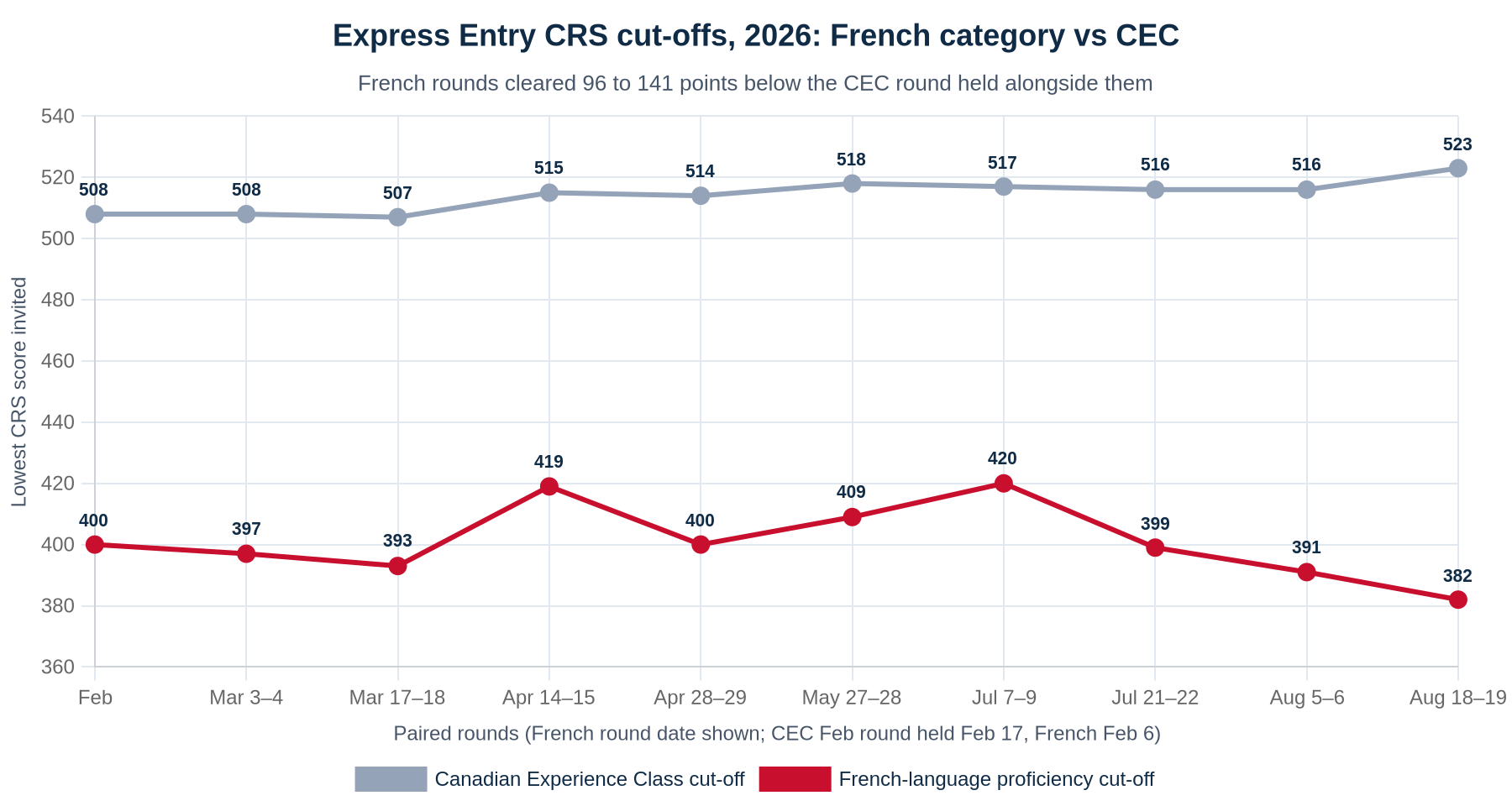
On August 18, the Canadian Experience Class round in Express Entry needed a CRS score of 523. The next day, a French-language proficiency round invited 5,000 people with scores as low as 382. That is a 141-point gap between two rounds held 24 hours apart.
It was not a one-off. IRCC has held ten French-language rounds in 2026, inviting 50,500 candidates in total, and every one cleared somewhere between 382 and 420. Every CEC round this year has needed 507 or more.
If you can prove strong French, it is currently worth more in Express Entry than almost anything else you can add to a profile. Here is why, what “strong” actually means, and what could change it.
Why the French line sits so low
A category-based round is a separate competition. IRCC picks a category, sets a number of invitations, and ranks only the candidates who meet that category’s condition. The cut-off is simply the score of the last person invited.
The French category’s condition is narrow: NCLC 7 or higher in all four abilities — reading, writing, listening and speaking. That pool is much smaller than the CEC pool. So when IRCC asks for 5,000 names from it, it has to reach further down the rankings to find them. The low cut-off is a function of pool size, not generosity.
The volume is the other half. The 50,500 French invitations this year compare with roughly 53,000 CEC invitations over the same period — on our count of the published rounds, the two categories have been running at near parity, even though one draws on a far smaller population.
The policy behind it
This is target-driven. The 2026–2028 levels plan requires French-speaking permanent residents to make up 9% of admissions outside Quebec in 2026 — 30,267 people — rising to 9.5% in 2027 and 10.5% in 2028. The government has also committed to 12% by 2029.
IRCC has beaten each recent target: 4.7% in 2023, 7.2% in 2024 and 8.9% in 2025, when more than 29,500 French-speaking permanent residents settled outside Quebec. Express Entry is the main engine. IRCC told MPs that more than 81,000 candidates were invited through the French category between 2023 and the end of February 2026.
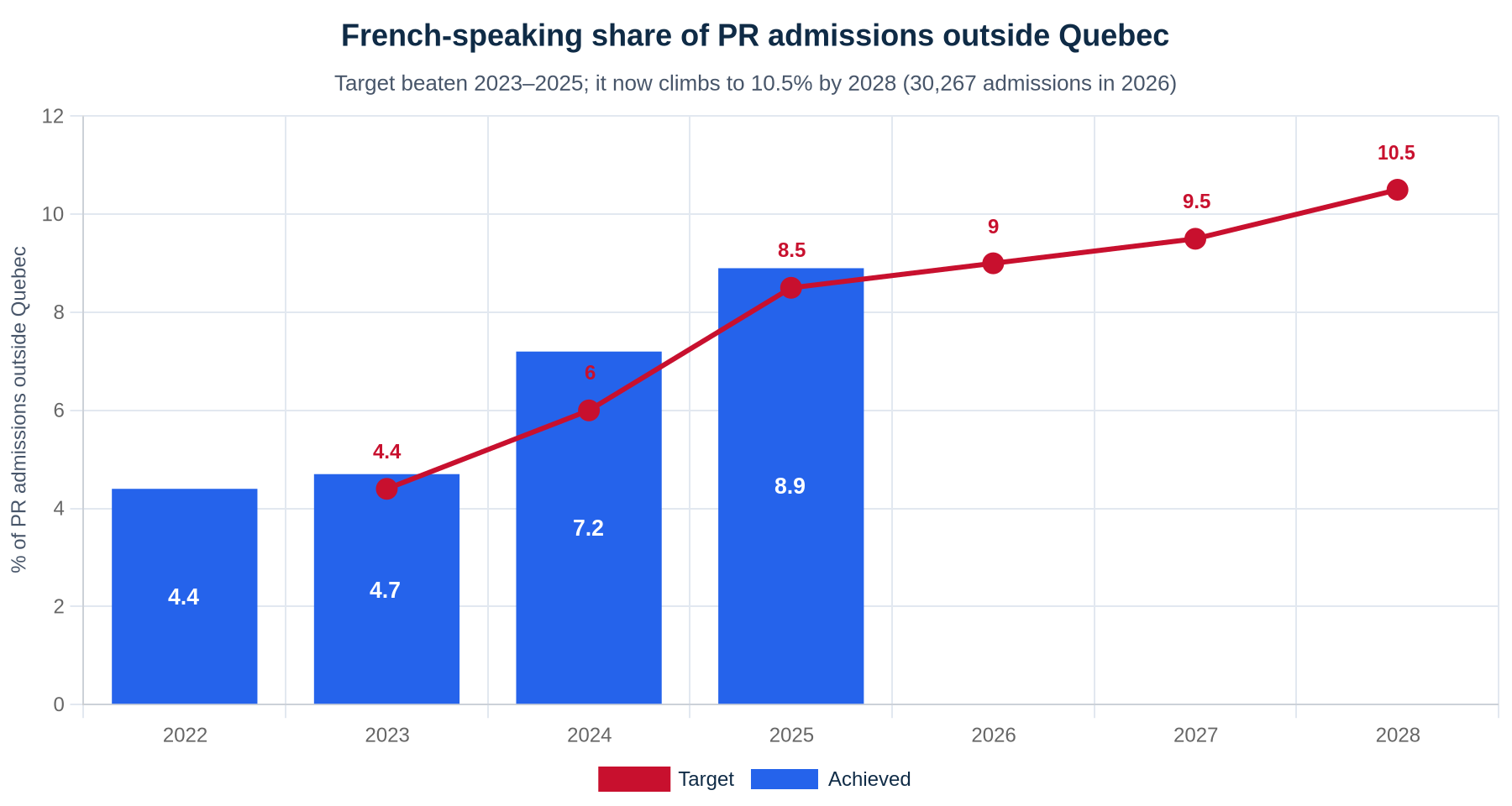
Note the shape. The target keeps rising while total immigration is being cut. A bigger slice of a smaller pie still requires IRCC to select French speakers deliberately, and category rounds are the most direct tool it has.
What “speaks French” actually has to mean
This is where most of the bad advice online lives. You will see claims that “basic French” or a few months of classes will get you into a 380-point round. It will not.
NCLC 7 in all four skills is solid upper-intermediate French. The test has to be TEF Canada or TCF Canada, and results must be less than two years old both when you create your profile and when you submit your permanent residence application. One weak ability — writing is the usual culprit — and you are not in the category at all, however good your speaking is.
You also still have to be in the Express Entry pool, which means qualifying for the Federal Skilled Worker, Canadian Experience Class or Federal Skilled Trades program. French is a way to be ranked in a smaller competition. It is not a way around the entry requirements.
French helps in general rounds too
Separately from the category, the CRS gives additional points for French: 25 if you score NCLC 7 or higher in all four French abilities with CLB 4 or lower in English, and 50 if you also score CLB 5 or higher in all four English abilities. Those points count in every round, including CEC rounds. Bilingual candidates get the bigger bonus.
The other French doors
Francophone Mobility. This is a work permit, not permanent residence. It waives the LMIA for French-speaking workers destined anywhere outside Quebec. The bar is lower than Express Entry: NCLC 5 in speaking and listening. Almost any occupation qualifies, in any TEER category, except primary agriculture jobs in TEER 4 and 5. The employer submits the offer through the Employer Portal under exemption code C16 and pays a $230 compliance fee; your work permit fee is $155.
Provincial nominations. IRCC has reserved federal spaces for provinces and territories to nominate up to 5,000 Francophone candidates in 2026, on top of their regular allocations. That matters because provinces otherwise have to choose between French speakers and every other labour shortage on their list. Check your target province’s French-speaking streams — Ontario’s program was rebuilt this year, so older guides are out of date.
What to do about it
If you already have good French: test now, with TEF Canada or TCF Canada, and aim for NCLC 7 in every ability, not an average. Then update your profile. A candidate sitting at 400 in the general pool is more than 100 points short of recent CEC rounds but has been inside most French cut-offs this year.
If your French is intermediate: find out which ability is weakest before you pay for a full test. The category is all-or-nothing across four skills, so a targeted push on writing often matters more than more conversation practice.
If you are starting from zero: be realistic. Reaching NCLC 7 in all four abilities is a long project, and the policy environment could shift before you get there. Treat French as a real long-term investment, not a shortcut, and keep working on the factors that count in every round, such as English scores.
If you need to get to Canada sooner: NCLC 5 in speaking and listening plus a job offer outside Quebec can get you a Francophone Mobility work permit. If the job is in TEER 0 to 3, a year of that Canadian experience can later make you eligible for the CEC. Just be clear that it is a work permit, not a promise of permanent residence.
If you intend to live in Quebec: none of this applies. Express Entry, the French category and Francophone Mobility all target communities outside Quebec. Quebec runs its own selection system.
What to watch
First, the pause. There has been no French round since August 19. The seven published rounds that followed, up to September 16, went to CEC, provincial nominees, physicians, health care and senior managers. Gaps of several weeks have happened before this year — there was none between May 28 and July 9 — so a pause alone is not a signal. But if IRCC has already invited enough French speakers to hit 2026 admissions, fewer rounds for the rest of the year would be a rational response. IRCC has not said so, and we cannot confirm it.
Second, the 2027–2029 levels plan, due this fall. It will confirm or change the 9.5% and 10.5% targets and the overall admissions ceiling they are measured against. As our look at IRCC’s two queues showed this morning, that ceiling already decides how fast whole categories move.
Third, the CRS itself. IRCC’s 2026 Express Entry consultation ranked the French bonus among the weaker predictors of labour-market outcomes. Nothing has been proposed or enacted, and Francophone targets rest on separate policy commitments. But the 50-point bonus and the category rounds are two different levers, and only one of them is backed by a published admissions target. If one gets trimmed, expect it to be the bonus, not the category.
Related reading
- IRCC Wants to Merge Express Entry’s Three Programs Into One — and 135 CRS Points Are on the Table
- The CEC Cut-Off Climbed 16 Points Since March: What Express Entry Actually Looks Like in September 2026
- The OINP Was Rebuilt in 2026: What Replaced Ontario’s Nine Streams
Express Entry round data is from IRCC’s published rounds of invitations on canada.ca, retrieved September 28, 2026; the most recent round shown was September 16. Francophone targets and results are from IRCC’s January 19, 2026 news release, its April 22, 2026 committee briefing on Francophone immigration and its 2026 deputy minister transition binder. Eligibility rules for the French category, CRS additional points, approved tests and the Francophone Mobility work permit are as published on canada.ca on the same date. Several figures are our own arithmetic rather than published numbers: the 50,500 total French-category invitations and the roughly 53,000 CEC invitations in 2026 (sums of published round sizes; the January 7 CEC round was taken from a secondary summary of IRCC data), and the 96- to 141-point gaps between paired rounds. Invitations are not admissions: not every invited candidate applies or is approved. This article is general information, not legal advice. For guidance on your own case, consult a licensed immigration lawyer or an RCIC, and verify current requirements on canada.ca before you act.
Discover more from CanadianUpdates
Subscribe to get the latest posts sent to your email.