
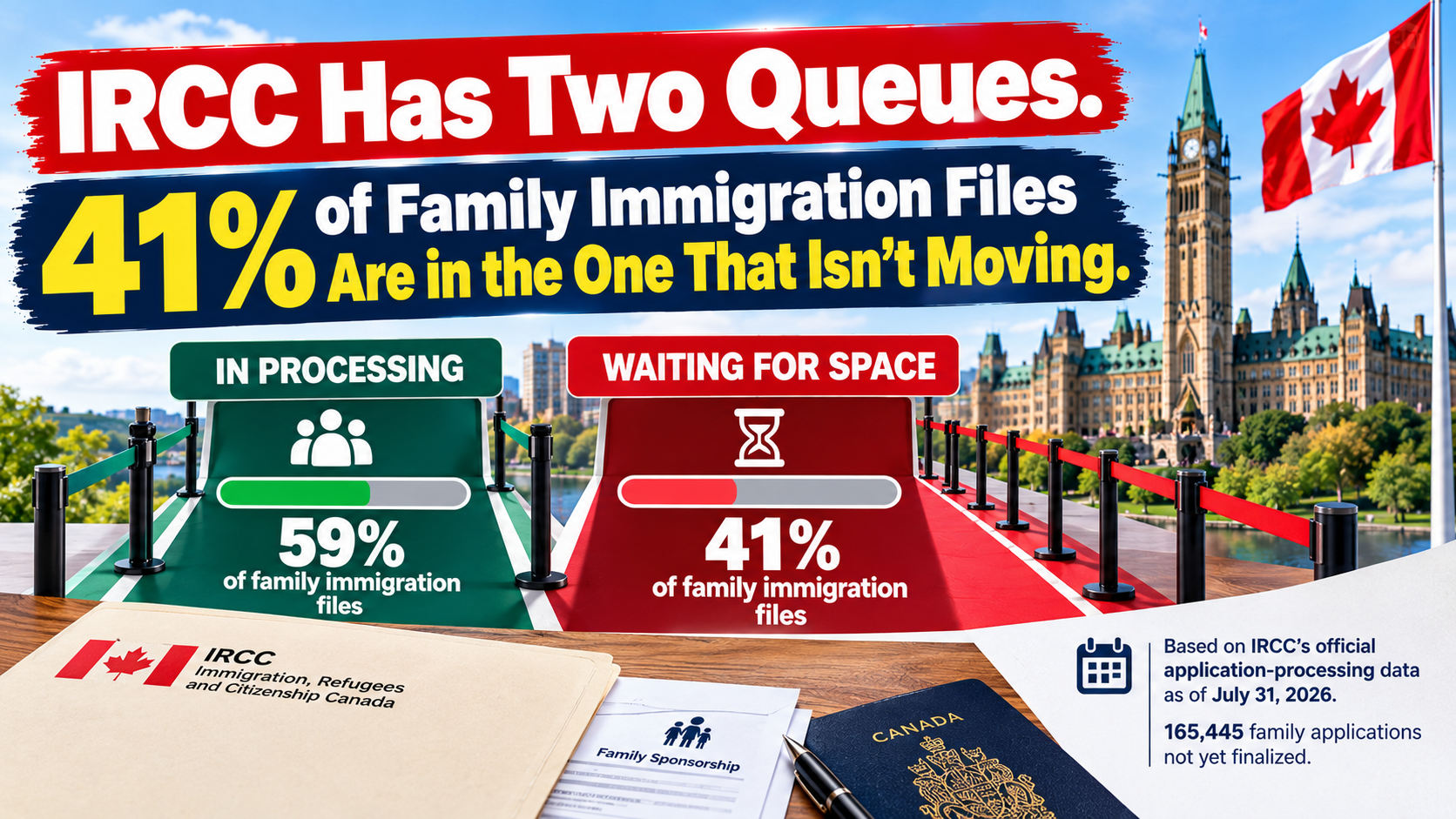
There are two queues inside IRCC, and almost nobody applying tells them apart. One holds files an officer is actively working. The other holds files that are complete, paid for, and sitting untouched because there is no room left under this year’s immigration targets.
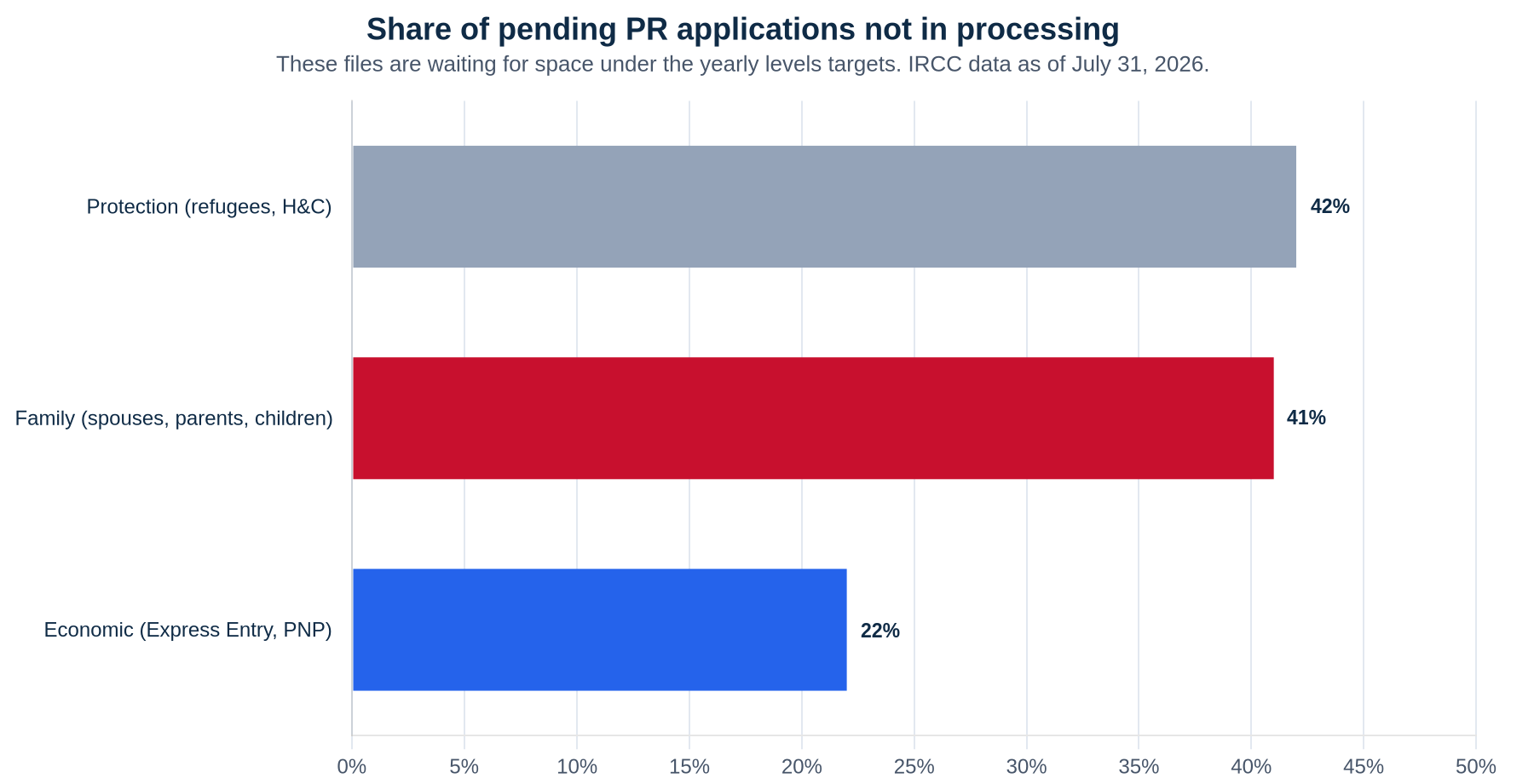
As of July 31, 2026, 41% of pending family immigration applications are in the second queue. For refugee and humanitarian files it is 42%. For economic applicants — Express Entry, provincial nominees — it is 22%.
Your file can be in perfect order and still not be in processing. That is the part the published processing times do not tell you.
How the second queue works
Canada’s Immigration Levels Plan sets how many people can be admitted as permanent residents each year, by category. IRCC describes the consequence plainly: when it receives more applications for a program than there are spaces in the plan, “some applications must wait until space becomes available in a future year.”
So the department now reports its pending inventory in two parts — the share “in processing” and the share “waiting for space under yearly targets.” These are the numbers above.
The distinction matters because the two states behave completely differently. A file in processing moves: it gets an officer, medicals, background checks, requests for documents. A file waiting for space does nothing at all until a future year’s allocation opens. No officer is assigned. Nothing is being reviewed. Sending more documents does not speed it up, because nobody is looking.
It also means a published processing time is an average across both groups, which is why quoted times keep drifting upward even when IRCC’s staff are working at the same pace.
The scale of it
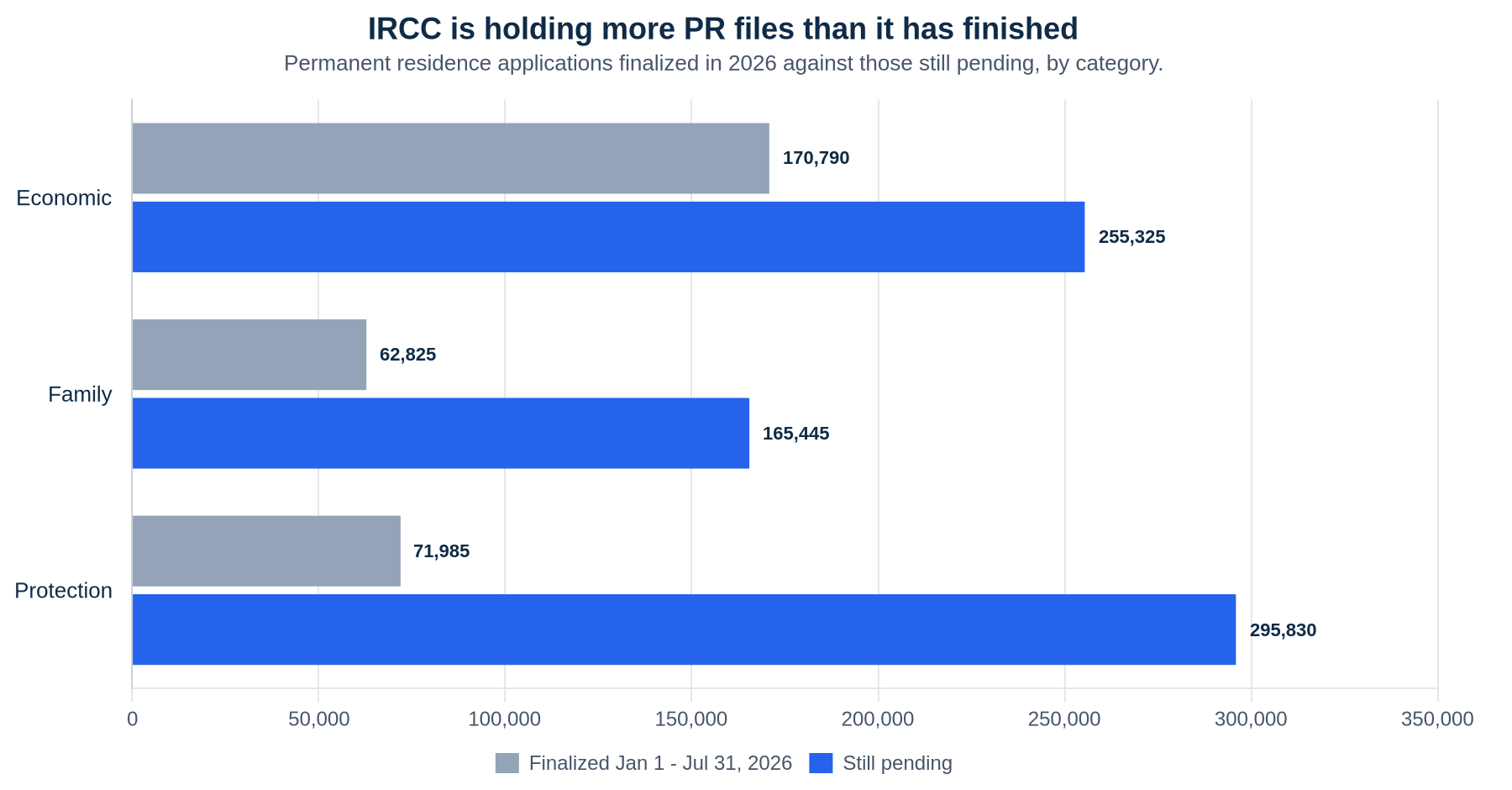
IRCC had 255,325 economic, 165,445 family and 295,830 protection applications not yet finalized on July 31 — 716,600 permanent residence files in total. Apply the department’s own processing shares and roughly 248,000 of them were not in processing.
Against that, the department finalized 170,790 economic, 62,825 family and 71,985 protection applications in the first seven months of the year.
The family numbers are the ones worth sitting with. IRCC finished 62,825 family files in seven months and is holding 165,445 — more than two and a half times what it cleared. Roughly two in five of those pending files are not being worked at all.
Why economic applicants fare better
The 22% figure for economic immigration is not luck. Economic admissions get the largest share of the levels plan, and IRCC controls intake directly: it decides how many Express Entry invitations to issue and when. If the department does not want an application, it does not invite it in the first place.
That control shows in the service standard. Between August 2025 and July 2026, about 78% of Federal Skilled Worker and Canadian Experience Class applicants got a decision within the six-month standard, and about half got one in five months or less.
Family and protection intake works the other way. A citizen who marries a foreign national can apply whenever they like, and Canada has a legal obligation to assess asylum claims regardless of targets. Demand is not rationed at the front door, so it gets rationed in the queue instead. That is also why parent and grandparent sponsorship has been closed to new applications — capping intake is the only lever available once the pending pile exceeds the plan.
Temporary residence is a different system
Temporary applications are not rationed the same way, and the numbers look nothing alike. IRCC finalized 1,832,065 temporary residence applications between January and July and was holding 394,325 — a pending pile smaller than three months of output.
Within that: 37,730 study permits pending against 126,230 finalized, 28,615 work permits pending against 175,710 finalized, and 327,980 visitor visas pending against 1,530,125 finalized. Visitor visas carry no arrival target at all, which is precisely why that queue turns over.
Citizenship is its own story again: 328,200 grant applications pending against 193,320 new citizens this year, plus 121,800 proof of citizenship files outstanding.
What to do about it
If you are sponsoring a spouse or partner: IRCC processed spousal and partner applications from inside and outside Canada, destined outside Quebec, in about 15 months over the last year. Budget for that, not for the optimistic figure a consultant quoted you. If your status in Canada expires in the meantime, deal with that separately and early — the spousal open work permit has its own eligibility trap.
If your file has gone quiet: silence is not evidence of a problem. A file waiting for space produces no correspondence because no officer has it. Web-form enquiries, ATIP requests for your GCMS notes and repeat submissions will not move it, and paying someone to send them is money wasted.
If you are choosing between pathways: the economic queue moves roughly twice as reliably as the family one. That is not a reason to abandon a sponsorship, but if you independently qualify through Express Entry or a provincial program, running that in parallel is rational.
If you are a physician or a PhD student: there are genuine fast lanes, and they are narrow. IRCC has launched two-week processing for study permit applicants at the PhD level, and 14-day work permit processing for up to 5,000 licensed doctors with job offers nominated through a provincial nominee program. Both are real, both are capped, and neither is a general rule.
If you are reading a processing-time tool: treat the posted figure as a description of files already finished, not a promise about yours. It is backward-looking by construction.
What to watch
Two commitments will absorb space over the next 15 months. IRCC is transitioning up to 33,000 work permit holders to permanent residence across 2026 and 2027 through the In-Canada Workers Initiative, explicitly in addition to the levels plan targets. Separately, it is processing up to 115,000 additional permanent residence applications from protected persons and their in-Canada dependants over the same period.
Both are carve-outs that sit outside or on top of the ordinary allocation. That is the tell: the department is reaching for exceptions because the plan itself cannot absorb what is already pending.
The number to track is not the posted processing time. It is the share of your category’s inventory reported as “in processing.” When that share rises, the queue is genuinely clearing. When it falls while the posted time holds steady, the backlog is quietly moving from the working pile to the waiting pile — and the posted time has not caught up yet.
Related reading
- IRCC Processing Times: July 2026
- Canada Has Stopped Taking Parent and Grandparent Sponsorships
- IRCC Finished 31,980 Citizenship Proofs in Six Months. 99,520 Are Still Waiting.
All inventory, finalization and processing-share figures are IRCC data as of July 31, 2026, published on canada.ca. IRCC rounds these values to the nearest multiple of 5 and describes them as approximate and subject to change. Two figures are our own arithmetic rather than published totals: the 716,600 combined permanent residence inventory, which is the sum of the three published category inventories, and the roughly 248,000 applications not in processing, which applies each category’s published processing share to its published inventory — both are therefore approximations. This article is general information, not legal advice. For guidance on your own case, consult a licensed immigration lawyer or an RCIC, and verify current requirements on canada.ca before you act.
Discover more from CanadianUpdates
Subscribe to get the latest posts sent to your email.