

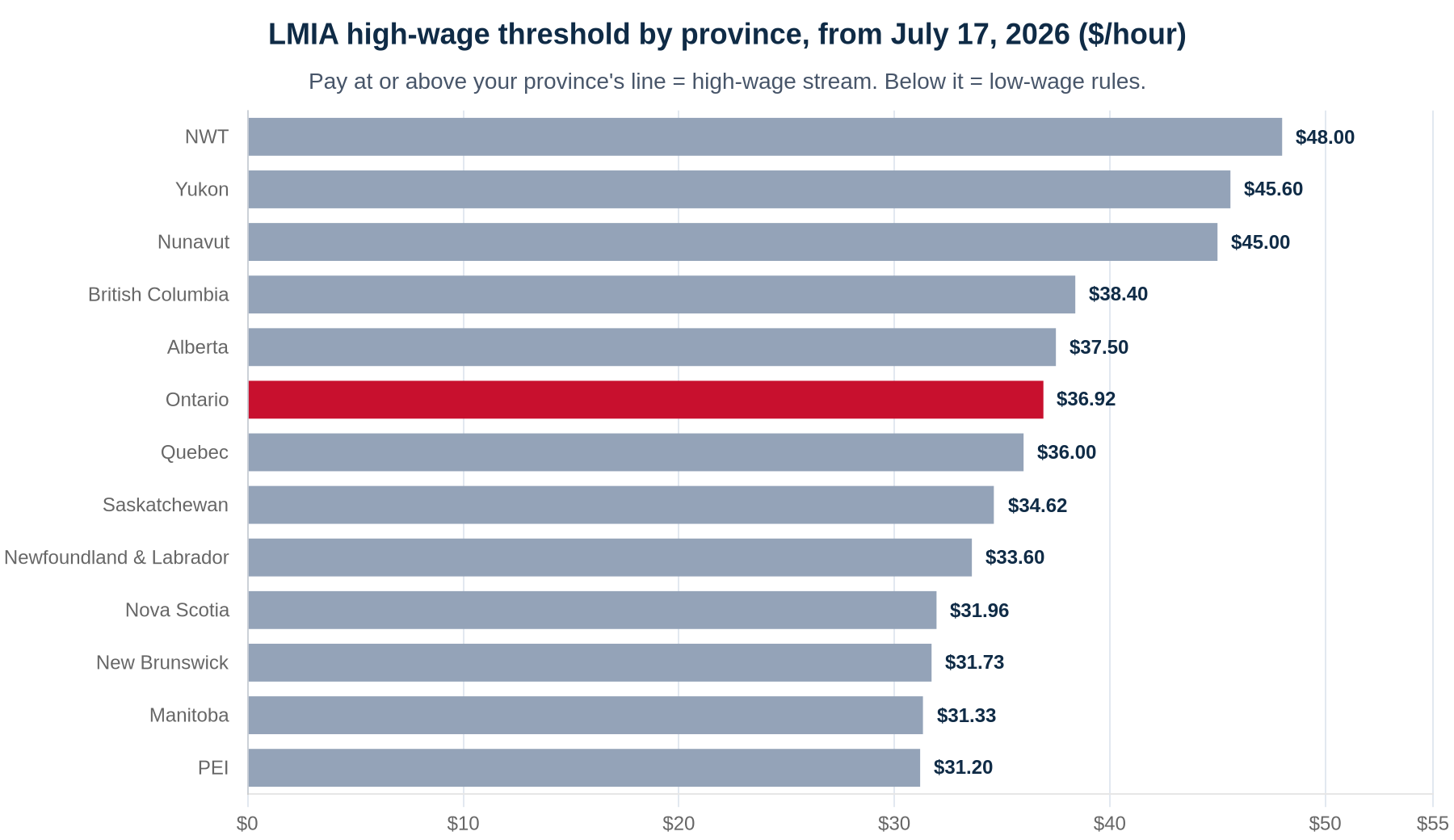
Ontario’s LMIA high-wage threshold is now $36.92 an hour. It was $36.00 until July 16. That 92-cent move quietly reclassified every Ontario job offer paying between $36.00 and $36.91 from high-wage to low-wage.
Every province and territory got a new line on July 17, 2026. Employment and Social Development Canada (ESDC) sets each one at the local median hourly wage plus 20%, using Labour Force Survey data. Eleven of the thirteen went up by more than a dollar. The Northwest Territories stayed flat at $48.00.
Which side of the line your offer lands on decides almost everything about the LMIA: how long the permit can run, how long the employer must advertise, whether there’s a cap on foreign workers, and whether the application gets processed at all in your city.
How the line actually works
The test is simple. The employer compares the hourly wage it is offering with the threshold for the province or territory where the job is. At or above it, the application goes in the high-wage stream. Below it, low-wage.
It is not about the occupation or its skill level. A software developer offered $35 an hour in Toronto is low-wage. A welder offered $38 an hour in Toronto is high-wage. Same program, same fee — $1,000 per position either way — but very different rules.
The wage that counts is the guaranteed wage. ESDC’s low-wage requirements say overtime, tips, bonuses, commissions and benefits are excluded. So a $34 base plus tips does not get you over Ontario’s $36.92.
Where the 2026 increases landed
Ontario’s rise was one of the smallest: 92 cents, about 2.6%. Nova Scotia went up $1.96 (about 6.5%), New Brunswick $1.73, British Columbia $1.80, and Nunavut $3.00. Quebec’s line moved from $34.62 to exactly $36.00.
For scale: at a 40-hour week, Ontario’s threshold works out to roughly $76,800 a year. In PEI, the lowest in the country at $31.20, it is about $64,900.
What changes when you fall below it
This is where a few cents turn into real consequences. Here is what ESDC’s current program pages say for each stream.
Permit length: 1 year vs up to 3
Low-wage LMIAs allow employment for a maximum of 1 year. High-wage employers can request up to 3 years. For a worker, one high-wage LMIA can cover three years of work that would take three separate low-wage LMIAs. It also matters for family: a work permit’s remaining validity affects things like whether your spouse can get an open work permit.
Advertising: 8 weeks vs 4
Low-wage employers must advertise for at least 8 consecutive weeks within the 3 months before applying, make efforts to recruit youth aged 15 to 30, and use at least two additional recruitment methods aimed at under-represented groups. High-wage employers need 4 consecutive weeks on Job Bank plus two other methods, one of them national, with at least one kept running until a decision.
Caps and city freezes apply only below the line
Low-wage workers are capped at 10% of an employer’s workforce at a location, or 20% in construction, food manufacturing, hospitals and nursing care. On top of that, ESDC refuses to process most low-wage LMIAs in census metropolitan areas with unemployment of 6% or higher. We covered which cities are on that refusal list. The current list runs to October 8, and ESDC says the next update is October 9, 2026.
High-wage employers face none of that. Instead they must submit a mandatory transition plan that stays valid for the whole period the foreign worker is employed.
High-wage is not the fast lane
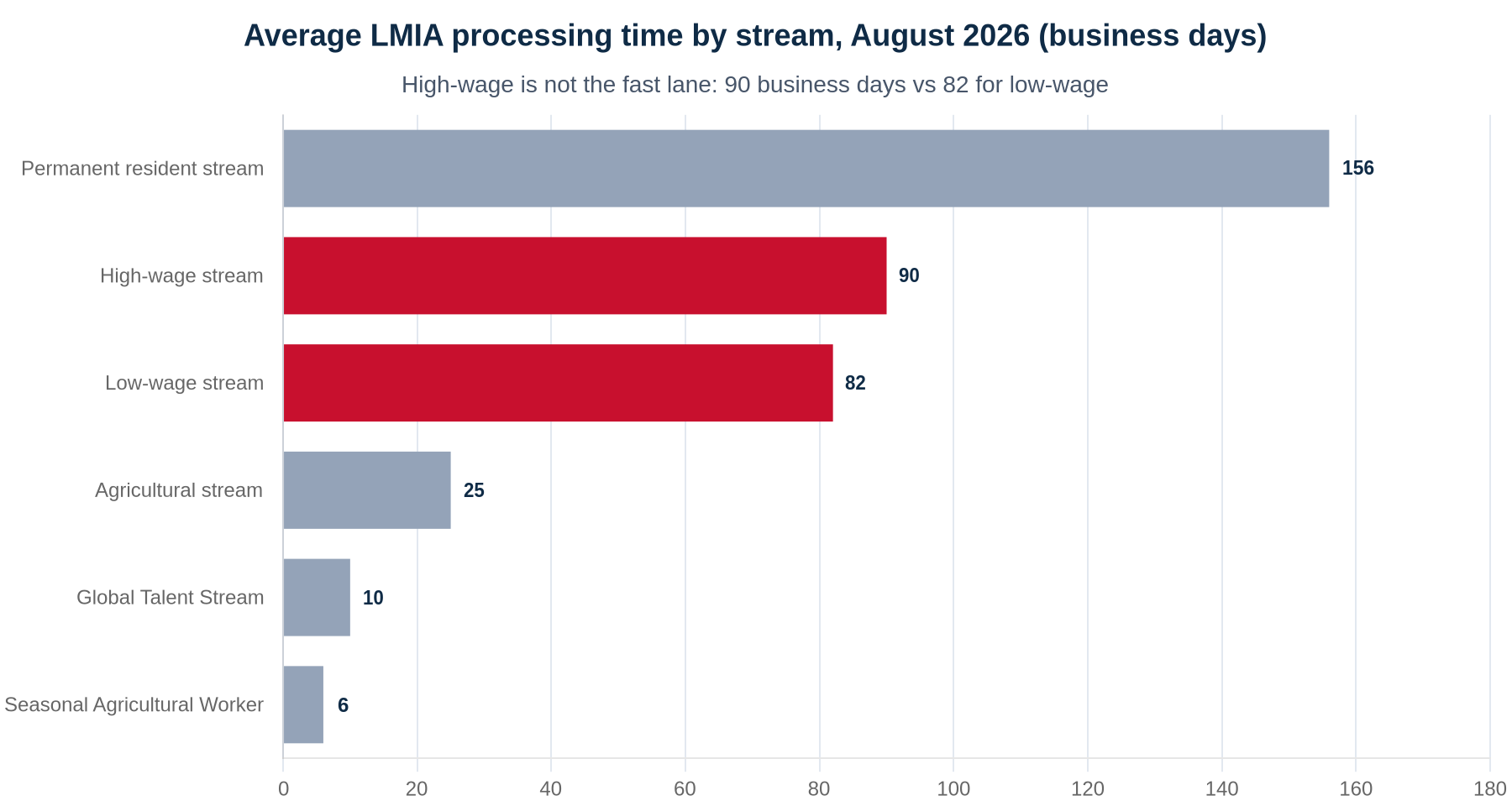
It is tempting to assume a high-wage file moves faster. ESDC’s own numbers say otherwise. In August 2026 the high-wage stream averaged 90 business days and the low-wage stream 82. That is roughly 16 to 18 weeks either way, counted from a complete application.
The permanent resident stream — LMIAs used only to support a PR application — was slowest at 156 business days. The Global Talent Stream held at 10.
The real advantage of high-wage is scope, not speed: longer permits, no cap, and no city freeze.
What to do about it
If your offer was drafted before July 17: check the wage against the new number, not the one in the employer’s template. In Ontario, anything from $36.00 to $36.91 is now low-wage. In Quebec, $34.62 to $35.99 moved the same way.
If you are a few cents under: the employer can raise the guaranteed hourly wage to meet the threshold. That is legitimate. What is not: counting tips or bonuses, or having the worker pay any of it back. ESDC says the $1,000 LMIA fee cannot be recovered from the worker.
If you are low-wage in a frozen city: check whether your employer’s sector is exempt before giving up, and watch the October 9 update. The list moves with local unemployment rates.
If you are aiming for PR in Ontario: the wage matters there too. The OINP’s Workforce Priority stream awards 12 points for $35–$39.99 an hour and 15 for $40 or more. A job at Ontario’s LMIA line sits in the 12-point band.
If your permit is up for renewal: a new LMIA is measured against the current threshold, not the one on your last LMIA. A job that was high-wage last year may not be this year if your raise lagged the median.
What to watch
The thresholds follow wages, so they will keep rising each year. A job offer that is not indexed will drift toward the low-wage side over time.
The direction of policy is tighter at the low end: eight-week advertising, one-year permits, caps and city freezes. None of that applies above the line. For workers, it pays to know the number for your province before you sign — and to remember that a temporary permit is a bridge, not a plan. If PR is the goal, the Canadian Experience Class cut-offs are where your Canadian work hours eventually get counted.
Related reading
- 30 Canadian Cities Where Low-Wage LMIAs Are Frozen This Quarter
- The OINP Was Rebuilt in 2026: What Replaced Ontario’s Nine Streams
- Your Work Permit Needs 16 Months Left Before Your Spouse Can Apply
Data as of September 27, 2026: wage thresholds from ESDC (in effect July 17, 2026); LMIA processing times from ESDC’s August 2026 figures, published September 10, 2026; program requirements from ESDC’s high-wage and low-wage pages; OINP points from ontario.ca. Annual equivalents (hourly × 2,080 hours), percentage changes and week conversions are our own arithmetic, not published figures. This is general information, not legal advice. Consult a licensed immigration lawyer or regulated Canadian immigration consultant (RCIC) about your situation, and verify current rules on canada.ca before acting.
Discover more from CanadianUpdates
Subscribe to get the latest posts sent to your email.