
If you are in Canada as a visitor and apply today to stay longer, IRCC’s own estimate says you will wait 393 days for an answer. That is the published processing time for a visitor record as of September 22, 2026.
It matters because the people who rely on visitor status are rarely tourists. They are parents staying with grandchildren, graduates between permits, and spouses waiting on paperwork. A standard visitor entry lasts six months. The decision on extending it now takes more than twice that.
Here is how the number compares, what it does to you in practice, and the one rule that keeps you legal while you wait.
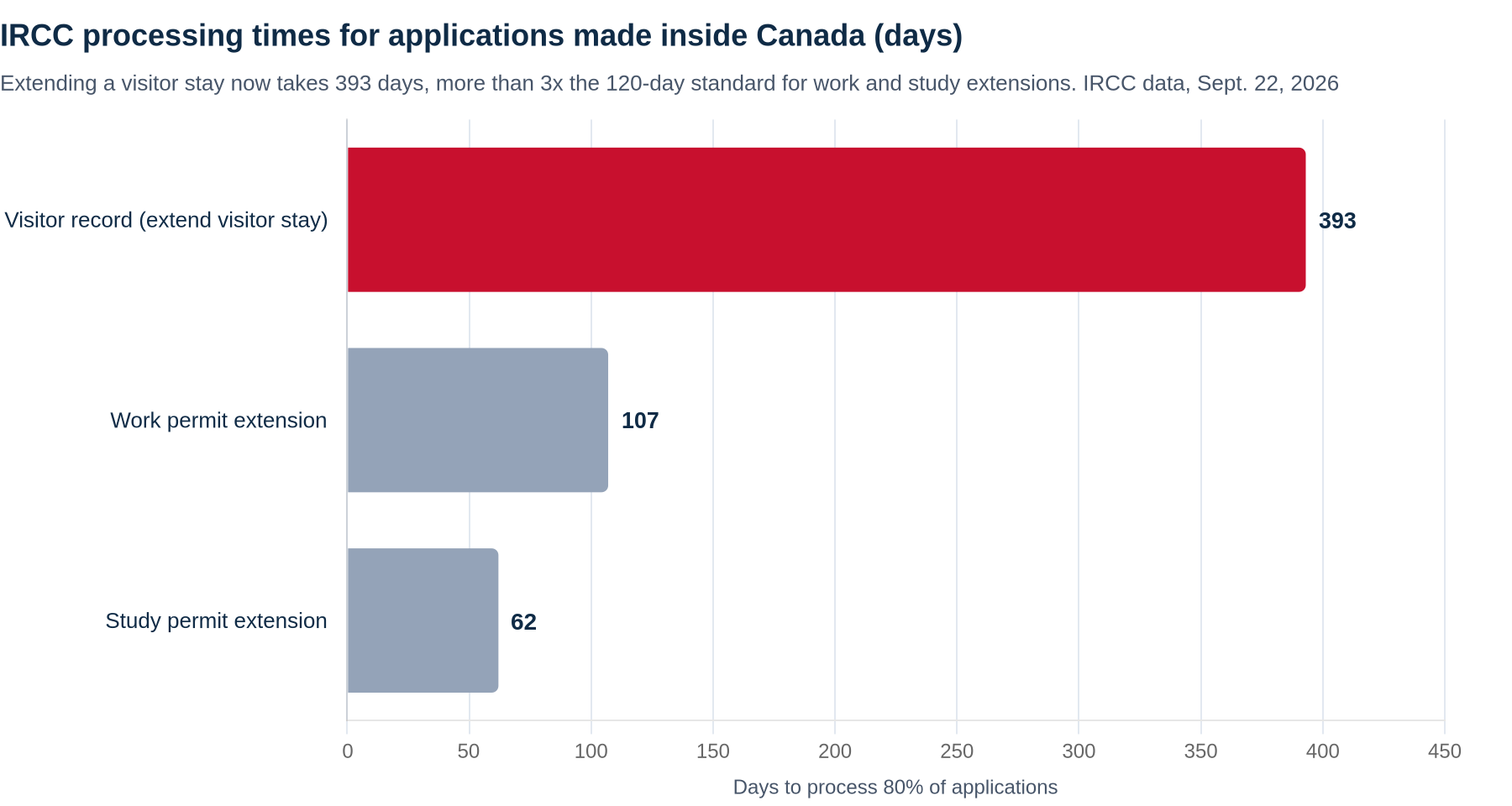
393 days, next to everything else processed in Canada
IRCC updated its processing times on September 22. For applications filed from inside Canada, the picture is lopsided. A study permit extension takes 62 days. A work permit extension takes 107 days. A visitor record takes 393.
Work and study extensions both carry a published service standard of 120 days, with a target of meeting it for 80% of applications. Both are currently inside it. Visitor records have no published service standard at all. There is no target IRCC is measured against, and that is part of the reason this line of business can drift without anyone announcing it.
One more thing about how to read these figures. IRCC’s processing time is how long it took to finalize 80% of recent applications. It describes files already decided, not a promise about yours. Yours could come faster. It could also come slower.
Why a visitor file sits longer than a work permit
IRCC does not explain the gap on its processing-times page, so treat any confident explanation you read online with caution. What is clear is where the department has pointed its capacity. Work and study extensions have published service standards, and IRCC reports its performance against them, including to the House of Commons immigration committee in April. Visitor records have no standard to report against.
The mechanism that follows is simple. When officers are measured on one queue and not another, the unmeasured queue absorbs the delay. That is an inference, not an IRCC statement, but it is consistent with every number on the chart above.
The wait is now longer than the stay
If there is no stamp in your passport, IRCC says your visitor status ends six months from the day you entered Canada. Six months is roughly 183 days. The extension decision takes 393.
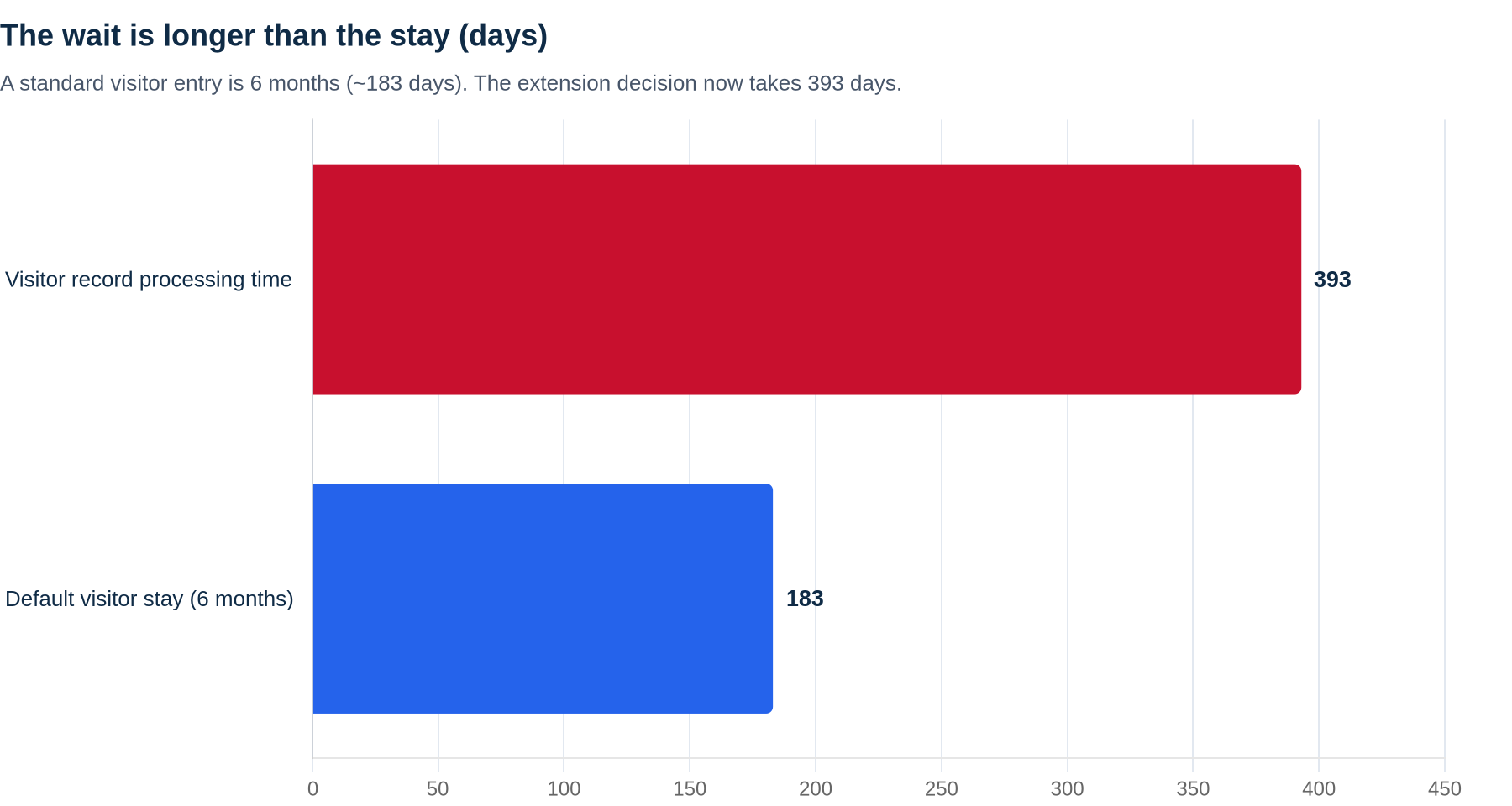
In practice, many people who apply for a six-month extension will reach the end of the period they asked for before IRCC has decided whether to grant it. The application does not fail because of that. But it changes how you should plan.
Maintained status is what keeps you legal
The rule that matters most is timing. If you apply to extend before your status expires, IRCC says you can legally stay in Canada until a decision is made. This is called maintained status. Your original status continues under the same conditions until you are notified of the decision.
Two consequences follow. First, “same conditions” means visitor conditions. If you switched to visitor status after a work permit ended, maintained visitor status does not let you work. Second, IRCC advises applying at least 30 days before your status expires. With a 393-day queue, there is no benefit to cutting it close.
What if you miss the date
If your status has already expired, you may be able to apply to restore it within 90 days of losing it. That is a separate application with its own fee and its own conditions. Do not treat restoration as a backup plan.
Leaving Canada while you wait
You will see claims online that leaving Canada automatically cancels a pending visitor record. IRCC’s application guide says something more specific: you may leave, but if you do not have a document that lets you re-enter, you will have to apply again, at a port of entry if you are eligible to, or at a visa office, and pay another fee. Read the guide for your own situation before you book a flight, not a forum post.
What this means for you
If you are a parent or grandparent visiting family: apply early, and apply once. With the Parents and Grandparents Program no longer taking new sponsorships, more families are leaning on visitor status for longer visits. A super visa may suit a long stay better than repeated extensions, so compare the two before you file.
If your work or study permit is ending and you plan to switch to visitor status: you can apply to change to visitor status from inside Canada. Just know what you are trading. You are leaving a 62- or 107-day queue for a 393-day one, and you cannot work as a visitor. If you are eligible for a work permit extension or a post-graduation work permit, that is usually the faster file.
If you are waiting on a spouse’s work permit or a PR decision: visitor status can bridge the gap, but plan for it to last the full 393 days. Check whether you qualify for a permit that lets you work, such as a spousal open work permit, before defaulting to a visitor record.
If you already applied and are past the date you asked for: your maintained status continues until IRCC decides, provided you applied before your status expired. Keep proof of the date your application was submitted where you can find it.
What to watch next
IRCC refreshes temporary residence processing times regularly, and we track them in our processing times roundups. The question is whether the visitor record figure keeps climbing or whether IRCC shifts capacity toward it. Nobody outside the department knows which. Without a service standard, there is no public benchmark that would force the issue.
The other thing to watch is the 2027–2029 immigration levels plan, normally tabled by November 1. If it tightens temporary residence further, watch whether more people lean on visitor status as a bridge. That is the queue that is already slowest.
Related reading
- IRCC Processing Times: July 2026
- Canada Has Stopped Taking Parent and Grandparent Sponsorships — and 60,500 People Are Still Waiting
- Your Work Permit Needs 16 Months Left Before Your Spouse Can Apply
Processing times are IRCC’s published estimates as of September 22, 2026, and service standards are as published on canada.ca. The 183-day figure for a six-month stay is our own conversion, not an IRCC number. This article is general information, not legal advice. For guidance on your own case, consult a licensed immigration lawyer or an RCIC. Verify current requirements on canada.ca before you act.
Discover more from CanadianUpdates
Subscribe to get the latest posts sent to your email.