
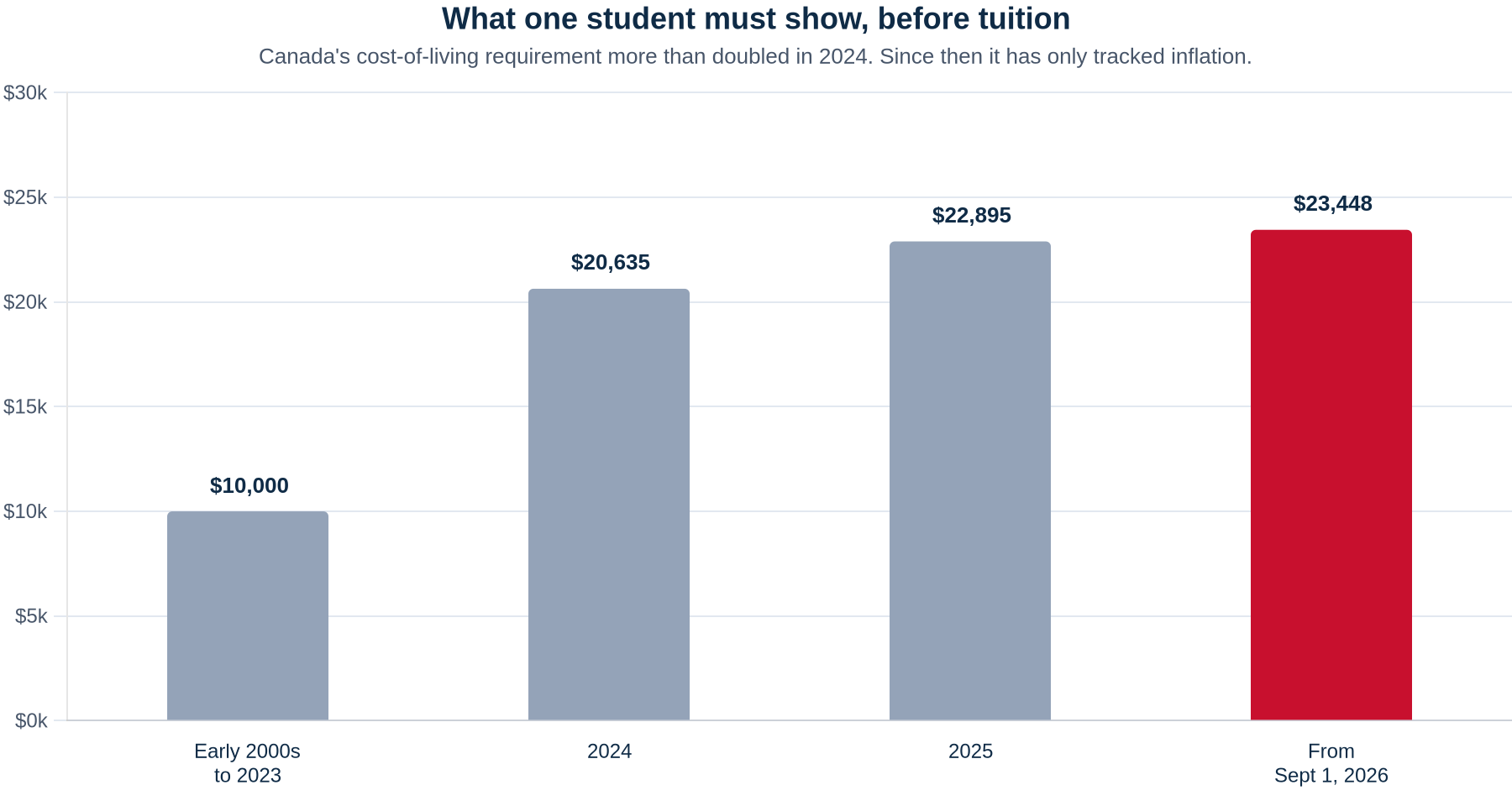
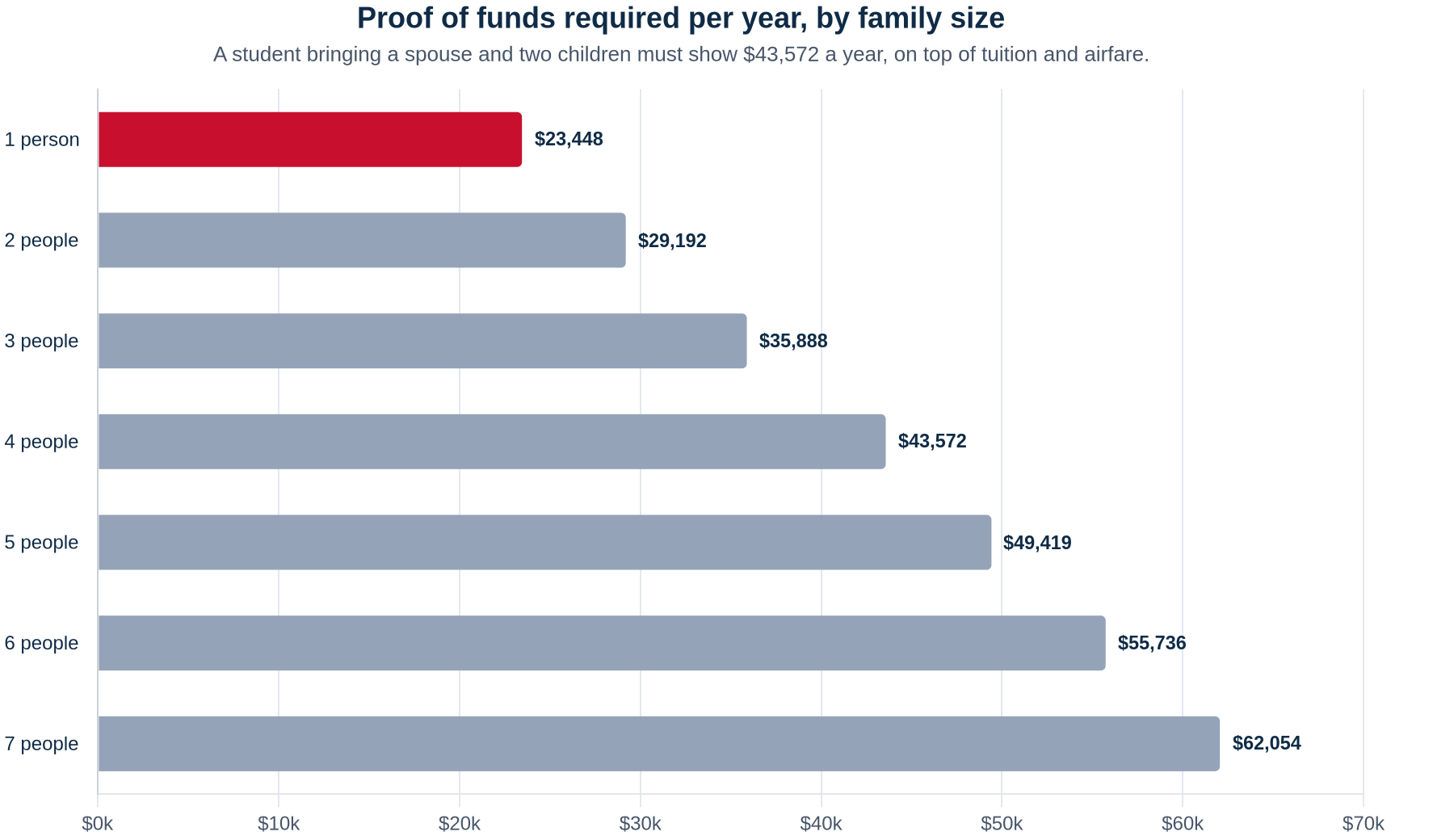
Since 1 September 2026, a single student applying for a Canadian study permit has to show $23,448 for living costs — and that is before tuition and before airfare. Bring a spouse and two children and the number is $43,572.
The increase itself is small: $553 for a single applicant, about 2.4% across every family size. What matters is that the old figure, $22,895, is now wrong, and it sat unchanged for twenty months, so it is printed on a great many consultant pages and university checklists.
Show the old amount and you are short. There is no rounding allowance and no officer discretion advertised for being a few hundred dollars under.
What the number does not include
Read IRCC’s own column heading and the scope is explicit: this is the “amount required per year (excluding tuition and transportation costs).” Tuition sits on top. Your flight sits on top. The $23,448 is what the department expects you to live on.
It also covers everyone travelling with you. The requirement is per year for the household, which is why the jump from one person to two is $5,744 and the jump from three to four is $7,684. A spouse who intends to work in Canada does not reduce the figure. The rule is that you can pay for the year without working here.
You prove one year and explain the rest
This is the part people get backwards. IRCC asks you to “show you have enough financial resources for the first year of your studies,” and separately to “tell us how you plan to pay” for the full duration. So a four-year degree does not require four years of money in an account. It requires one year proven, and a credible account of years two to four.
Acceptable proof is broader than the forums suggest: bank statements for the past six months, a guaranteed investment certificate from a Canadian financial institution, proof of a student loan, scholarship or funded-programme letters, and a letter from whoever is supporting you setting out the relationship and the amount. The six-month bank history is the quiet trap — a lump sum that appears three weeks before you apply invites questions about where it came from and whether it is really yours.
This is an indexed number, not a policy decision
The mechanism explains both the enormous 2024 jump and the small one this month. Until the end of 2023 the requirement was $10,000, set in the early 2000s and never touched. On 1 January 2024 IRCC moved it to $20,635 and defined it as 75% of Statistics Canada’s low-income cut-off, stating that “moving forward, this threshold will be adjusted each year when Statistics Canada updates the low-income cut-off (LICO).”
Once you know that, the rest follows. The 2024 change was a one-off correction of two decades of drift. Everything since is arithmetic: $22,895 in 2025, $23,448 now. Expect the same modest movement next time rather than another doubling.
One wrinkle worth noting: this adjustment did not arrive on 1 January. IRCC’s table shows the previous amounts applying from 1 January 2025 all the way to 31 August 2026, with the new figures taking effect 1 September 2026. If you assumed the number changes every New Year, it does not reliably do so — check the date range on the table itself, not the calendar.
Québec sets its own, higher number
If you are studying in Québec, the federal table does not apply to you. IRCC directs Québec-bound applicants to the amounts set by the Ministère de l’Immigration, de la Francisation et de l’Intégration, and Québec’s figure for one person applying as of 1 January 2026 is $24,617 — $1,169 above the federal amount. Québec publishes its own scale for accompanying family members too, and it does not track the federal one. Use the province’s table, not the one on the IRCC page.
Three things circulating online that are wrong
“You need $20,635.” That was the 2024 figure. It has been superseded twice. Any page still quoting it has not been updated in over two years, which tells you what else on that page is worth trusting.
“Buy the SDS GIC and you’re fast-tracked.” The Student Direct Stream and Nigeria Student Express closed to new applications on 8 November 2024 at 2:00 p.m. ET. Everyone now applies through the regular stream. A GIC is still perfectly good proof of funds — it is on IRCC’s accepted list — but it buys you no processing advantage, and the amount has to meet the current threshold, not the old SDS figure. Processing now runs on the ordinary timelines, which vary enormously by where you apply from.
“Money in the bank is the main thing.” Funds are one requirement among several. You still need a provincial attestation letter in most cases under the 2026 study permit cap, and refusals turn on purpose of study and ties as often as on money. Refusal rates have moved sharply in recent years, and not evenly across countries.
What to do about it
If you are applying in the next few weeks: recalculate against the table for your exact household size, including any dependant travelling with you, and add first-year tuition and airfare on top. Then check the figure against canada.ca yourself rather than against the school’s PDF.
If you already have a GIC or a savings balance at the old amount: top it up by the difference — $553 for a single applicant — before you submit. It is a trivial sum to be refused over.
If a relative is funding you: get the support letter right. IRCC wants the relationship stated and the amount committed, backed by that person’s own financial documents. A vague letter saying someone “will cover all expenses” is weaker evidence than a plain one naming a figure and showing where it sits.
If your account only recently reached the threshold: be ready to explain it. Six months of statements are on the accepted-documents list for a reason. Document the source of a large deposit — a property sale, a loan, a gift — in the same submission rather than waiting to be asked.
If you are already in Canada and extending: do not assume the number that applied when you first arrived still applies. Requirements are assessed against the rules in force on the day you apply, and after the 2024 reset that gap can be large. The same holds for the study-to-work transition, where the PGWP field-of-study list is frozen for 2026.
The direction of travel
The financial bar is no longer a number someone chooses. It is pinned to a Statistics Canada series, which means it will keep rising quietly, in small increments, without a press release each time. That is easier to plan around than a policy announcement — and easier to miss.
The honest framing is that Canada has decided international students should arrive able to afford the country. Whether $23,448 actually covers a year in Toronto or Vancouver is a separate question, and the answer in those two cities is arguably no. The requirement is a floor for a visa decision, not a budget. Build your own, and build it higher.
Related reading
- Canada’s 2026 Study Permit Cap Is 408,000 — And Ontario and Quebec Hold Two Thirds of the Spaces
- The Same Study Permit Takes 2 Weeks From France and 51 Weeks From Iran
- 920 Fields of Study Get You a PGWP. IRCC Froze That List for All of 2026.
Data as of 25 September 2026, taken from IRCC’s study permit proof of financial support page on canada.ca (last modified 28 August 2026), IRCC’s December 2023 announcement of the cost-of-living requirement increase, IRCC’s notice ending the Student Direct Stream and Nigeria Student Express, and the Gouvernement du Québec page on costs related to studying in Québec (updated 1 January 2026). Four figures here are our own arithmetic rather than published numbers: the $553 increase for a single applicant, the approximate 2.4% increase across family sizes, the $5,744 and $7,684 household step-ups, and the $1,169 gap between the federal and Québec amounts for one person. This is general information, not legal advice. Financial thresholds are indexed and change without individual notice — consult a licensed Canadian immigration lawyer or an RCIC about your own case, and verify the current amount for your family size on canada.ca, or on quebec.ca if you are studying in Québec, before you apply.
Discover more from CanadianUpdates
Subscribe to get the latest posts sent to your email.