
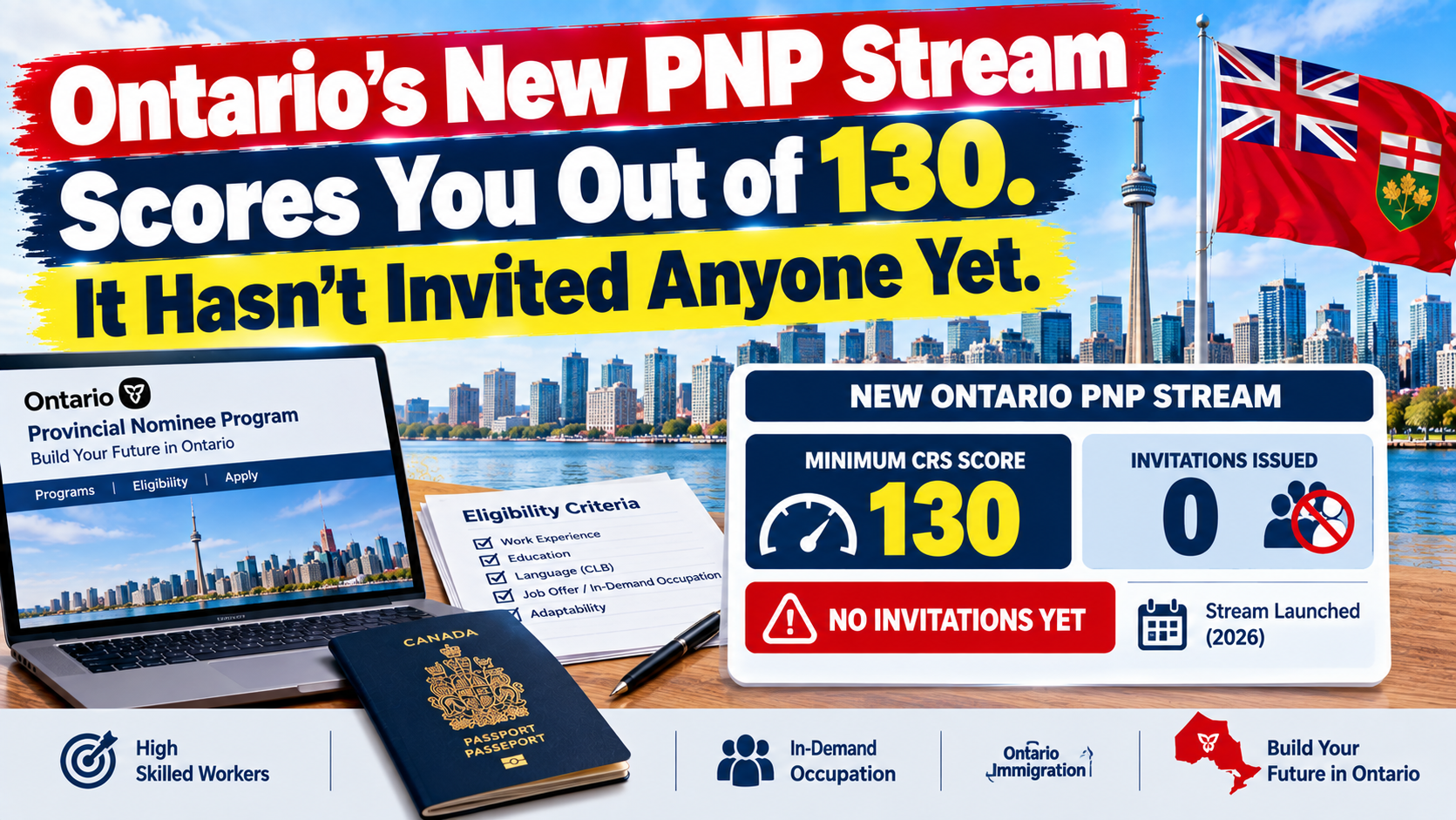
Ontario’s provincial nominee program now scores every candidate out of 130 points. Since August 4, workers with an Ontario job offer have been able to register an expression of interest in the new Ontario Workforce Priority stream. As of September 29, Ontario has not issued a single invitation under it.
That gap matters because the new stream is now the whole program. On June 25, Ontario closed all eight of its previous OINP streams, including the three Express Entry streams, and replaced them with this one employer-driven pathway. Ontario’s federal allocation for 2026 is 14,119 nominations. Its last draw of any kind was on April 30.
Nobody outside the ministry knows what score will get invited. But the grid itself is published, and reading it closely tells you who this stream is built for. It is not built for the highest earner in Toronto.
What closed, and what replaced it
The streams that closed on June 25 were Employer Job Offer: Foreign Worker, In-Demand Skills and International Student; the Masters Graduate and PhD Graduate streams; and Express Entry Human Capital Priorities, French-Speaking Skilled Worker and Skilled Trades. Applications already filed are assessed under the rules in place when they were submitted.
The Ontario Workforce Priority stream has three doors:
- TEER 0 to 3 job offers. Full-time, permanent offer. CLB 6 in all four skills (CLB 5 for skilled trades). A post-secondary credential of at least one year, or a high school diploma for trades. Experience: six consecutive months in the offered job within the last 12, three months if you are a recent Ontario graduate, or two years in the same NOC within five.
- TEER 4 and 5 job offers. Nine months of cumulative full-time experience in the offered job, with that employer, within two years. CLB 4. A high school diploma or equivalent.
- Self-employed physicians. No job offer. You need an OHIP billing number and a certificate of registration with the College of Physicians and Surgeons of Ontario.
The employer must have been operating for at least three years, have premises in Ontario and pay the required wage for the job’s location. Ontario says lower revenue thresholds apply to employers in rural communities, which it defines as census divisions under 150,000 people.
How the 130 points actually work
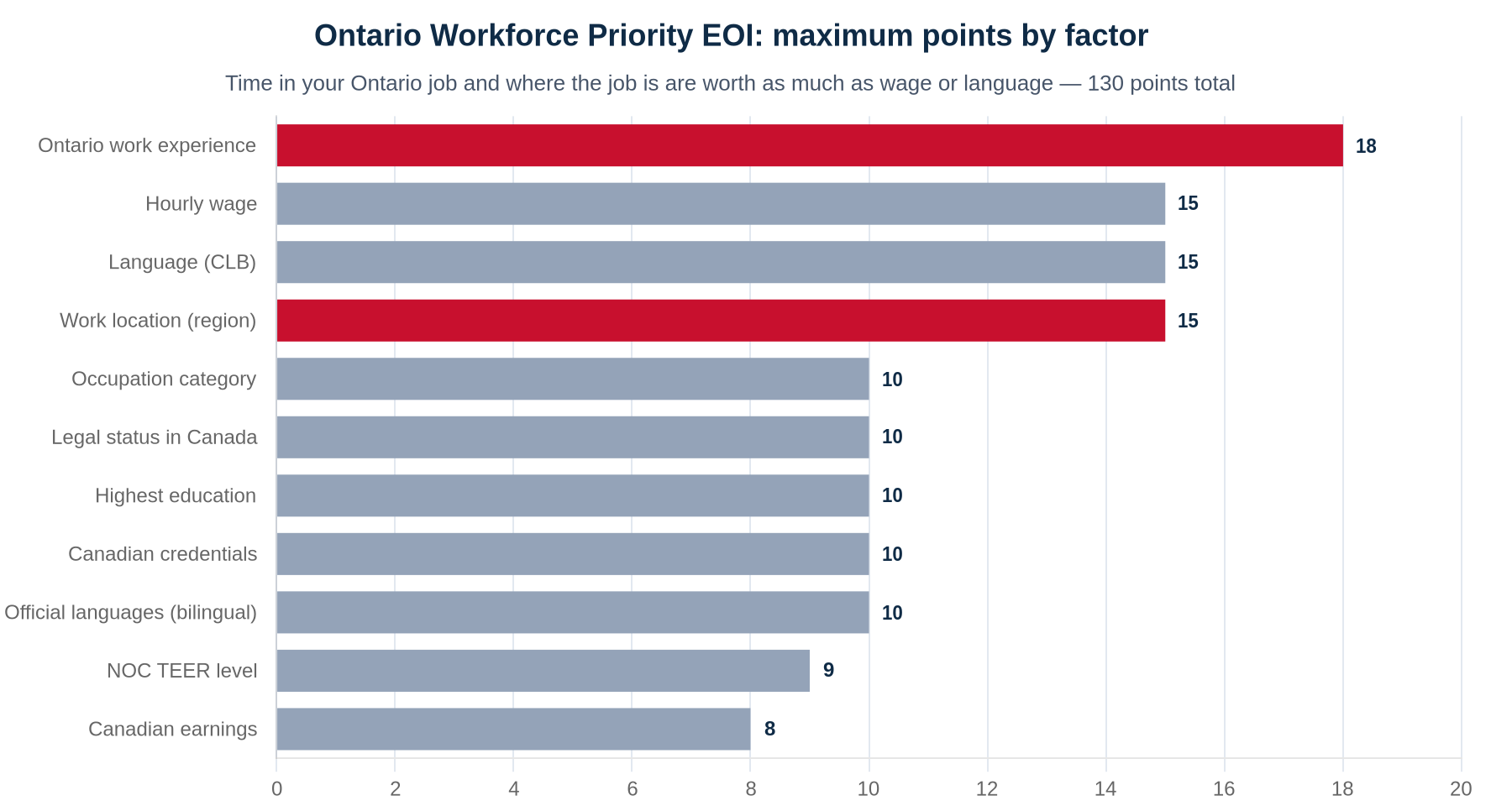
The most valuable single factor is not wage or language. It is time in the job. Over 24 months in your offered position is worth 18 points. If you have under six months in that position, you fall back to a smaller scale based on total Ontario work, capped at 12.
Wage tops out at 15 points for $40 an hour or more. That is the same as the regional bonus: 15 points for a job in Northern Ontario, 10 in Eastern, Central (outside the GTA) or Southwestern Ontario, 5 elsewhere in the GTA, and zero in Toronto.
Occupation beats seniority
The TEER bonus is modest: 9 points for TEER 0 or 1, 6 for TEER 2 or 3, nothing for TEER 4 or 5. The broad occupational category does more steering. Health occupations (category 3) get 10 points, trades and transport (category 7) get 8, natural and applied sciences (category 2) get 6. Sales and service, and arts and culture, get 2.
Language and education are capped low
CLB 9 or higher earns 15 points, CLB 8 earns 12, CLB 7 earns 8. A second official language at CLB 6 or better adds 5 on top of the base 5. A master’s degree is worth 8, a bachelor’s 6. More than one Canadian credential adds 10. Compare that with Express Entry, where a strong IELTS score and a degree can swing a profile by more than a hundred CRS points. Here, the ceiling on either is modest.
Who comes out ahead
To show how the weights interact, we scored four hypothetical workers, each on a valid work permit, against Ontario’s published grid.
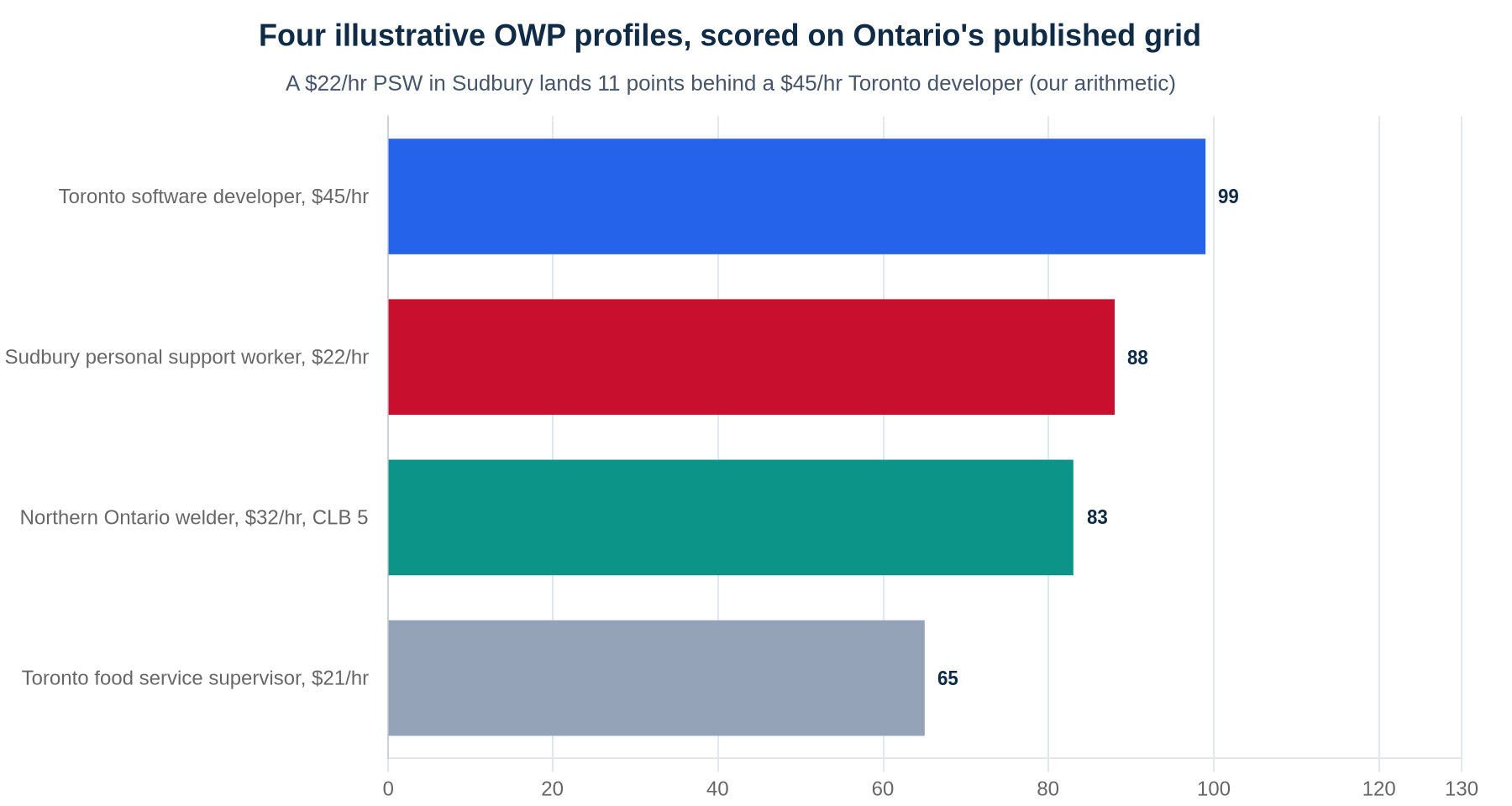
The Toronto software developer has everything the old Human Capital Priorities stream rewarded: $45 an hour, a Canadian master’s degree, CLB 9 and more than two years in the role. That scores 99. The personal support worker in Sudbury earns $22 an hour, holds an Ontario college certificate and tests at CLB 7. She scores 88. The health-category bonus and the Northern Ontario bonus together are worth 25 points, and the Toronto developer gets 6.
The Northern Ontario welder at CLB 5 with no Canadian credential still reaches 83. The Toronto food service supervisor earning $21 an hour, with the same language and education as the PSW, scores 65. He loses 8 points on occupation category and 15 on location.
The design is deliberate. Ontario said the redesign aims to raise language and education benchmarks for eligibility, then built a ranking that tilts toward health care, trades and jobs outside Toronto. If you remember the Masters Graduate stream, which needed no job offer at all, this is a different program.
What to do about it
If your employer hasn’t started: nothing happens until they do. The employer submits the job offer in the OINP Employer Portal first. You then have 30 calendar days to register your EOI. Miss that window and the employer has to start over.
If you are in a Toronto job with under two years in it: time is your cheapest lever. Moving from the 13 to 24 month band to over 24 months is worth 3 points. Reaching six months in the position moves you onto the full scale, worth up to 12 points more if you have little other Ontario work. Check the difference before you change jobs, because a new position resets the clock that carries the most weight.
If your work permit expires soon: a valid work permit is worth 10 points, a study permit 5. Maintained status keeps you eligible, but plan the renewal before you register. Our explainer on the 16-month rule for spousal open work permits covers a related timing trap.
If you were counting on Ontario’s Express Entry streams: they are gone. You can still be nominated through Express Entry, but only by applying to the new stream in a TEER 0 to 3 job, meeting the rules of a federal Express Entry program, and keeping your profile valid until nomination. Accepting that nomination adds 600 CRS points, which is how Ontario nominees end up in the federal PNP rounds covered in this morning’s post on the September 28 draw. Let the profile lapse after nomination and you start the OINP process over.
If a website quotes an OWP cut-off score: ignore it. No draw has taken place, so there is no cut-off. Treat any page that still lists the Human Capital Priorities or Masters Graduate streams as open as out of date. Both closed on June 25.
What to watch
The first draw is the event that turns this grid from theory into a number. Ontario gives no advance notice of draws and has published no schedule. When invitations come, expect them to be targeted, as the pre-redesign draws were: by region, by occupation group, or for physicians. Between February 2 and April 30 Ontario issued 13,642 invitations across its old streams, many of them in draws limited to health care, trades or a single region.
Invitations are not nominations, and 2026 has three months left. Whether Ontario uses its full 14,119 allocation depends on how fast it can move a brand-new pool through invitation, employer applications and approval. The June update called this “Phase 1” of the redesign. A second phase has not been described yet. Note that the OWP wage bands do not line up with federal ones. A $36.50 job is “low-wage” now that Ontario’s LMIA high-wage line rose to $36.92, yet it still earns 12 of 15 wage points here.
Related reading
- Canada Invited 733 Provincial Nominees on September 28. The Cut-Off Doesn’t Mean What You Think.
- 30 Canadian Cities Where Low-Wage LMIAs Are Frozen This Quarter
- 920 Fields of Study Get You a PGWP. IRCC Froze That List for All of 2026.
Program rules, points and draw data as published on ontario.ca as of September 29, 2026. The 130-point maximum, the four sample profile scores and the 13,642 invitation total are our own arithmetic from Ontario’s published scoring grid and draw announcements; the profiles are hypothetical. This article is general information, not legal advice. Consult a licensed immigration lawyer or a regulated Canadian immigration consultant (RCIC) about your situation, and verify current requirements on ontario.ca and canada.ca before applying.
Discover more from CanadianUpdates
Subscribe to get the latest posts sent to your email.