
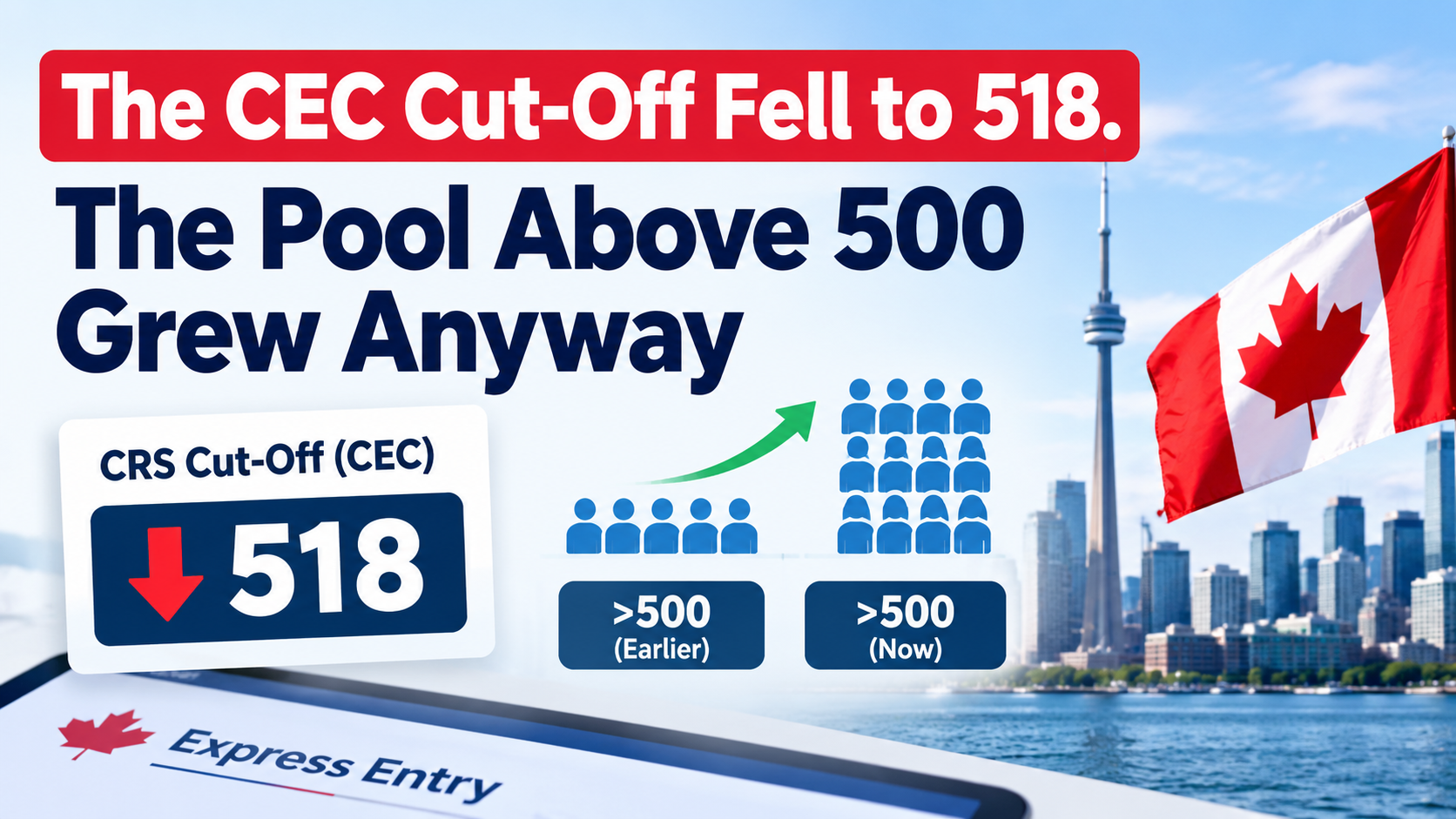
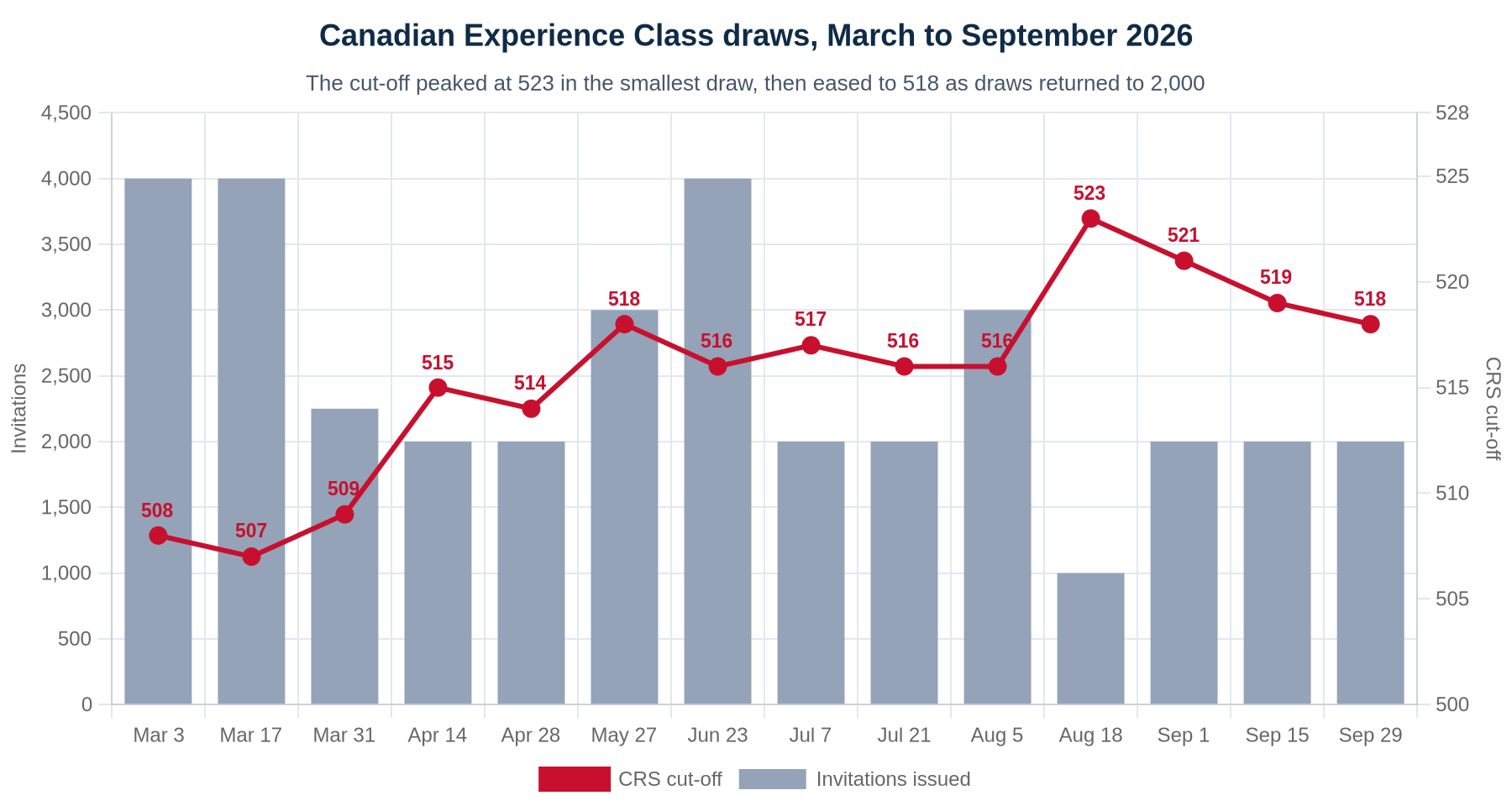
The Canadian Experience Class cut-off fell to 518 on September 29, 2026. That is the third CEC round in a row with a lower score: 523 on August 18, 521 on September 1, 519 on September 15, and now 518, with 2,000 invitations each time.
Five points in six weeks sounds like relief. It is real, but it is small, and the pool data IRCC published alongside the draw shows why it may not go much further: the group of candidates scoring above 500 got bigger in September, not smaller.
Here is what moved the score, and what did not.
September was the biggest CEC month since March
When we looked at the CEC cut-off at the start of September, the explanation for the climb was draw size. The August 18 round invited just 1,000 people, and the score jumped to 523.
September reversed that. IRCC held three CEC rounds of 2,000 each — 6,000 invitations in one month. That is more than any month since March, when three rounds totalled 10,250. Every month from April to August came in between 3,000 and 4,000.
The mechanism is the same one that pushed the score up, running the other way. A cut-off is just the score of the last person who fit inside the draw. Run larger draws on a steady two-week rhythm and you reach a little further down the ranking each time. That is all 518 means.
The tie-break date tells the same story
When several candidates share the lowest score in a draw, IRCC invites the ones who submitted their profiles first, and publishes the cut-off timestamp. On September 15, candidates at 519 were invited if their profile was in before March 26, 2026. On September 29, candidates at 518 needed a profile submitted before February 13, 2026 at 20:48:08 UTC.
An earlier tie-break date at a lower score means the draw ran out of room partway through the 518s. In other words, there are a lot of people sitting at exactly this level.
The pool above 500 grew anyway
This is the part most draw coverage skips. IRCC publishes a snapshot of the pool with every round. Between August 30 and September 27, two CEC draws invited 4,000 people. Over the same four weeks, the number of profiles scoring 501 to 600 rose from 19,542 to 21,070 — an increase of 1,528. Profiles above 600, most of them provincial nominees, went from 559 to 728.
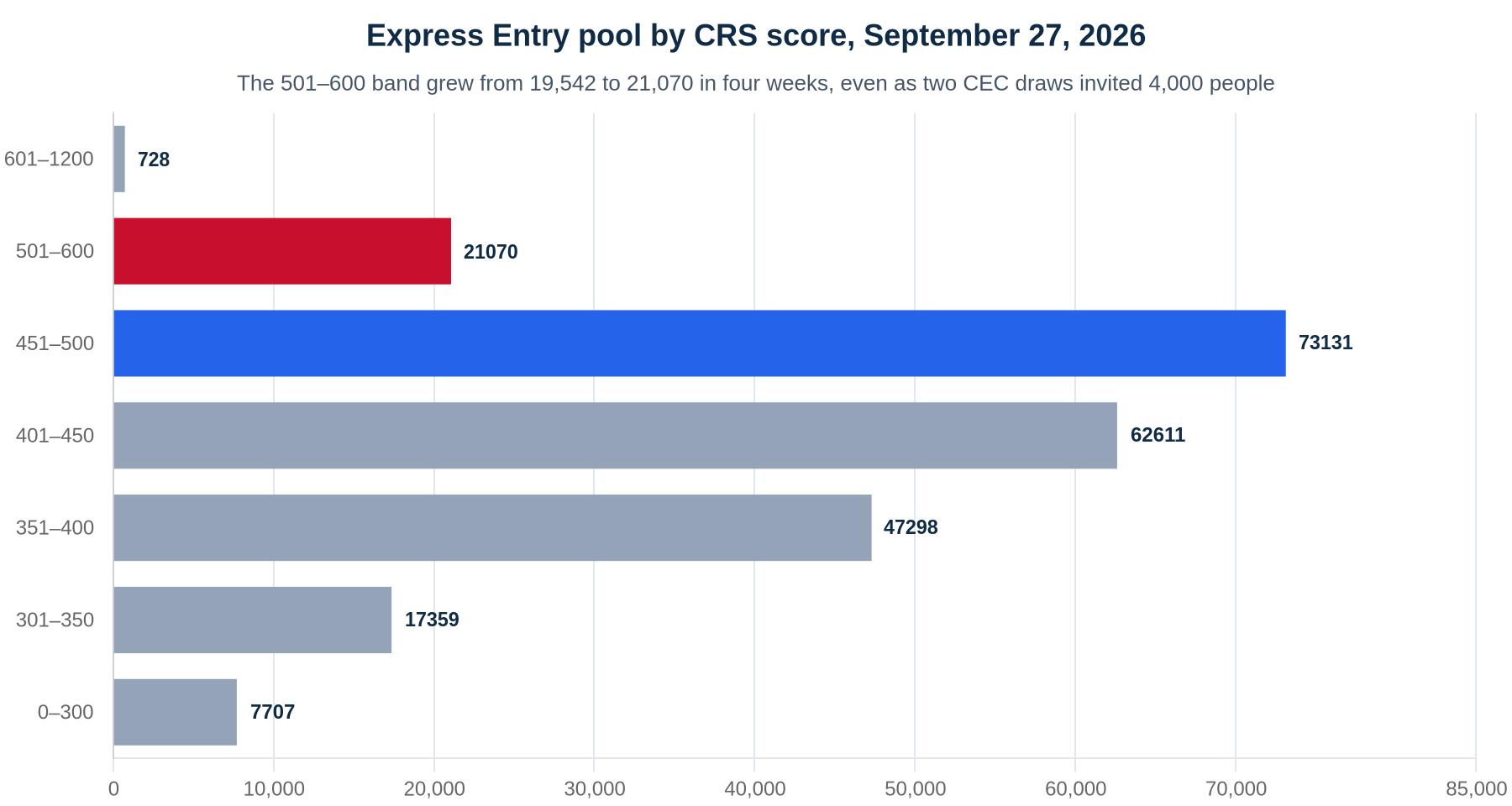
The pool as a whole grew too, from 226,673 to 229,904 profiles. The one band that shrank was 451 to 500, down from 74,105 to 73,131. Some of that movement is likely people crossing 500 — through a language retest, another year of Canadian work experience, or a new credential — rather than leaving the pool. IRCC does not publish how individual profiles move, so that is an inference, not a measurement.
Why a growing band did not push the score back up
Not everyone scoring 501 to 600 can be invited in a CEC draw. That band also holds Federal Skilled Worker candidates abroad with no Canadian experience, and CEC rounds cannot reach them. IRCC does not split the published distribution by program, so nobody outside the department knows how many of those 21,070 are actually competing for CEC invitations.
What the numbers do show is near-balance. The top of the pool is refilling at roughly the pace 2,000-person draws are clearing it. That is why the score is drifting down one or two points at a time, not falling off a cliff.
Where the other invitations are going
CEC is still only part of the picture. In September alone, IRCC also ran a healthcare and social services round of 3,500 at 475, a physicians round at 198, a senior managers round at 389, and two PNP rounds. The 733-person PNP round on September 28 was the largest since June.
Those category rounds are where scores in the 300s and 400s get invited. The gap is the same one we found when we lined up the French-language draws against CEC: the category you qualify for matters far more than a few points of CRS.
What this means for you
If you are between 515 and 520: you are in the zone the last three draws have been working through. Keep your profile current and make sure your documents — police certificates, reference letters, language results with time left on them — are ready before an invitation arrives. You get 60 days to submit a complete application once invited, and some documents, like police certificates from other countries, can take weeks to arrive.
If you are sitting exactly on a recent cut-off: your profile’s submission date is the tie-breaker. Do not withdraw and recreate an active profile to “refresh” it. A new profile gets a new timestamp and goes to the back of the line at your score. You will need a new profile if yours expires after 12 months, but there is no reason to give up an earlier date voluntarily.
If you are between 501 and 514: a few more 2,000-person rounds could bring the score toward you, but nothing guarantees it, and the band above you is filling as fast as it empties. Treat any gain you can make — a language retest, a spouse’s language score, a credential assessment you have not claimed — as the plan, not the backup.
If you are between 451 and 500: a 518 cut-off does not change your situation. With 73,131 profiles in your band, a general CEC round is unlikely to reach you at current volumes. Check whether your occupation falls under a 2026 category, and look at provincial nomination — understanding that Ontario’s new Workforce Priority stream has not invited anyone yet.
Be wary of sites claiming to know the next cut-off to the point. A falling trend of one or two points per round says nothing reliable about the next round. The score depends on the draw size, and IRCC announces that at the same moment it announces the score.
What to watch next
Watch draw size first. If CEC rounds stay at 2,000 every two weeks, the September pattern suggests small downward steps or a plateau in the high 510s. If IRCC drops back to 1,000, expect a repeat of August 18.
Then watch the policy calendar. The next immigration levels plan, expected this fall, sets how much permanent residence space Express Entry has to work with in 2027. And IRCC’s proposal to merge CEC, FSW and FST into one program would change who competes in these rounds altogether. Neither has a confirmed effect on the cut-off yet, and anyone telling you otherwise is guessing.
Related reading
- Why the CEC cut-off climbed from 507 to 523 in five months
- CRS cut off at 389 for senior managers. The day before, CEC cut off at 519.
- Canada invited 733 provincial nominees on September 28
Draw results and pool distributions are from IRCC’s published Express Entry rounds data for rounds up to September 29, 2026, with pool composition as of August 30 and September 27, 2026. Monthly CEC invitation totals and the change in each score band are our own arithmetic from those published figures. This article is general information, not legal advice. For guidance on your own case, consult a licensed immigration lawyer or a regulated Canadian immigration consultant (RCIC). Verify current requirements on canada.ca before you act.
Discover more from CanadianUpdates
Subscribe to get the latest posts sent to your email.