

Since September 1, 2026, Nova Scotia charges $1,000 to assess a provincial nominee application in its worker streams, and $2,000 for entrepreneurs. Before that, its nominee program was free. It also has no waivers: the fee applies to every stream and every applicant selected.
Nova Scotia is not an outlier. It is the latest province to start charging or raise its fee. British Columbia went from $1,475 to $1,750 in January. Saskatchewan started charging skilled workers with job offers $500 in April. Alberta added a $135 fee just to submit a worker expression of interest. Across the nine provinces with a nominee program, worker-stream fees now run from $0 to $2,000.
Here is what each province charges, when you pay, and what you get back if it goes wrong.
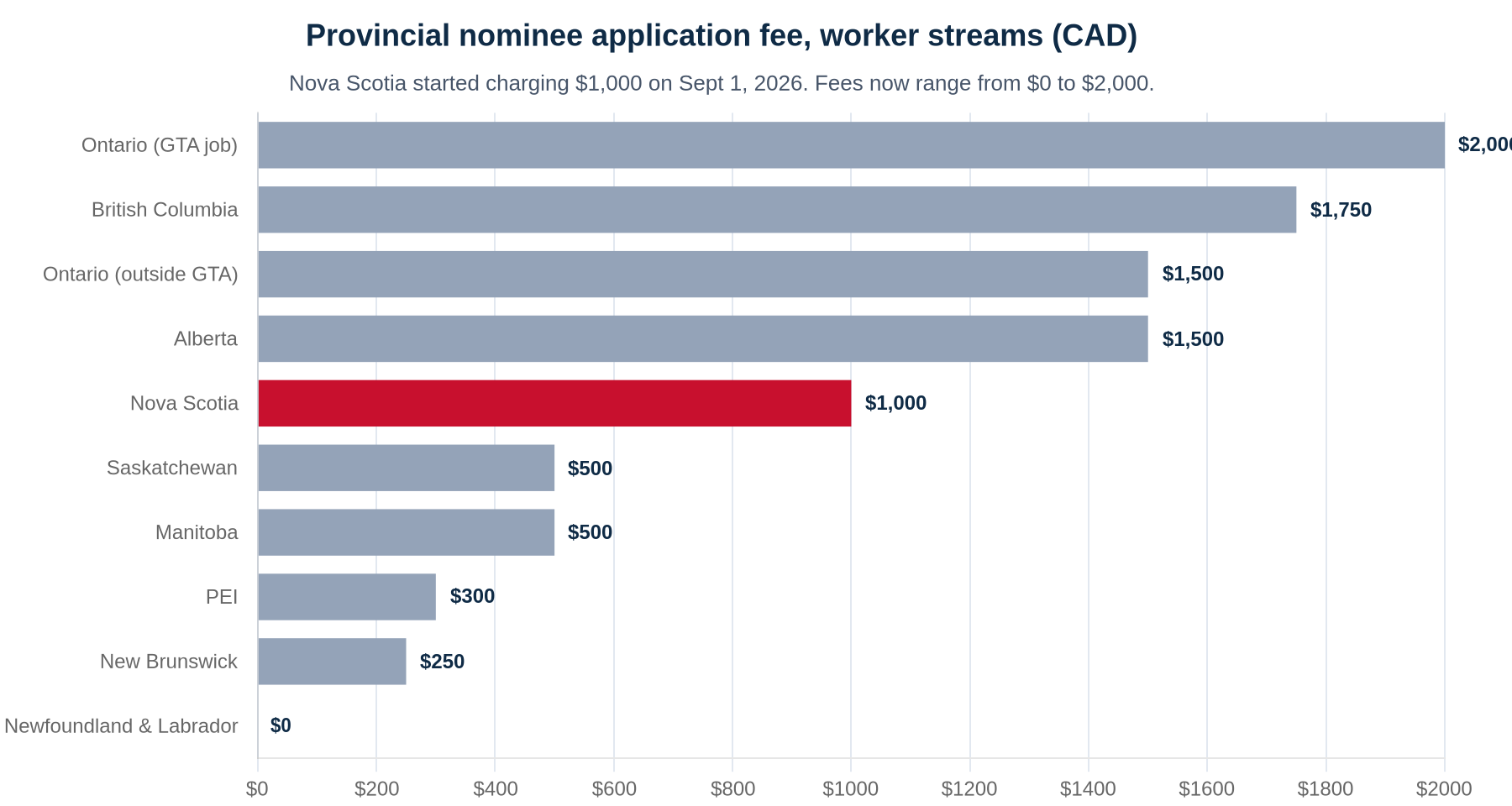
What every province charges in worker streams
These are the provincial fees only, as published on each province’s own program pages. Quebec runs its own selection system and is not a PNP, so it is not included.
- Ontario: $2,000 if the job offer is in the Greater Toronto Area, $1,500 if it is outside. That applies to the new Workforce Priority stream, which is now Ontario’s only stream. Registering an EOI is free.
- British Columbia: $1,750 for Skills Immigration, up from $1,475 on January 22, 2026.
- Alberta: $1,500 for every worker stream, plus $135 to submit a Worker EOI since April 7, 2026.
- Nova Scotia: $1,000 for Skilled Worker, Nova Scotia Graduate and Nova Scotia Express Entry, from September 1, 2026.
- Saskatchewan: $500 for International Skilled Worker applications. From April 1, 2026, the province also began charging $500 to skilled workers with job offers, who used to pay nothing, and added a $250 fee for a second review.
- Manitoba: $500, charged once you receive a Letter of Advice to Apply.
- Prince Edward Island: $300.
- New Brunswick: $250 for Skilled Worker and Express Entry. EOIs are free.
- Newfoundland and Labrador: no fee. The province removed its fees in 2022.
Entrepreneur streams cost far more
Business streams carry the highest fees: $3,500 in Alberta, $2,500 in Saskatchewan and Manitoba, $2,000 in Nova Scotia and New Brunswick. Prince Edward Island’s Business Impact stream costs $10,000. Its guide says $7,500 of that comes back if the application is declined before the interview.
The provincial fee is the first bill, not the only one
A nomination does not make you a permanent resident. It lets you apply to IRCC, and IRCC charges separately. Its fee list shows $1,590 for a principal applicant in the provincial nominee class: a $990 processing fee plus the $600 right of permanent residence fee. A spouse or partner pays the same $1,590. Each dependent child pays $270.
Put the two together and the government fees alone for a single applicant now range from $1,590 in Newfoundland and Labrador to $3,590 for an Ontario job in the GTA. Add a spouse and the IRCC side doubles. And that is before language tests, credential assessments, medical exams and police certificates.
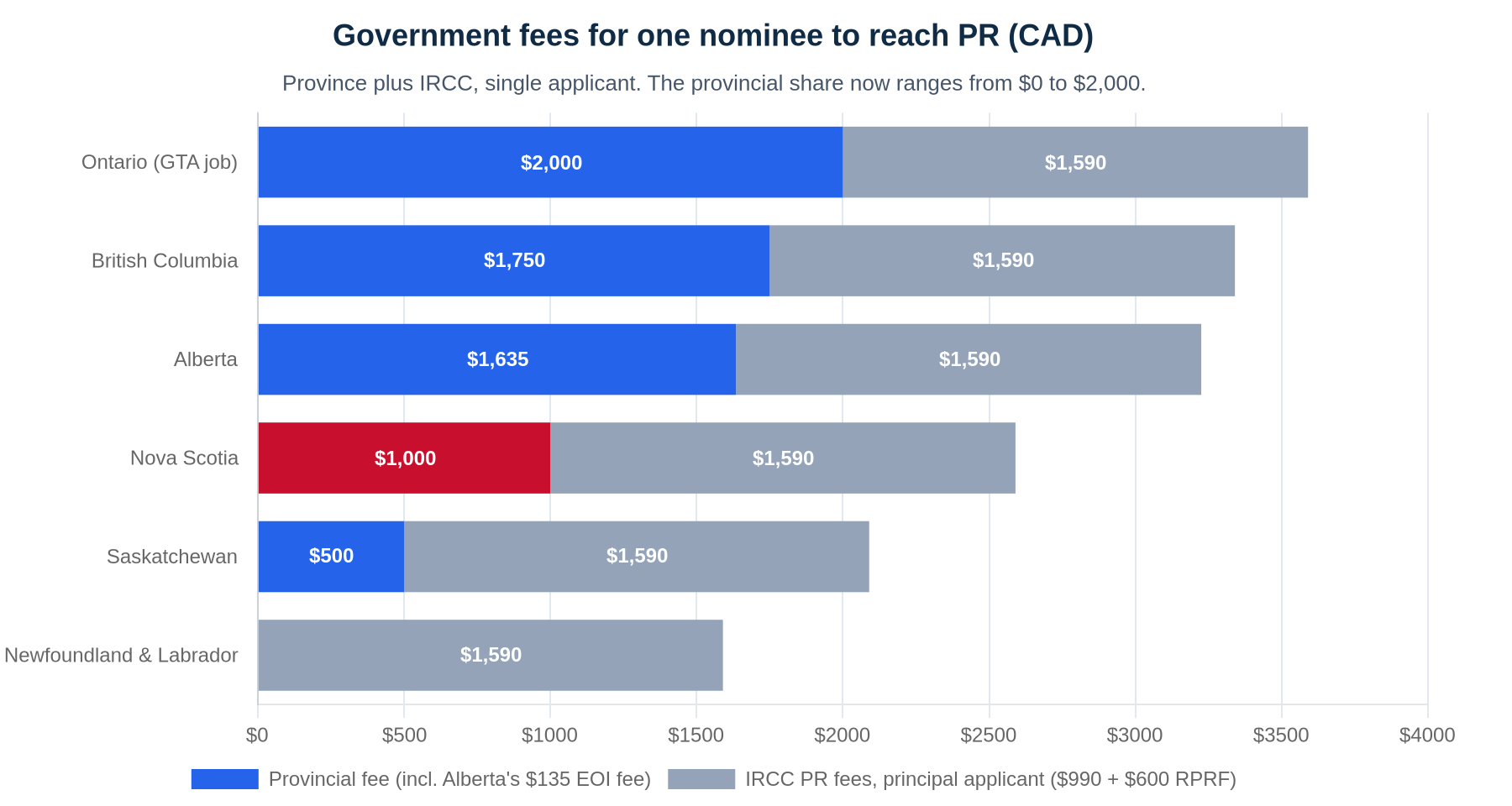
Why provinces are charging now
The mechanism is simple. Ottawa caps how many people each province can nominate, and demand for those spots far outruns supply. A fee does not change your odds of being chosen in a points-based draw. What it does is make each application pay for its own assessment. Alberta tied its 2025 increase to the cost of delivering the service. When a province only assesses people it has already selected, as Nova Scotia now does, a fee also discourages people from sitting on an invitation they never plan to use.
The fees also follow the shape of each program. Ontario charges more for a GTA job, while its new Workforce Priority points grid gives Toronto jobs zero location points. Both nudge applicants away from the city.
When you pay, and what you get back
Timing and refunds differ more than the amounts do, and this is where people lose money.
In Nova Scotia, the fee is due within 7 calendar days of being told you were selected for assessment, for the worker streams. It is non-refundable except where required by law or after an administrative error. Anyone selected on or after September 1 pays, even if their EOI went in months earlier. Only people who had a selection letter before that date are exempt.
In Ontario, the fee is refunded if your application is found incomplete, or if you withdraw before processing starts. Once processing begins it is not refunded, and a refusal does not get you your money back.
In British Columbia, the higher fee applies only to applications submitted on or after January 22, 2026. Earlier applicants did not have to pay the difference.
In Alberta, the $135 is charged when you submit a Worker EOI, before anyone has decided whether to invite you. You pay it whether or not you are drawn.
What to do about it
If you have an EOI in Nova Scotia’s pool: have $1,000 ready on a card now. Seven days is a short window, and you do not control when the selection email arrives. Check your spam folder settings while you are at it.
If you are choosing between provinces: do not let the fee decide. A $1,500 difference is small next to your actual eligibility, the province’s allocation and how often it draws. A free province you cannot qualify for is worth nothing. Look at whether you match a stream’s rules and recent draws first, then budget for the fee.
If you are thinking about submitting EOIs everywhere “just in case”: that used to cost nothing. In Alberta it now costs $135 per Worker EOI, and in Nova Scotia an invitation you cannot follow through on can leave you scrambling for $1,000 in a week. Apply where you meet the criteria and would actually move.
If you are also in the Express Entry pool: a provincial nomination adds 600 CRS points, which is why the cut-offs in rounds like the September 28 PNP draw look so high. With the general CEC cut-off still at 518 as of this week, a nominee fee can be the cheapest route to an invitation for anyone stuck in the 400s.
If a consultant quotes you one “PNP fee”: ask what it covers. Fee tables written before these changes still circulate. If one shows B.C. at $1,475, Nova Scotia as free or Alberta’s EOI as free, it is out of date. Your total bill has at least three parts: the province, IRCC and the consultant’s own fee, which is separate from both.
What to watch
The direction is clear. In the last 18 months, Alberta raised its fee, B.C. raised its fee, Saskatchewan extended its fee to more applicants, Alberta started charging for EOIs and Nova Scotia started charging at all. None of the provinces we checked lowered a fee in that period. At the bottom of the chart, New Brunswick’s $250 fee has been set in regulation since 2012.
The next pressure point is federal. The immigration levels plan expected this fall sets how many nominations Ottawa hands out for 2027. If allocations shrink, expect more provinces to look at fees as a way to manage demand and cover costs. Watch provincial budget documents and “fees and charges” backgrounders, which is where Saskatchewan announced its change. Fee increases are rarely front-page news, and they rarely come with much notice.
Related reading
- Ontario’s New PNP Stream Scores You Out of 130. It Hasn’t Invited Anyone Yet.
- Canada Invited 733 Provincial Nominees on September 28. The Cut-Off Doesn’t Mean What You Think.
- Ontario’s LMIA Wage Line Rose to $36.92. A $36.50 Job Is Now “Low-Wage.”
Fees are as published on each province’s official nominee program pages and on IRCC’s fee list as of October 1, 2026, in Canadian dollars. Combined totals in the second chart (provincial fee plus IRCC fees, and Alberta’s application fee plus its EOI fee) are our own arithmetic from those published figures. Saskatchewan’s page for its Saskatchewan Experience categories was not clear on whether the $500 fee applies there. This article is general information, not legal advice. For guidance on your own case, consult a licensed immigration lawyer or a regulated Canadian immigration consultant (RCIC). Verify current fees on your province’s official site and on canada.ca before you apply.
Discover more from CanadianUpdates
Subscribe to get the latest posts sent to your email.