
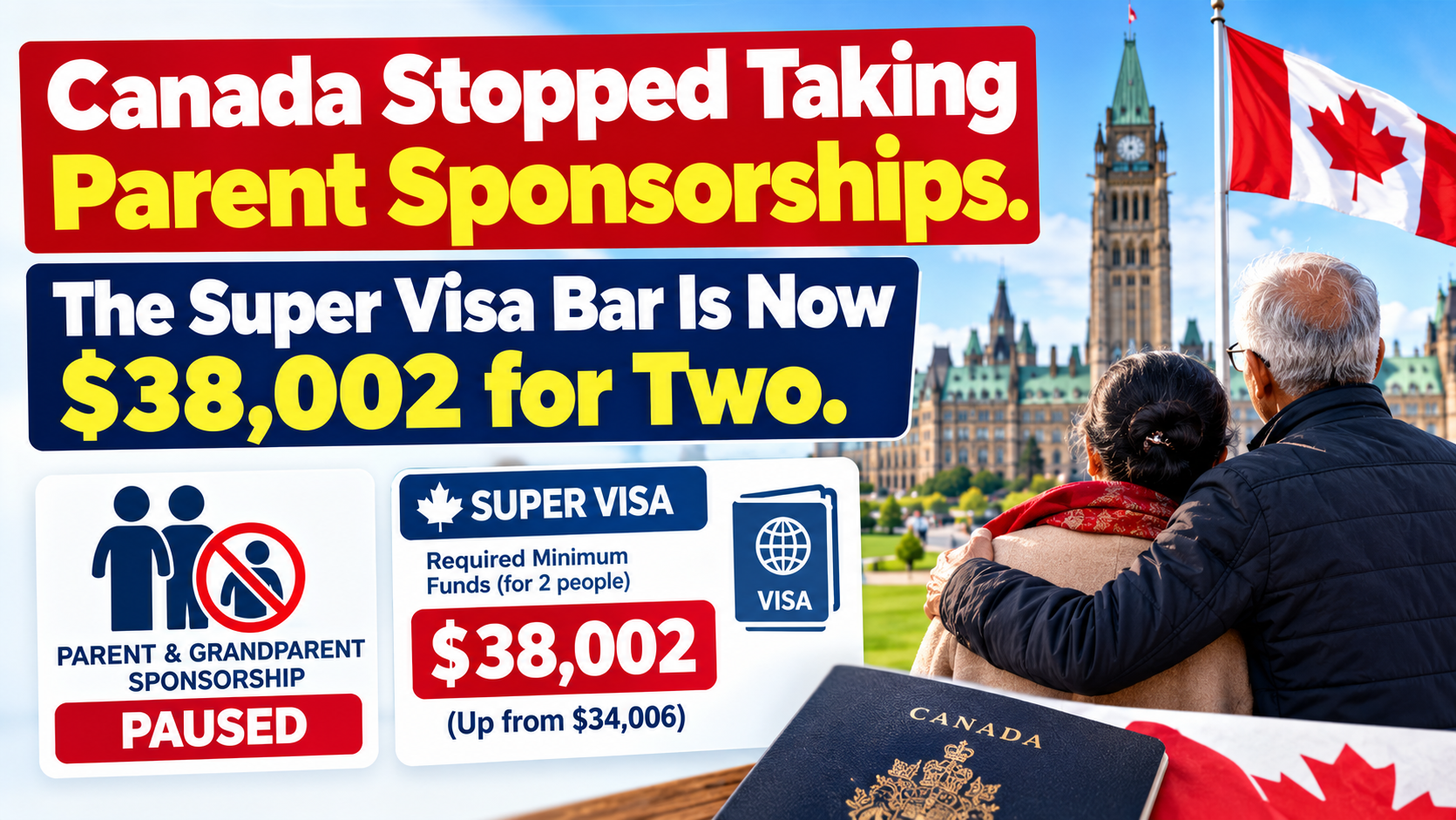
Canada is not taking new applications to sponsor parents and grandparents for permanent residence. No intake has opened in 2026, and IRCC’s July 15 notice says it won’t accept interest-to-sponsor forms or send invitations “until further notice.” There is no reopening date.
What the government is offering instead is the super visa. And the super visa got cheaper to qualify for this year. A host inviting one parent now needs $38,002 in household income, against $47,549 for a parent sponsorship at 2024 levels. Since March 31, the host only has to cover 75% of the threshold. The parent’s own income can fill the rest.
Here’s what was paused, why the super visa is a different product rather than a substitute, and who should do what now.
What actually stopped, and when
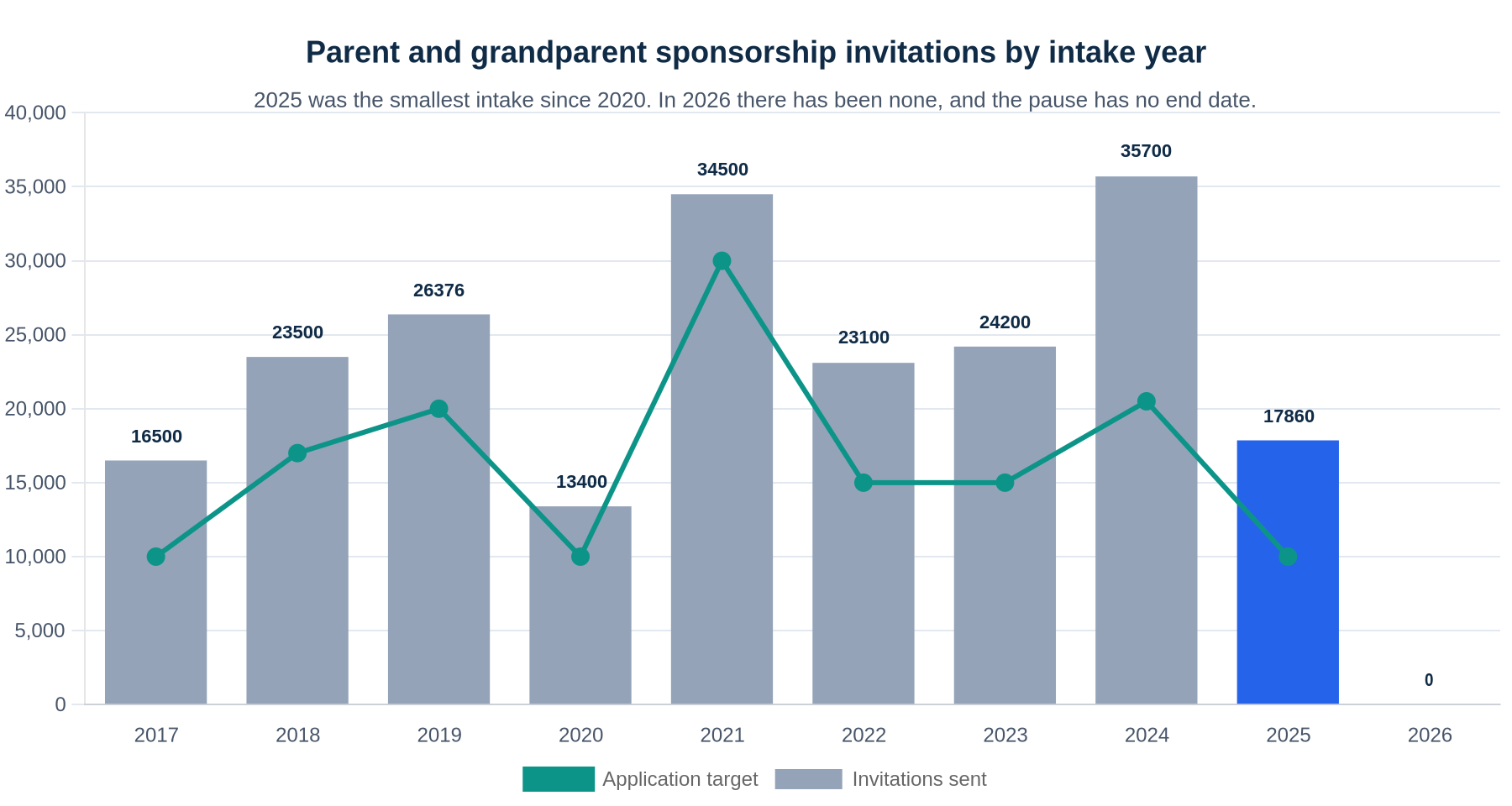
The pause came in two steps. Ministerial Instructions 89 took effect January 1, 2026. They let IRCC process up to 10,000 applications from the 2025 intake and said no new parent or grandparent PR applications would be received “until further instructions are issued.” Then on July 15, IRCC made it explicit: no new interest-to-sponsor forms, no invitations, no end date.
The 2025 intake was already small. IRCC sent 17,860 invitations to get 10,000 complete applications. In 2024 it sent 35,700. Every invitation since 2021 has gone to people who submitted an interest form back in 2020. No new names have entered that pool in six years.
Applications already in the system keep moving
If you already submitted a PGP application, the pause doesn’t touch it. The 2026–2028 levels plan sets 15,000 parent and grandparent admissions a year, with a range of 13,000 to 19,000. As of January 31, 2026, IRCC told the Commons immigration committee there were about 48,400 people in the inventory outside Quebec and 12,100 for Quebec. Processing then sat at 23 months outside Quebec and 46 months for Quebec.
Do the math and the pause makes sense from IRCC’s side. At 15,000 a year, the existing queue alone fills more than three years of targets. We covered how that “waiting for space” problem works across all family files in IRCC’s two-queue system.
The super visa got easier to qualify for
The super visa lets a parent or grandparent stay up to five years per entry, on a multiple-entry visa that can be valid for up to 10 years. Roughly 52,900 were issued in 2025, according to IRCC. That’s more than three times this year’s PGP admissions target.
Two income changes took effect March 31, 2026. They apply to applications already in processing as well as new ones.
Option 1: two years to qualify instead of one
The host (and a co-signing spouse, if any) can meet the minimum income in either of the two tax years before applying. A bad year no longer sinks you if the year before it was fine.
Option 2: the parent’s income counts
The host must reach at least 75% of the threshold in the tax year immediately before applying. The visiting parent’s or grandparent’s own income can make up the rest, as long as they prove they’ll keep earning it while in Canada. A pension from home counts if it’s documented.
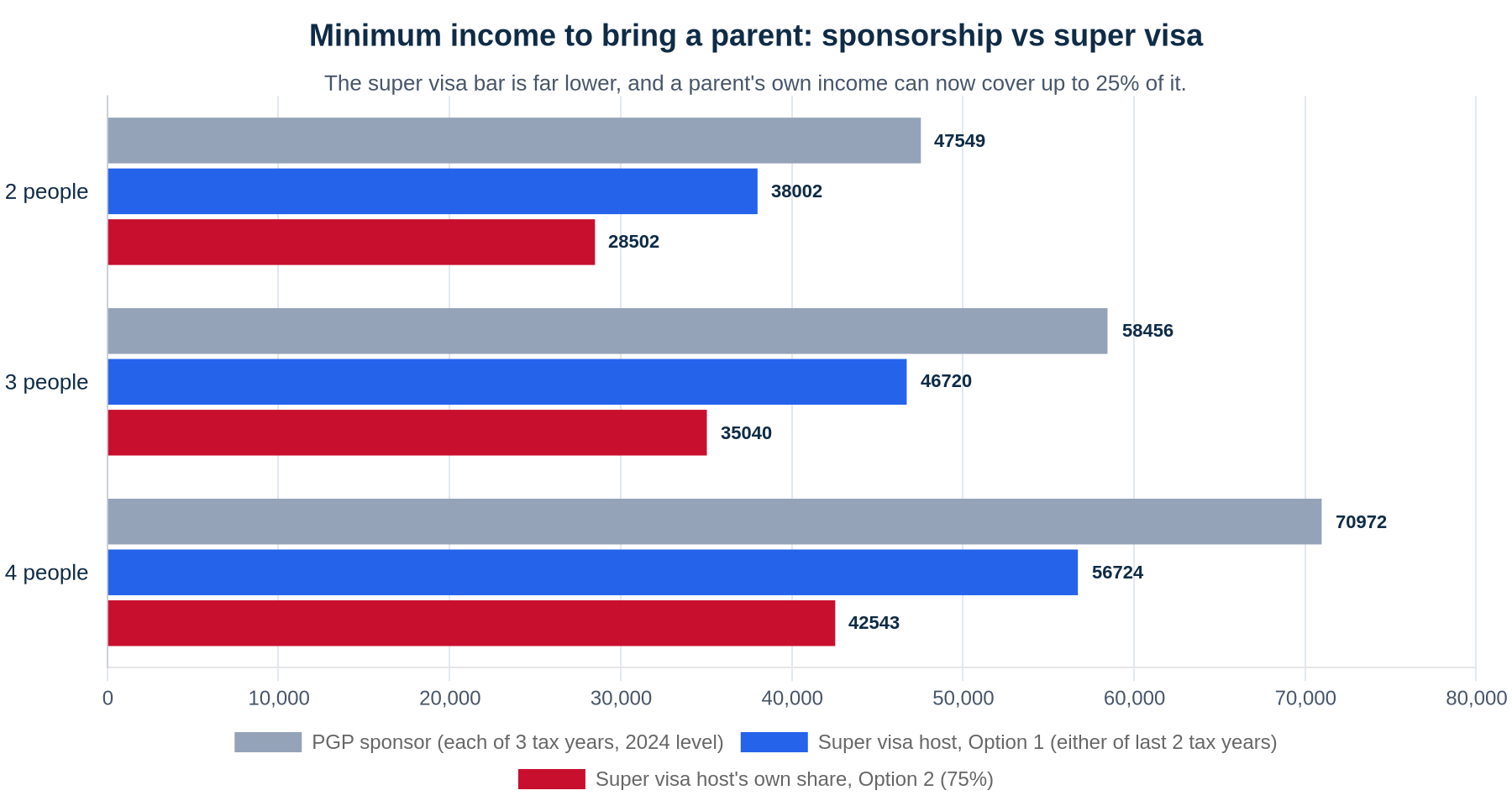
The family count includes you, your spouse, your dependent children, the parents you’re inviting, and anyone you’ve previously sponsored or hosted whose obligation is still running. A couple with two kids inviting both parents is a family of six: $72,560 under Option 1.
A super visa is not a slower sponsorship
Some advice online treats the super visa as “PR-lite.” It isn’t. Your parent stays a visitor. They can’t work. They aren’t covered by provincial health care, which is why IRCC requires private insurance: at least $100,000 in emergency coverage, covering health care, hospitalization and repatriation, valid for a year from entry, and paid in full or by instalments with a deposit. A quote doesn’t count.
That insurance is the real recurring cost for most families, and it rises with age. Since 2025, policies from insurers outside Canada are accepted, but only if the company is authorized by OSFI and issued the policy as part of its Canadian insurance business. A policy from a regular foreign travel insurer will not pass.
Watch for anyone selling a “guaranteed” route to sponsor parents in 2026. There is no open federal route. Nothing you pay for changes that.
What to do about it
If you already have a PGP application in process: Do nothing different. It’s still being processed. Keep your contact details current and answer any document request fast. A missed request is the easiest way to lose your place.
If you were waiting for the next intake: Stop planning around a date. None has been announced. Keep your Notices of Assessment for each year anyway, since PGP sponsors have historically had to prove income for three straight tax years. If an intake reopens, you’ll want them ready.
If you want a parent here soon: Price the super visa properly. Get real insurance quotes for your parent’s age first, then check your income against the table. If you fall short on your own, see whether 75% plus their documented pension gets you there.
If your parent is already here on a regular visitor visa: Don’t count on extending in Canada as a plan. Extensions now take a very long time, as we showed in our look at visitor record processing. A super visa applied for from outside Canada is the cleaner option.
If you’re in Quebec: PGP processing for Quebec runs roughly twice as long as elsewhere, and Quebec sets its own sponsorship rules. Check Quebec’s requirements as well as IRCC’s.
What to watch
The next immigration levels plan is due by November 1. It will show whether the 15,000 parent and grandparent target holds for 2027 and 2028, or drops further. A lower number would mean the pause lasts longer. Pay attention to the spouses, partners and children line too. It’s already scheduled to fall from 69,000 in 2026 to 66,000 in 2027.
The direction is clear. Family reunification is being pushed toward temporary status: visits, not permanent residence. Ottawa used the same playbook on caregivers, where the PR pathways are closed until 2030. Expect more tweaks to the super visa before you see a new PGP intake.
Related reading
- IRCC Has Two Queues. 41% of Family Immigration Files Are in the One That Isn’t Moving.
- Extending Your Visitor Stay in Canada Now Takes 393 Days
- Canada Has No Caregiver PR Pathway Left until March 2030
Data as of October 2, 2026, from IRCC’s July 15, 2026 PGP notice, Ministerial Instructions 89, the 2026–2028 Immigration Levels Plan, IRCC’s March 2026 committee briefing on family reunification, IRCC’s PGP intake history, and the super visa income and insurance pages on canada.ca. The super visa income table is the one IRCC last updated July 29, 2025; the PGP sponsor figures are the 2024 tax-year amounts used for the 2025 intake. The 75% amounts in the second chart ($28,502, $35,040, $42,543) are our own arithmetic, not published figures. Inventory and processing-time figures date from January 31, 2026 and have likely changed. This is general information, not legal advice. Consult a licensed immigration lawyer or a regulated Canadian immigration consultant (RCIC) about your situation, and verify current rules on canada.ca before you apply.
Discover more from CanadianUpdates
Subscribe to get the latest posts sent to your email.