
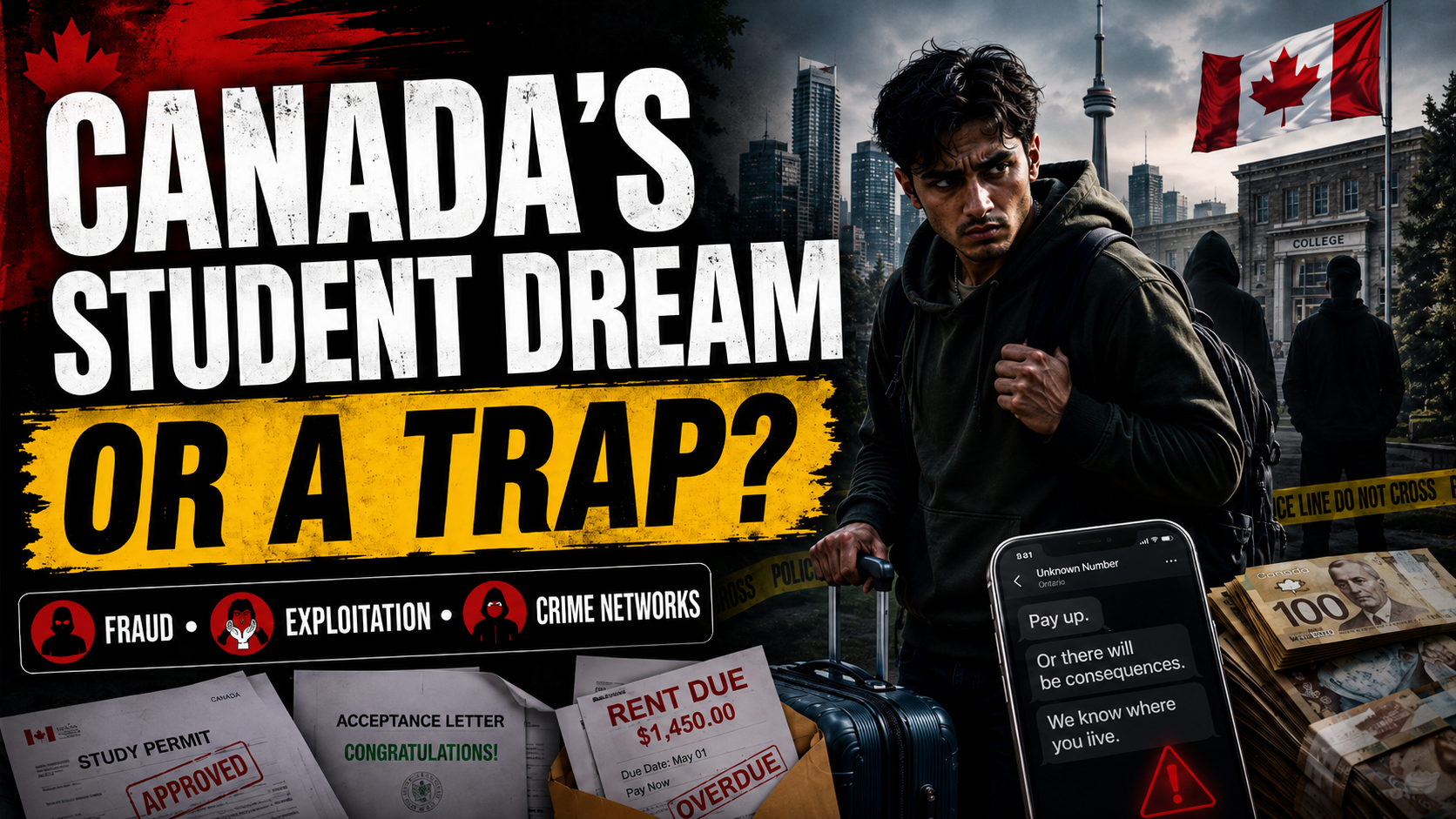
Canada has long been seen as one of the best countries in the world for international students. Every year, thousands of young people leave their home countries with dreams of studying in Canada, building a career, getting permanent residence, and supporting their families.
But behind the attractive image of Canadian education, a darker problem has been growing.
Many international students are not simply coming to Canada and committing crimes. A more serious and complicated issue is emerging: some students are being used, exploited, pressured, or recruited by fraudsters, employers, traffickers, and organized crime networks.
This is an important distinction. The evidence does not prove that international students are more criminal than the general population. Instead, the stronger evidence shows that Canada’s international student system has created vulnerabilities that criminals and bad actors can exploit.
Canada’s International Student Dream Has Become Risky
For many families overseas, Canada represents hope.
Parents often spend life savings to send their children here. Students take loans, sell property, or borrow from relatives because they believe Canadian education will lead to a better future.
They are often promised:
- High-paying jobs
- Easy permanent residence
- Affordable living
- Safe communities
- A smooth path from study permit to work permit
But once many students arrive, reality can be very different.
They face expensive rent, high tuition, limited legal work hours, difficulty finding jobs, and pressure to send money back home. When students become financially desperate, they become easier targets for people who want to exploit them.
That is where the danger begins.
The Problem Is Not “Students Are Criminals”
A responsible discussion must be clear: this is not about blaming all international students.
Most international students in Canada are hardworking people trying to study, work legally, and build a future. Many contribute to the economy, pay high tuition, support local businesses, and later become skilled workers.
The real issue is that Canada’s international education system has grown so quickly that oversight has not always kept up.
This has created openings for:
- Fake admission letters
- Unauthorized immigration consultants
- Exploitative employers
- Human traffickers
- Money laundering networks
- Extortion groups
- Criminal recruiters
In many cases, students are victims first. They may only become involved in illegal activity after being deceived, threatened, or financially trapped.
Fake Admission Letters: The First Warning Sign
One of the clearest examples of exploitation is fake acceptance letters.
Some students paid immigration agents or consultants believing they had real admission letters from Canadian colleges or universities. Later, they discovered the letters were fake or altered.
According to research included in the report, Immigration, Refugees and Citizenship Canada manually checked more than 41,000 letters of acceptance between February 2018 and October 2023 and found 3,794 were fraudulent or altered. After mandatory digital verification began, thousands more letters were flagged or cancelled by schools.
This shows the problem was not small.
It also shows that fraud often happens before the student even arrives in Canada. A student may believe everything is legal, only to later face removal, refusal, or allegations of misrepresentation.
Students Can Be Punished for Fraud They Did Not Create
One of the most painful parts of this issue is that students may face severe immigration consequences even when they were deceived.
If a fake document is used in an application, Canadian immigration law can still treat it as misrepresentation. That can lead to a five-year inadmissibility ban, removal from Canada, or future permit refusals.
But many affected students say they never knowingly submitted fake documents.
In some cases, students relied on unauthorized agents who promised admission, handled paperwork, collected fees, and then disappeared when problems started.
That means the student becomes stuck between two powerful forces: fraudsters who exploited them and immigration enforcement that may still hold them responsible.
Why Criminals Target International Students
International students can be attractive targets for criminals because many are young, financially stressed, and unfamiliar with Canadian law.
Criminal recruiters may look for students who are:
- Struggling to pay rent
- Working too few legal hours to survive
- In debt to family or lenders
- Afraid of losing immigration status
- Isolated from family support
- Desperate for quick cash
A student may be offered what looks like an easy side job: receive money in a bank account, deliver a package, drive someone somewhere, collect cash, or let someone use their documents.
At first, it may seem harmless.
But these small actions can involve money laundering, fraud, extortion logistics, drug movement, or organized crime activity.
By the time the student realizes the seriousness, they may already be exposed to criminal charges or immigration consequences.
Money Mules and Extortion Networks
One of the most concerning trends involves students being used as “money mules.”
A money mule is someone who allows their bank account to receive, move, withdraw, or transfer money for another person. The money may come from fraud, extortion, scams, or other criminal activity.
The student may be told:
- “Just receive this payment.”
- “Withdraw this cash for me.”
- “Send this money to another account.”
- “You will get a small commission.”
But if the money is connected to crime, the student can become part of a criminal investigation.
The uploaded research notes that Canada’s financial intelligence agency, FINTRAC, warned in 2026 that extortion networks targeting South Asian communities appeared to use financially vulnerable young men in Canada on study permits as money mules, enforcers, or low-level operatives.
This is not proof that international students as a group are criminals. It is evidence that organized crime may be exploiting vulnerable students.
From Financial Pressure to Criminal Coercion
Many students do not arrive in Canada planning to break the law.
The problem often begins with financial pressure.
A student may arrive with tuition debt, high rent, grocery costs, transportation expenses, and limited income. If they cannot legally work enough hours to survive, they may accept cash jobs or risky offers.
This can create a dangerous chain:
| Stage | What Happens |
|---|---|
| Financial stress | Student cannot afford rent, tuition, or food |
| Illegal work | Student accepts under-the-table job |
| Exploitation | Employer underpays or threatens them |
| Criminal contact | Someone offers quick cash |
| Coercion | Student is pressured to continue |
| Legal trouble | Student faces criminal or immigration consequences |
This is how a study dream can turn into a trap.
Labour Exploitation Is a Major Issue
Not all exploitation is linked to organized crime. Some of it happens in ordinary workplaces.
International students may work in restaurants, warehouses, delivery jobs, gas stations, cleaning jobs, factories, or construction-related work.
Some employers take advantage of their immigration status by:
- Paying below minimum wage
- Refusing overtime pay
- Threatening to report them
- Forcing unsafe working conditions
- Paying cash to avoid records
- Making students work beyond legal limits
Because students fear losing status, they may stay silent.
This makes them easy to control.
The research report notes that international students can become vulnerable to exploitation because high living costs and work-hour restrictions may push some toward under-the-table employment.
Sex Trafficking and Housing Vulnerability
Another disturbing risk is sexual exploitation.
Some international students face housing insecurity soon after arriving in Canada. They may not understand rental laws, may have no family nearby, and may be desperate for affordable accommodation.
Predators can use this vulnerability.
They may offer housing, jobs, rides, money, or emotional support, then slowly create control. In some cases, this can lead to sexual exploitation or trafficking.
Human trafficking does not always look like kidnapping. It can involve manipulation, debt, threats, isolation, or control over documents and money.
For students who are young, alone, and afraid of deportation, reporting abuse can feel impossible.
The Role of Bad Consultants and Recruiters
Unauthorized consultants and dishonest recruiters are a major part of the problem.
Some agents overseas sell Canada as a guaranteed immigration pathway. They may promise:
- Guaranteed visas
- Guaranteed jobs
- Guaranteed permanent residence
- Fake admission support
- Fake financial documents
- Easy work permits
Students and parents may trust them because they appear professional.
But once the student pays, the agent may provide false documents, misleading advice, or incomplete applications.
When immigration problems appear later, the consultant is often outside Canada or difficult to hold accountable.
This leaves the student alone with the consequences.
Colleges and the International Student Business Model
Canada’s education system also shares responsibility.
International students pay much higher tuition than domestic students. Some colleges and institutions became heavily dependent on this money.
The report notes that Ontario public colleges received a large share of tuition revenue from international students, creating strong financial incentives to recruit more students.
When recruitment becomes too focused on volume, students may not receive honest information about:
- Housing shortages
- Job market realities
- Cost of living
- Immigration competition
- Campus support
- Post-graduation work permit rules
This creates disappointment and desperation after arrival.
Canada Has Started Tightening the System
In response to growing concerns, Canada has introduced changes to the international student system.
These include:
- Study permit caps
- Provincial attestation letters
- Stronger letter-of-acceptance verification
- Stricter school compliance rules
- Changes to post-graduation work permit eligibility
- More focus on fraudulent documents
These changes are meant to protect system integrity, but they can also create uncertainty for genuine students.
A stricter system may reduce fraud, but Canada also needs better protection for students who were already exploited.
Why Crime Statistics Can Be Misleading
Some people online claim international students are causing a crime wave in Canada.
That claim should be treated carefully.
The research report clearly states that Canada does not appear to publish a reliable national crime rate comparing international students with the general population.
That means it is not accurate to say international students are more criminal than others unless strong official data proves it.
There are real cases involving student exploitation, fraud, trafficking, money mules, and organized crime recruitment. But those cases should not be used to blame an entire group.
The better question is: why are so many students vulnerable to being used?
The Immigration Consequences Can Be Severe
When international students become involved in fraud or crime, even unknowingly, the consequences can be life-changing.
They may face:
- Study permit cancellation
- Removal from Canada
- Criminal charges
- Loss of future immigration options
- Five-year inadmissibility for misrepresentation
- Refusal of permanent residence
- Deportation after conviction
This is why students must be extremely careful.
A “quick cash” offer can destroy years of effort.
What International Students Should Do to Stay Safe
Students can protect themselves by following basic rules:
- Use only authorized immigration representatives
- Verify admission letters directly with the school
- Never pay tuition through unknown agents
- Keep copies of all documents and receipts
- Do not let anyone use your bank account
- Do not receive or transfer money for strangers
- Do not work more hours than allowed
- Avoid cash jobs that feel suspicious
- Report threats, coercion, or exploitation early
- Ask for help before the situation becomes serious
Students should remember that being scared is exactly what exploiters rely on.
What Canada Needs to Fix
Canada needs more than stricter rules. It needs a smarter protection system.
The government should focus on:
- Regulating recruitment agents
- Publishing fraud and enforcement data
- Protecting victims of trafficking
- Punishing exploitative employers
- Increasing school accountability
- Creating multilingual reporting channels
- Educating students before and after arrival
- Investigating organized networks instead of only punishing low-level victims
If Canada only targets students after something goes wrong, the real criminals will continue operating.
Final Thoughts
The issue of international students being used in crimes in Canada is serious, but it must be reported responsibly.
This is not a story about international students destroying Canada.
It is a story about a system that grew too fast, became too profitable, and left too many young people exposed to fraud, exploitation, and criminal recruitment.
Some students are tricked with fake documents. Some are pushed into illegal work by financial pressure. Some are used as money mules. Some are exploited by employers, traffickers, or organized crime groups.
The real problem is not the student dream itself.
The problem is the dangerous gap between what Canada promises and what many students actually face when they arrive.
Canada must protect genuine students, punish the people exploiting them, and rebuild trust in the international education system before more lives are damaged.
Discover more from CanadianUpdates
Subscribe to get the latest posts sent to your email.