
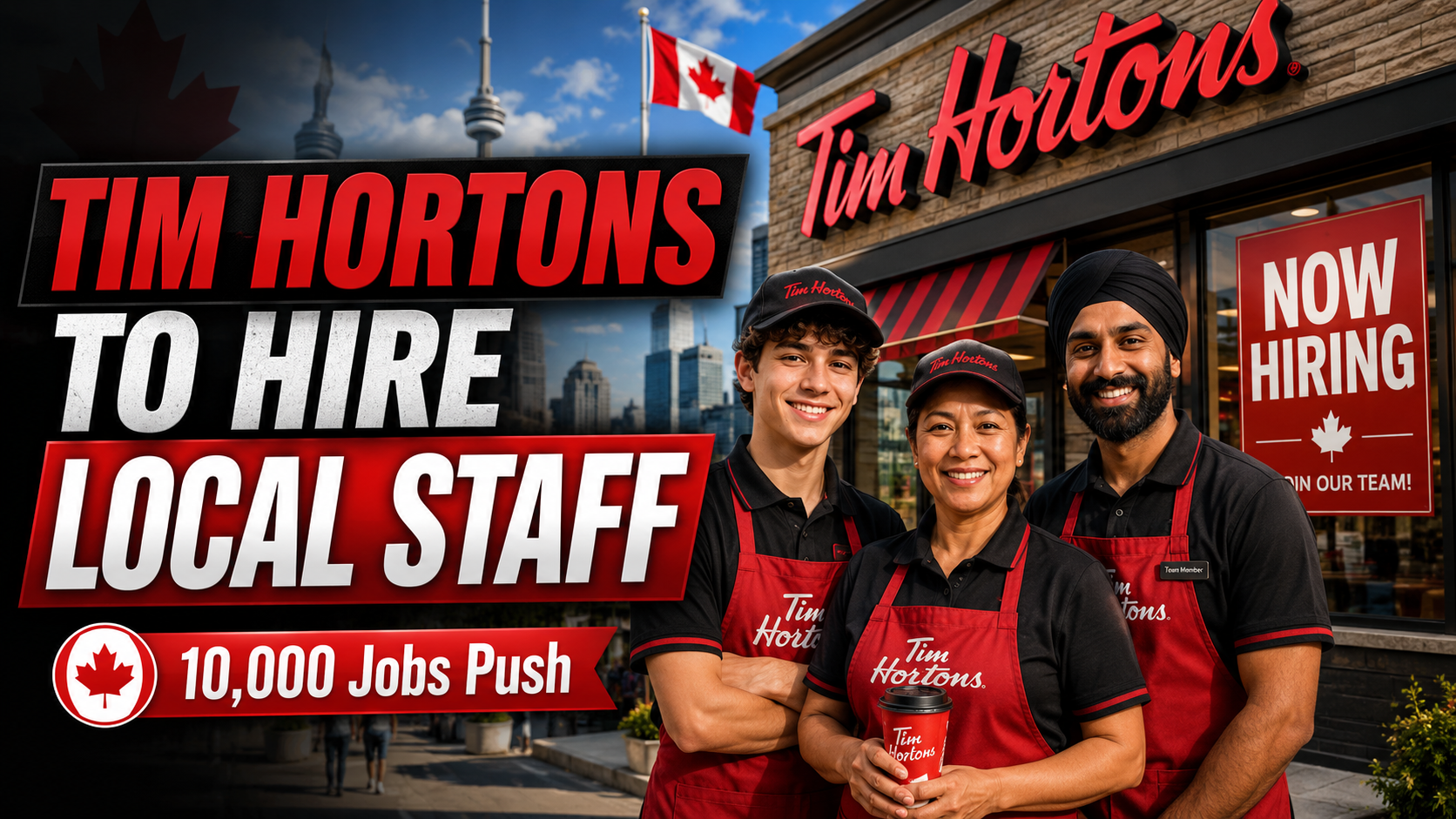
Tim Hortons is making a major move in Canada, and it has sparked a national conversation about jobs, immigration, wages, and who should get first access to entry-level work.
The company says it wants to help restaurant owners hire 10,000 local team members across Canada. On the surface, this sounds like a simple hiring campaign. But the timing makes it much bigger than that.
Canada is facing rising youth unemployment, public frustration over temporary foreign workers, higher living costs, and growing pressure on companies to hire people already living in local communities. Tim Hortons, one of Canada’s most famous brands, is now trying to show that it is putting local workers first.
According to the research summary, Tim Hortons has said more than 95% of its employees are hired locally, while less than 5% of team members are hired through the Temporary Foreign Worker Program. The company also said that about 4,000 of roughly 110,000 restaurant roles were held under the TFW program.
But the bigger question is this:
Is Tim Hortons really changing its hiring strategy, or is this a response to public pressure?
Why Tim Hortons’ Hiring Announcement Is Getting So Much Attention
Tim Hortons is not just another coffee shop. For many Canadians, it is part of everyday life.
People stop there before work, during road trips, after school, and late at night. Because the brand is so visible, its hiring decisions matter more than most fast-food chains.
When Tim Hortons says it wants to hire more local staff, people pay attention.
The debate became even more sensitive because many Canadians have been asking why young people are struggling to find jobs while some employers continue to use temporary foreign workers.
That question has become louder in 2025 and 2026 as Canada deals with:
- Higher youth unemployment
- Rising immigration concerns
- Expensive housing
- Cost-of-living pressure
- Labour shortages in some regions
- Public anger over low-wage jobs
- Stronger government scrutiny of temporary foreign worker use
Tim Hortons’ local hiring campaign is landing right in the middle of this debate.
Tim Hortons Says It Wants Local Workers First
Tim Hortons’ message is simple: hire local whenever possible.
The company says restaurant owners are looking for workers from the communities they serve. That includes Canadian citizens, permanent residents, students, newcomers already in Canada, Indigenous workers, mature workers, people with disabilities, and anyone legally allowed to work.
According to the research summary, Tim Hortons restaurant owners held around 400 local hiring events in March and April 2026. The company also said about 45% of its team members are between 15 and 24 years old, showing that youth workers remain a huge part of its workforce.
That matters because Tim Hortons has long been a first-job employer for teenagers, college students, and young adults.
For many Canadians, a Tim Hortons job is not just a job. It is where they learn customer service, teamwork, time management, and how to handle pressure.
The Temporary Foreign Worker Debate Behind the Announcement
This story is bigger than Tim Hortons.
The Temporary Foreign Worker Program has become one of the most controversial labour issues in Canada.
Businesses say they need temporary foreign workers when they cannot find enough local staff. Critics argue some companies rely on the program instead of improving wages, schedules, and working conditions.
Tim Hortons has been under scrutiny because reporting showed the company and Restaurant Brands International had previously lobbied Ottawa for more flexibility around temporary foreign worker rules. Later, the company shifted its message and said high youth unemployment made that expansion unnecessary.
That shift is important.
It suggests Tim Hortons understands the political mood has changed.
Canadians are no longer only asking whether businesses need workers. They are asking whether businesses are doing enough to hire people already living in Canada.
Why This Could Be Good News for Young Canadians
One of the biggest groups affected by Tim Hortons’ hiring push could be young workers.
Food service is one of the main entry points into Canada’s labour market. It is where many people get their first real job.
According to the research summary, 43.8% of workers in food services and drinking places were under age 25 in 2023, and 84.1% of workers in the sector were part-time.
That means fast-food jobs are heavily connected to youth employment.
For students and young workers, local hiring could mean more chances to get:
- First-job experience
- Part-time income
- Customer service skills
- Work references
- Flexible hours
- Promotion opportunities
- A path into management
At a time when many young Canadians say it is harder to find work, Tim Hortons’ 10,000 local hiring campaign could be a major opportunity.
But Will These Jobs Pay Enough?
This is where the story gets more complicated.
Hiring local workers sounds great, but people still need jobs that are worth taking.
Fast-food work can be stressful. Workers deal with early mornings, drive-thru pressure, long lines, impatient customers, food preparation, cleaning, and unpredictable schedules.
Many jobs are part-time. Some workers may not get enough hours to cover rent, groceries, transportation, and phone bills.
That is why the local hiring debate cannot ignore wages.
If Tim Hortons wants to attract and keep local staff, the jobs need to compete with other options.
A student may accept a low-wage part-time job for experience, but an adult supporting a family may need stable hours and better pay.
This is the challenge for Tim Hortons: hiring 10,000 people is one thing. Keeping them is another.
The Franchise Problem: Corporate Promise, Local Reality
Another key detail is that most Tim Hortons restaurants are independently owned and operated by franchisees.
That means hiring decisions are often made by local restaurant owners, not directly by corporate headquarters.
This makes the local hiring promise harder to judge.
A Tim Hortons in Mississauga, Brampton, Toronto, or Calgary may receive hundreds of applications from local workers. But a Tim Hortons in a small town or remote northern area may struggle to find enough people willing to work early mornings, weekends, or overnight shifts.
So the question is not only whether Tim Hortons wants local workers.
The question is whether each franchisee can actually find enough local workers in their area.
The research summary notes that local hiring is easier in dense urban markets, while small-town and remote markets may show signs of recruitment strain, including relocation language and staff accommodation in some job postings.
That means one national slogan may not work the same way everywhere.
“Local Hiring” Does Not Mean Anti-Immigrant
This is an important point.
Some people may misunderstand the phrase “local hiring.”
Local hiring does not mean only hiring Canadian-born workers.
A local worker can be:
- A Canadian citizen
- A permanent resident
- A newcomer already living in Canada
- An international student with legal work authorization
- A refugee claimant with authorization to work
- A mature worker
- An Indigenous worker
- A local high school or college student
Canada’s workforce is diverse.
The real issue is not immigrants versus Canadians. The issue is whether employers should first hire people already available in the local labour market before asking for more temporary foreign workers from outside Canada.
That is a fair question, especially when many people already in Canada are searching for work.
Why International Students Are Also Part of the Story
International students have long worked in fast food, including Tim Hortons.
They are often available for part-time shifts and may need income to cover rent and tuition.
But current rules limit eligible international students to 24 hours per week off campus during regular academic sessions, with unlimited work only during scheduled breaks.
That means international students can still be part of the local workforce, but they cannot fully replace full-time workers during school periods.
This makes Tim Hortons’ broader local hiring campaign even more important.
The company cannot rely on only one group. It needs youth, students, newcomers, permanent residents, mature workers, and other local applicants.
Small Towns Could Face the Biggest Challenge
In big cities, Tim Hortons may be able to hire locally without much trouble.
But in smaller towns, northern communities, and remote areas, hiring can be much harder.
Some locations may not have enough available workers. Others may struggle because people do not want part-time schedules or low wages. Remote locations may need to offer higher pay, staff housing, or relocation support.
That creates a difficult situation.
Can Tim Hortons promise local hiring everywhere when some communities simply do not have enough workers available?
This is where the debate becomes more realistic.
Local hiring should be the first choice. But in some regions, employers may still argue that they need outside labour to stay open.
Customers May Feel the Impact Too
Hiring problems do not only affect workers and employers. They affect customers.
When restaurants are short-staffed, customers may see:
- Longer drive-thru lines
- Slower service
- Reduced hours
- Closed dining areas
- More stressed workers
- Lower food quality
- Higher turnover
If Tim Hortons successfully hires and keeps more local workers, service may improve.
But if the company hires quickly without fixing wages, training, and scheduling, turnover could remain high.
The customer experience depends heavily on whether employees are trained, supported, and willing to stay.
Why This Is a Reputational Reset for Tim Hortons
Tim Hortons knows its brand is built on Canadian identity.
That is why the local hiring message is powerful.
At a time when many Canadians feel squeezed by inflation, immigration pressure, and job insecurity, a message about hiring local workers can rebuild trust.
It tells the public:
“We are part of your community.”
“We are giving young Canadians a chance.”
“We are not ignoring local workers.”
But that message also creates expectations.
If Canadians later see Tim Hortons franchisees still relying heavily on temporary foreign workers, or if workers complain about poor conditions, the company could face backlash.
A local hiring campaign only works if people believe it is real.
What Tim Hortons Needs to Do Next
To make this campaign successful, Tim Hortons and its franchisees should focus on more than just job fairs.
They need to make the jobs attractive enough for people to stay.
That means:
- More predictable schedules
- Better training
- Fair treatment
- Clear promotion pathways
- Competitive wages
- Stronger local recruitment
- Better communication with workers
- Support for students and young employees
Hiring 10,000 workers may create headlines.
Retention creates results.
If Tim Hortons wants this to be more than a public relations move, it must prove that these are real opportunities, not just low-wage jobs with high turnover.
What This Means for Canada’s Job Market
The Tim Hortons hiring push reflects a bigger shift in Canada.
For years, many businesses said they needed immigration and temporary labour because Canadians were not available for certain jobs.
Now, the public conversation is changing.
Canadians are asking:
- Are employers offering enough pay?
- Are young people getting a fair chance?
- Are temporary foreign workers being used properly?
- Are businesses too dependent on low-wage labour?
- Should local workers always be prioritized first?
Tim Hortons has become a symbol in this debate because it is everywhere.
What happens with this hiring campaign may influence how Canadians view other fast-food chains, grocery stores, restaurants, and service-sector employers.
Final Thoughts
Tim Hortons’ push to hire 10,000 local workers is more than a hiring campaign.
It is a major signal about where Canada’s labour market is heading.
The company is trying to show that it supports local workers at a time when Canadians are frustrated about job competition, immigration pressure, and affordability.
For young Canadians, this could mean more chances to enter the workforce. For communities, it could mean more local wages staying close to home. For Tim Hortons, it could be a chance to rebuild trust and strengthen its Canadian image.
But the real test is not the announcement.
The real test is whether these jobs are good enough for workers to stay.
If Tim Hortons can offer fair schedules, better training, respectful workplaces, and real advancement, this local hiring campaign could become a major win.
But if the jobs remain unstable, low-paid, and stressful, the campaign may be remembered as just another headline.
Canada’s fast-food labour debate is changing, and Tim Hortons is now right in the middle of it.
Discover more from CanadianUpdates
Subscribe to get the latest posts sent to your email.