
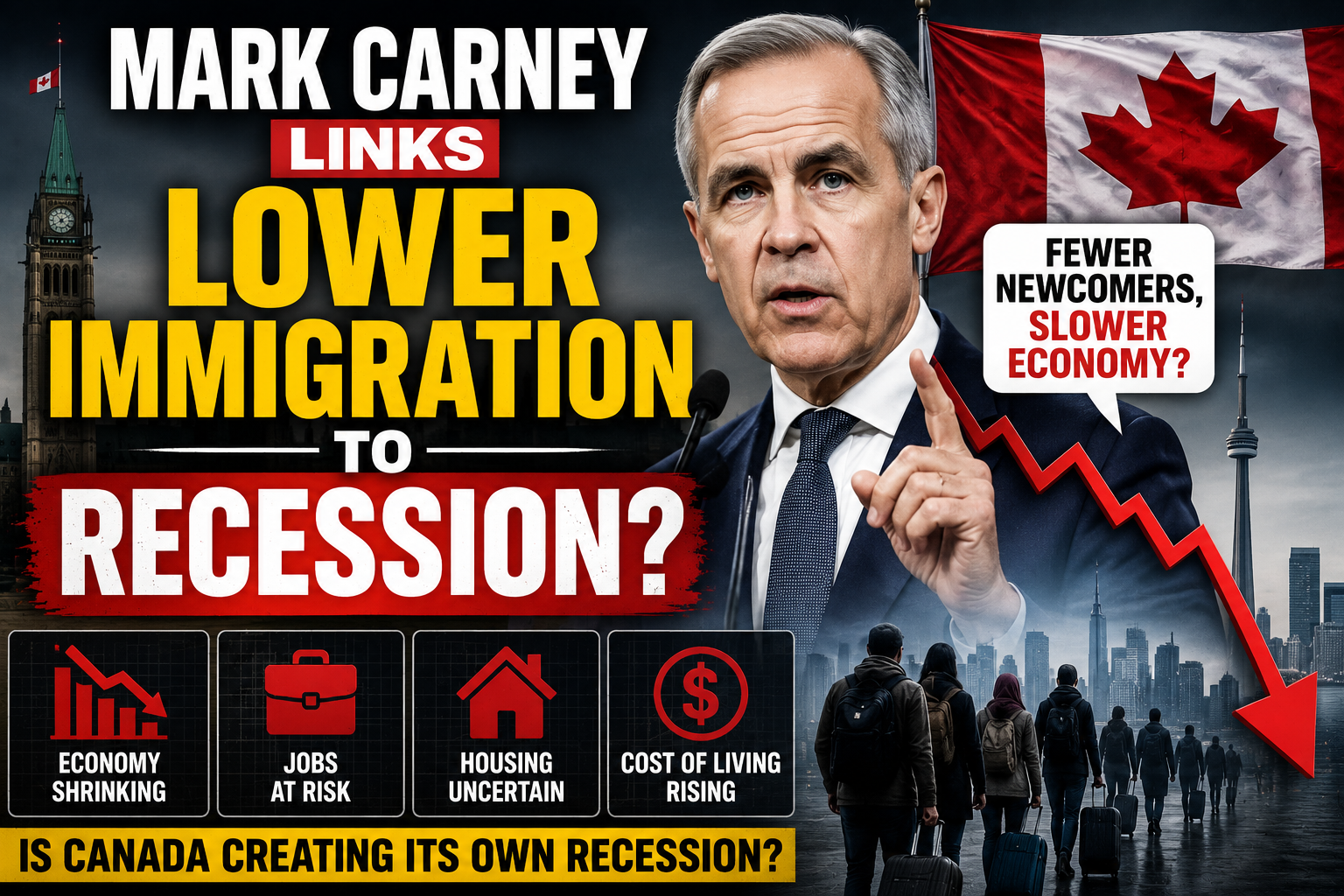
Canada’s economy is once again at the center of national debate as concerns about recession continue to grow across the country. After years of record immigration, rapid population growth, and a booming labour market, Canada has sharply changed direction. The federal government has reduced immigration targets, tightened temporary resident programs, and restricted international student admissions.
Now, some economists are asking a difficult question:
Did Canada accidentally create its own recession?
Former Bank of Canada Governor and current Prime Minister Mark Carney recently suggested that lower immigration levels could be one of the reasons economic growth is slowing. His comments have reignited discussions about whether Canada’s new immigration policies are contributing to weaker consumer spending, labour shortages, and slower economic expansion.
As Canadians face rising costs, housing uncertainty, and concerns about job security, understanding the connection between immigration and economic growth has become more important than ever.
Why Recession Fears Are Growing in Canada
Canada officially entered a technical recession in late 2025 after recording consecutive quarters of weak economic growth. While the economy has avoided a severe downturn so far, several warning signs continue to concern economists.
Key Recession Indicators
| Economic Indicator | Current Trend |
|---|---|
| GDP Growth | Slowing |
| Consumer Spending | Weakening |
| Business Investment | Declining |
| Job Creation | Moderating |
| Housing Market Activity | Cooling |
| Population Growth | Slowing |
While no single factor causes a recession, many analysts believe Canada’s sudden immigration slowdown is now having a noticeable impact on economic activity.
Mark Carney’s Immigration-Economy Connection
Mark Carney has repeatedly emphasized that immigration plays a crucial role in Canada’s economic success.
Canada faces an aging population, declining birth rates, and growing labour shortages in critical sectors. For years, immigration helped offset these challenges by bringing in workers, consumers, entrepreneurs, and taxpayers.
According to Carney, reducing immigration too quickly can create unintended economic consequences.
When fewer newcomers arrive:
- Consumer spending decreases
- Demand for housing slows
- Labour shortages worsen
- Business growth becomes more difficult
- Tax revenues grow more slowly
In simple terms, immigration is not only about population growth—it is also an important economic engine.
Canada’s Dramatic Immigration Policy Shift
Just a few years ago, Canada welcomed record numbers of newcomers.
However, growing concerns about housing affordability, infrastructure strain, healthcare access, and rental shortages prompted the federal government to change course.
Several major changes were introduced:
Immigration Changes Since 2024
| Policy Change | Impact |
|---|---|
| Lower permanent resident targets | Fewer newcomers |
| International student cap | Reduced enrollment |
| Stricter work permit rules | Fewer temporary workers |
| PGWP eligibility restrictions | Smaller graduate workforce |
| Temporary resident reductions | Slower population growth |
These measures were designed to reduce pressure on housing and public services.
But economists are now debating whether the economic side effects are larger than expected.
How Immigration Fuels Canada’s Economy
Many Canadians think immigration only affects housing demand.
In reality, newcomers contribute to nearly every part of the economy.
Consumer Spending
New immigrants spend money on:
- Housing
- Food
- Transportation
- Clothing
- Education
- Entertainment
- Technology
Every dollar spent helps local businesses grow and create jobs.
Labour Force Growth
Many industries depend heavily on immigrant workers.
Examples include:
- Healthcare
- Construction
- Hospitality
- Agriculture
- Transportation
- Technology
Without enough workers, businesses struggle to expand.
Tax Revenue
Immigrants pay:
- Income tax
- Sales tax
- Property tax
- Payroll deductions
These revenues help fund government programs and public services.
Labour Shortages Are Returning
One of Canada’s biggest economic challenges remains labour shortages.
Although unemployment has risen slightly, many industries still cannot find enough workers.
Sectors Facing Worker Shortages
| Industry | Labour Shortage Level |
|---|---|
| Healthcare | Severe |
| Construction | Severe |
| Skilled Trades | High |
| Agriculture | High |
| Hospitality | Moderate |
| Transportation | Moderate |
With fewer international students, temporary workers, and permanent residents entering Canada, businesses are once again reporting recruitment challenges.
Some employers say open positions remain vacant for months.
Housing Market: The Double-Edged Sword
One reason Canada reduced immigration was housing affordability.
Rapid population growth increased demand for:
- Rental units
- Condominiums
- Detached homes
As demand surged, housing prices climbed.
The government’s strategy was straightforward:
Lower immigration = less housing demand.
However, there is another side to the equation.
Many immigrants work in construction.
When immigration declines:
- Fewer construction workers are available
- Housing projects take longer
- New housing supply grows more slowly
This creates a paradox.
Reducing immigration may lower demand, but it can also reduce the workforce needed to build more homes.
International Students Were a Major Economic Driver
Before recent restrictions, international students contributed billions to Canada’s economy annually.
They paid:
- Tuition fees
- Rent
- Transportation costs
- Food expenses
- Consumer purchases
Many communities benefited significantly from student spending.
Economic Contributions of International Students
| Category | Impact |
|---|---|
| Universities | Tuition revenue |
| Local Businesses | Increased sales |
| Housing Market | Rental demand |
| Labour Market | Part-time workforce |
| Future Immigration | Skilled workers |
With student caps now in place, some colleges and businesses are already reporting financial challenges.
Consumer Spending Is Losing Momentum
Consumer spending represents one of the largest drivers of economic growth.
When population growth slows, spending growth often slows as well.
Economists have noticed:
- Lower retail sales growth
- Reduced housing-related spending
- Slower vehicle purchases
- Weakening discretionary spending
These trends may not trigger a severe recession alone, but they contribute to broader economic weakness.
Business Confidence Is Falling
Many Canadian businesses expanded during years of strong population growth.
They expected:
- More customers
- More workers
- Higher sales
Now some companies are adjusting expectations.
Business owners cite concerns about:
- Slower demand growth
- Rising operating costs
- Hiring difficulties
- Economic uncertainty
Reduced immigration is only one factor, but many economists believe it is becoming increasingly significant.
What Economists Are Saying
Economists remain divided on the issue.
Group One: Immigration Cuts Are Hurting Growth
These economists argue:
- Population growth supported GDP
- Consumer demand is weakening
- Labour shortages are worsening
- Economic growth will slow further
Group Two: Immigration Cuts Were Necessary
Others argue:
- Housing markets needed relief
- Infrastructure was overwhelmed
- Public services faced excessive pressure
- Long-term stability matters more than short-term growth
The reality may lie somewhere in the middle.
Could Canada Have Avoided This Situation?
Many experts believe Canada faces a policy balancing act.
The country needs:
- Affordable housing
- Strong economic growth
- Sustainable infrastructure
- Adequate healthcare services
Focusing too heavily on one objective can create challenges elsewhere.
Some economists suggest Canada could have:
- Increased housing construction faster
- Expanded infrastructure investments
- Improved immigration planning
- Targeted workers in shortage occupations
Instead of sharply reducing immigration levels.
What Happens Next?
The future of Canada’s economy may depend on how policymakers respond over the next year.
Several possibilities exist.
Scenario 1: Soft Economic Landing
- Inflation remains controlled
- Interest rates fall gradually
- Job market stays stable
- Growth slowly returns
Scenario 2: Mild Recession Continues
- Consumer spending remains weak
- Business investment slows
- Unemployment rises modestly
Scenario 3: Immigration Policies Adjust Again
The federal government could increase immigration targets if labour shortages become severe or economic growth weakens further.
Many analysts believe this possibility is becoming more likely.
What This Means for Canadians
For everyday Canadians, the debate is not just about economic theory.
It affects:
- Job opportunities
- Housing affordability
- Wage growth
- Business conditions
- Cost of living
Some Canadians may welcome slower population growth if it improves housing affordability.
Others worry that weaker economic growth could lead to fewer jobs and slower wage increases.
The challenge for policymakers is finding the right balance.
The Bigger Picture
Canada’s economy has historically relied on immigration more than many other developed nations.
The country’s demographic reality remains unchanged:
- Birth rates remain low
- Population is aging
- Retirements are increasing
Without immigration, workforce growth becomes increasingly difficult.
This is why many economists believe immigration will continue playing a major role in Canada’s future economic strategy—even if current targets remain lower than recent record levels.
Conclusion
The debate over whether Canada “created its own recession” is likely to continue throughout 2026.
Mark Carney’s comments have highlighted a reality that economists have discussed for years: immigration is deeply connected to economic growth.
Lower immigration may help address housing pressures and infrastructure concerns, but it can also reduce consumer spending, slow labour force growth, and weaken overall economic momentum.
The question facing Canada now is whether policymakers can find the right balance between sustainable population growth and economic prosperity.
As recession fears persist and economic indicators remain mixed, Canadians will be watching closely to see whether immigration policy becomes part of the solution—or remains part of the problem.
Discover more from CanadianUpdates
Subscribe to get the latest posts sent to your email.